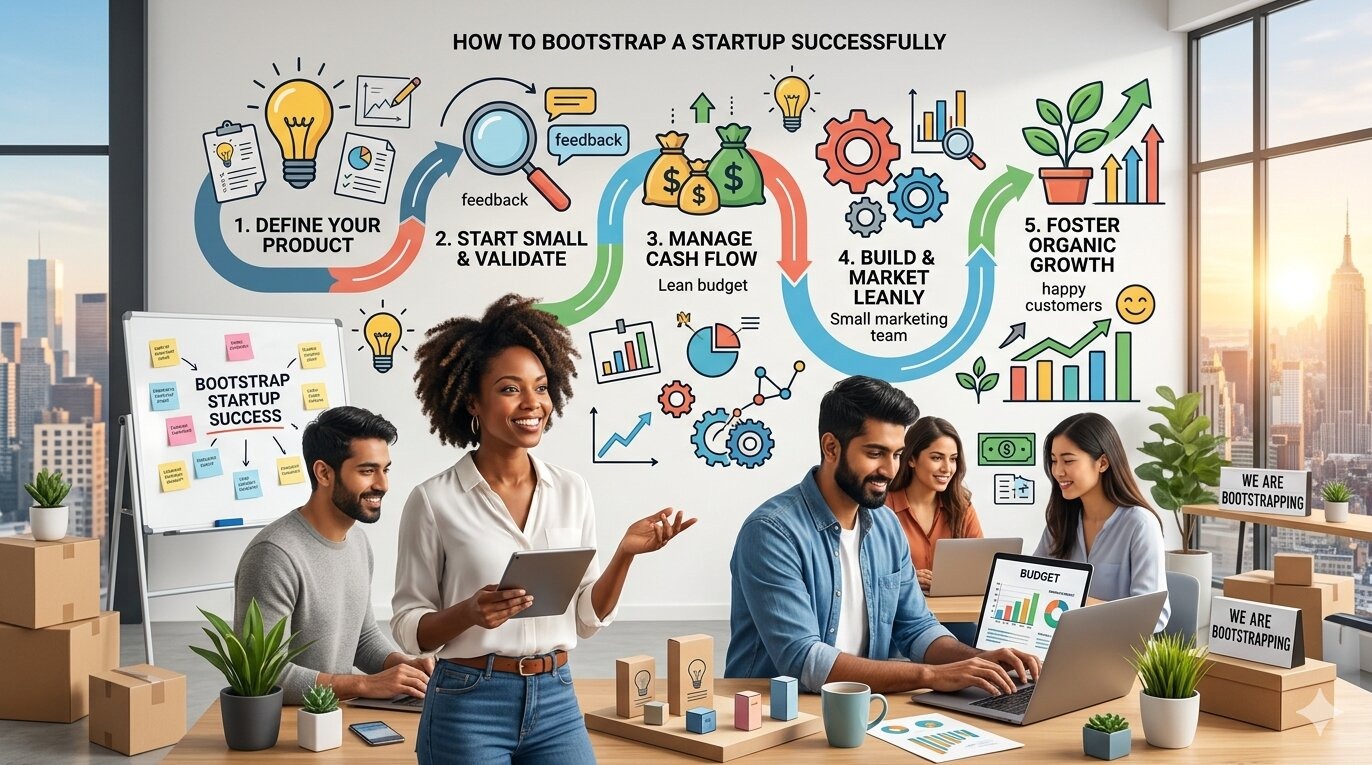
Bootstrapping a startup sounds simple in theory—start with your own money and grow from there. But in reality, it’s a completely different game compared to raising external funding.
You’re not just building a business—you’re managing risk, cash flow, and growth with limited resources. And that requires a different mindset.
The good news? Some of the most successful companies in the world started this way.
Let’s break it down in a practical, realistic way so you can actually make it work.
What Is Bootstrapping?
Bootstrapping means building and growing your business using:
- Personal savings
- Revenue generated by the business
- Minimal external funding (or none at all)
In short: you fund your own growth.
Why Many Founders Choose Bootstrapping
There’s a strong appeal to this approach—and for good reason.
- You keep full ownership
- You retain complete control
- You avoid debt and investor pressure
- You build financial discipline early
But let’s be honest—it’s not easy.
You’ll likely grow slower, and you’ll need to be extremely careful with spending.
When Bootstrapping Makes Sense
Bootstrapping works best when:
- Your startup costs are relatively low
- You can generate revenue quickly
- You have a clear, simple business model
- You’re comfortable growing gradually
If your business requires heavy upfront investment (like manufacturing or tech infrastructure), bootstrapping alone may not be enough.
Step-by-Step: How to Bootstrap Successfully
Let’s get practical.
Step 1: Start Lean (Really Lean)
This is where most people go wrong.
You don’t need:
- A fancy office
- Expensive branding
- Complex systems
You need:
- A working product or service
- A way to reach customers
- A way to collect payments
Focus only on what’s essential.
Step 2: Validate Before You Spend
Before investing money, make sure your idea actually works.
- Talk to potential customers
- Test your offer
- Gather feedback
If you haven’t done this yet, start here:
How to Validate a Business Idea Before Launch
https://statush.com/business/how-to-validate-a-business-idea-before-launch
Validation saves money—and headaches.
Step 3: Focus on Revenue Early
Bootstrapped businesses survive on cash flow.
That means:
- Sell early
- Sell often
- Improve based on feedback
Don’t wait for perfection. Revenue is your lifeline.
Step 4: Keep Costs Under Control
This is critical.
Track:
- Every expense
- Monthly burn rate
- Profit margins
Simple habits like this can make or break your business.
Step 5: Reinvest Profits
Instead of spending profits personally, reinvest them into:
- Marketing
- Product improvement
- Operations
This is how bootstrapped businesses grow sustainably.
Step 6: Build Systems Gradually
As your business grows:
- Automate repetitive tasks
- Improve processes
- Optimize operations
But don’t overbuild too early.
Simple Financial Comparison
Here’s how bootstrapping compares to other funding methods:
| Funding Type | Ownership Loss | Financial Risk | Growth Speed |
|---|---|---|---|
| Bootstrapping | No | Medium (personal risk) | Slow–Steady |
| Loans | No | High (repayment pressure) | Medium |
| Investors | Yes | Lower personal risk | Fast |
Bootstrapping trades speed for control.
Real-World Example
Imagine someone starting a digital design service.
They:
- Use a laptop they already own
- Find clients through social media
- Deliver services themselves
Revenue starts coming in.
Instead of hiring immediately, they:
- Build savings
- Improve skills
- Expand gradually
Within a year, they grow into a small agency—without taking any loans or giving up equity.
Common Challenges (And How to Handle Them)
1. Limited Resources
You can’t do everything at once—prioritize what matters most.
2. Slow Growth
Focus on consistent progress instead of rapid scaling.
3. Financial Pressure
Keep personal expenses low and maintain a buffer.
4. Burnout
Doing everything yourself can be exhausting—manage your time carefully.
Practical Tips That Actually Work
- Start small but start now
- Focus on customers, not perfection
- Track every rupee or dollar
- Avoid unnecessary tools and subscriptions
- Build relationships—not just transactions
One honest insight: constraints can actually make you more creative and efficient.
When to Move Beyond Bootstrapping
At some point, you may want to scale faster.
That’s when you can consider:
- Loans
- Investors
- Grants
Explore options here:
How to Raise Capital for Your Startup
https://statush.com/business/how-to-raise-capital-for-your-startup
Or if you want to avoid equity:
How to Get Funding Without Giving Equity
https://statush.com/business/how-to-get-funding-without-giving-equity
How Bootstrapping Fits Into Your Journey
Bootstrapping is often the foundation.
Your journey might look like:
- Idea → Validation
- Bootstrapping → Initial growth
- External funding → Scaling
Even if you raise funds later, bootstrapping teaches discipline that stays with you.
Final Thoughts
Bootstrapping isn’t the fastest way to build a business—but it’s one of the strongest.
It forces you to:
- Focus on what truly matters
- Build real value
- Stay financially disciplined
And perhaps most importantly, it lets you build your business on your own terms.
If you’re willing to be patient, consistent, and resourceful, bootstrapping can take you further than you might expect.