In the fast-paced economy of 2026, the mantra for the modern investor is "Work smarter, not harder." Passive investing has evolved from a simple retirement strategy into a comprehensive lifestyle choice. Whether you are a busy professional in the Silicon Prairie or a retiree in the Sun Belt, passive strategies allow you to decouple your income from your time.
As of March 2026, with inflation hovering at 2.9% and the S&P 500 showing resilient growth, these are the top-tier strategies to build a "money machine" that runs while you sleep.
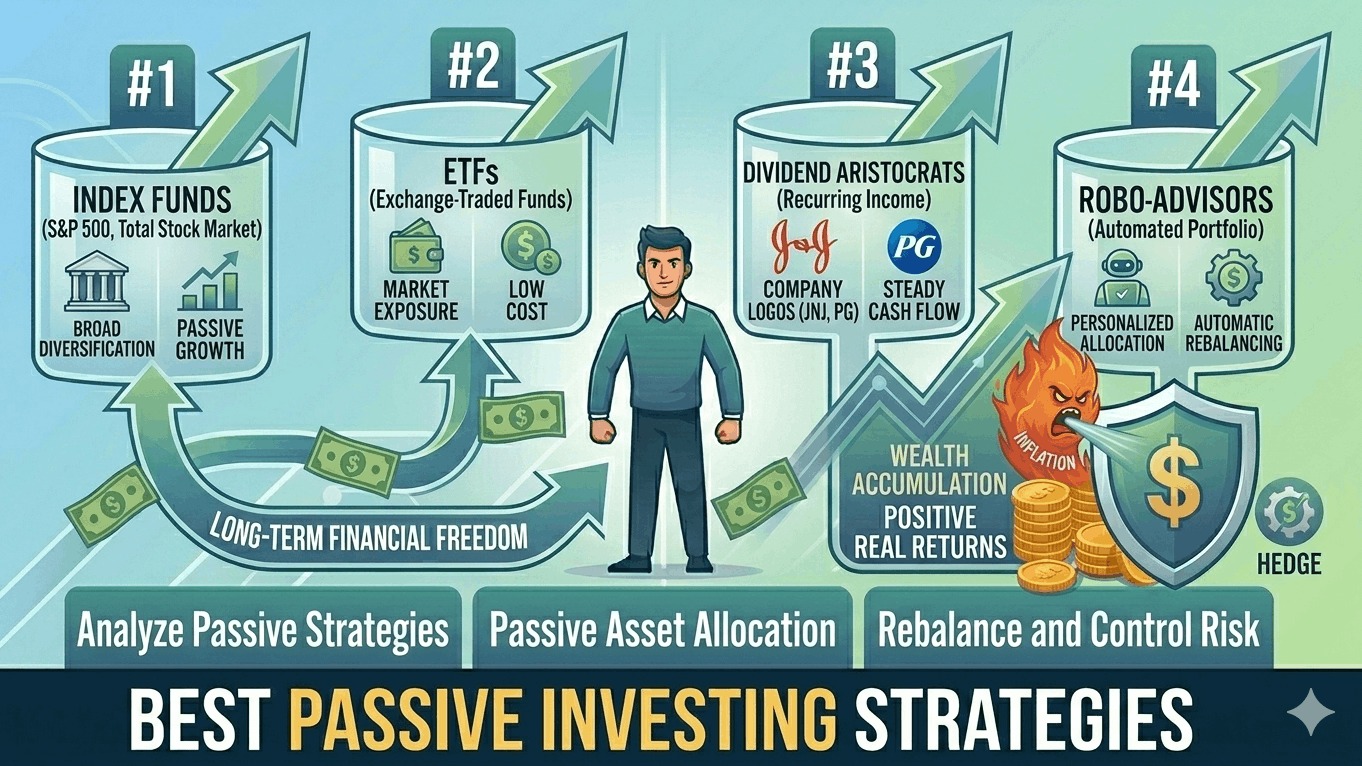
1. The Index Fund "Core" (The Foundation)
The most successful passive strategy in history remains the Broad Market Index Fund. Instead of trying to find the "needle in the haystack" (the next breakout AI stock), you simply buy the entire haystack.
- How it works: You invest in an Exchange-Traded Fund (ETF) like VOO (S&P 500) or VTI (Total Stock Market). You are essentially betting on the growth of the top 500+ companies in the USA.
- The 2026 Edge: Most major brokers now offer Zero-Expense Ratio funds. This means 100% of your money goes toward building wealth rather than paying management fees.
- Real-World Example: If you invested $1,000 a month into a total market index starting in 2016, by 2026, even with market dips, your portfolio would likely be worth over $185,000 due to the power of compounding dividends and price appreciation.
2. Dividend Growth Investing (The "Paycheck" Strategy)
This strategy focuses on buying shares of "Dividend Aristocrats"—companies that have not only paid but increased their dividends for 25+ consecutive years.
- How it works: You prioritize stocks that provide a steady stream of cash. In 2026, many investors use DRIPs (Dividend Reinvestment Plans) to automatically use those payouts to buy more shares.
- The 2026 Edge: With the new Dividend Tax Credit introduced in late 2025, the first $5,000 of qualified dividend income for many households is now effectively tax-free.
- Real-World Example: Companies like PepsiCo, Lowe's, or AbbVie. If you own 1,000 shares of a company paying a 3% dividend, you receive a "passive paycheck" every quarter regardless of whether the stock price goes up or down.
3. Real Estate Syndications & REITs
You no longer need to be a landlord to profit from real estate. Passive real estate allows you to own "bricks and mortar" without the "toilets and tenants."
- REITs (Public): Traded like stocks. You can buy a "Residential REIT" (like AVB) or an "Industrial REIT" (like PLD) to get a piece of the rental market.
- Syndications (Private): In 2026, "Crowdfunding" platforms allow you to pool money with hundreds of other investors to buy a massive apartment complex or self-storage facility.
- The 2026 Edge: Under the OBBBA Tax Act, passive real estate investors can still benefit from "Pass-Through Depreciation," which often makes the monthly income tax-sheltered.
4. Automated "Robo-Advisors" with AI
If you find asset allocation confusing, 2026 is the year of the AI-Optimized Robo-Advisor.
- How it works: Platforms like Betterment or Wealthfront use artificial intelligence to monitor your portfolio 24/7.
- The 2026 Edge: In 2026, these apps include "Direct Indexing." Instead of buying an ETF, the AI buys the individual stocks within the index to maximize Tax-Loss Harvesting.
- Real-World Example: If a specific stock in the S&P 500 drops, the AI sells it to lock in a "tax loss" to offset your gains and immediately buys a similar stock to keep your portfolio balanced. This can add 1% to 2% to your annual net returns.
5. High-Yield Debt & Private Credit
With interest rates stabilized around 3.75%, "lending" has become a highly attractive passive strategy.
- How it works: You act as the bank. You can invest in Bonds or use Peer-to-Peer (P2P) platforms to lend money to small businesses or real estate flippers.
- The 2026 Edge: Many 2026 brokerage accounts now offer "Auto-Lend" features for your uninvested cash, ensuring every dollar is earning at least 4% APY at all times.