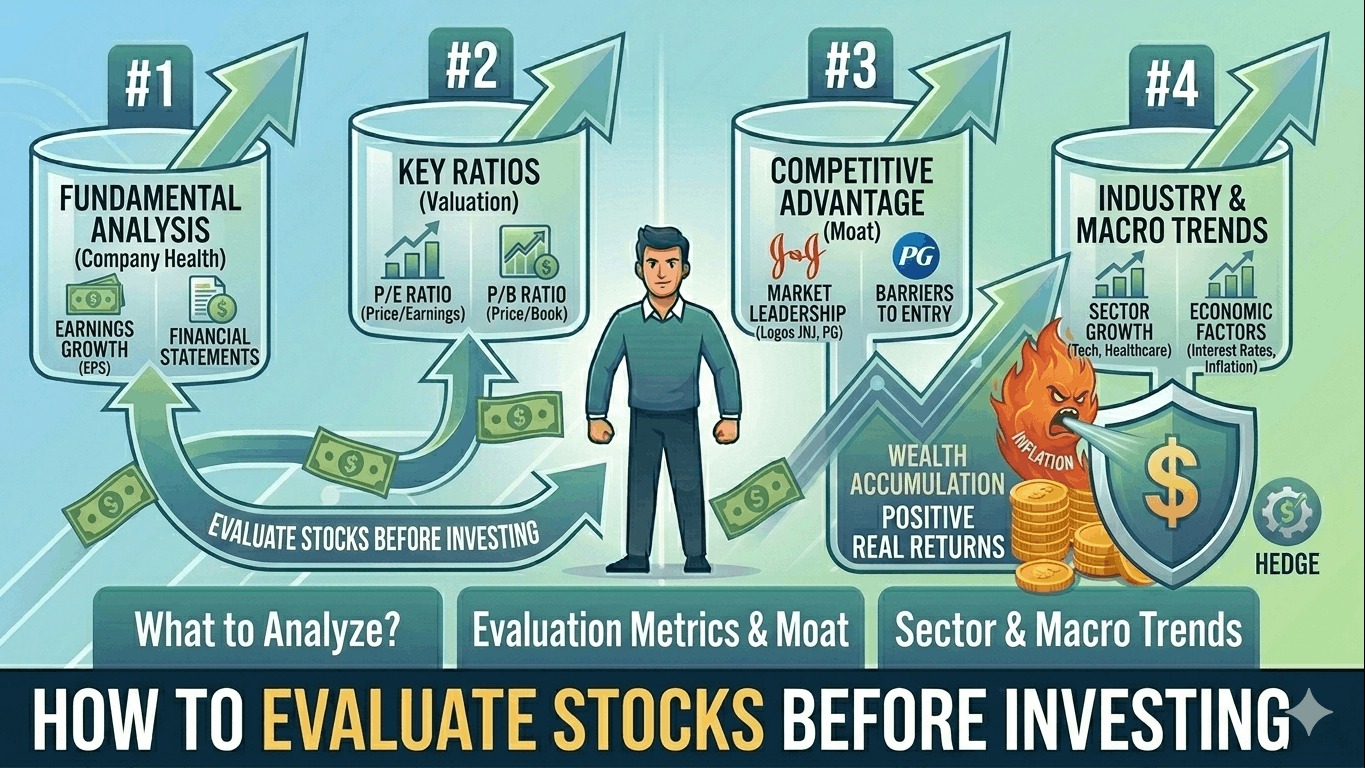
In the fast-moving market of 2026, where AI-driven volatility and "Higher for Longer" interest rates are the norm, picking a stock isn't about following a "hot tip" on social media. It is about performing a disciplined fundamental analysis to ensure you are buying a piece of a high-quality business at a fair price.
Evaluating a stock is like performing an "X-ray" on a company’s health. Here is the 2026 blueprint for analyzing a stock before you hit the "buy" button.
1. The Quantitative Analysis (The Hard Numbers)
Numbers don't lie. When you pull up a stock’s ticker symbol in your brokerage app, these are the core metrics you must examine:
A. Price-to-Earnings (P/E) Ratio
The P/E ratio tells you how much investors are willing to pay for every $1 of profit the company makes.
- The Benchmark: In 2026, the S&P 500 average P/E is around 21. If a stock has a P/E of 50, it is "expensive" (investors expect massive growth). If it has a P/E of 12, it might be "undervalued" or in a declining industry.
B. Earnings Per Share (EPS) Growth
EPS is the portion of a company's profit allocated to each outstanding share of common stock.
- What to look for: Look for consistent growth over the last 3–5 years. A company that grows its EPS by 10% annually is a compounding machine.
C. Debt-to-Equity Ratio
In a 2026 environment where interest rates are 3.75%, debt is expensive.
- The Rule: A ratio below 1.0 is generally considered healthy. If a company has a ratio of 3.0, they are heavily "leveraged" and a large chunk of their profit is going toward paying interest rather than growing the business.
2. The Qualitative Analysis (The "Moat")
Numbers are the "what," but qualitative analysis is the "why." Legendary investor Warren Buffett looks for a "Economic Moat"—a structural advantage that protects a company from competitors.
- Brand Loyalty: Can the company raise prices without losing customers? (e.g., Apple or Starbucks).
- Network Effect: Does the service become more valuable as more people use it? (e.g., Meta or Amazon).
- Switching Costs: How hard is it for a customer to leave? (e.g., Enterprise software like Microsoft or Salesforce).
3. Real-World Example: Evaluating "Alpha-Tech AI"
Scenario: It is March 2026, and you are looking at a fictional mid-cap AI hardware company.
- Check the P/E: It’s 35. This is higher than the market average, but you see their EPS Growth was 45% last year. The high price might be justified by the high growth.
- Examine the Balance Sheet: They have $500 million in cash and only $50 million in debt. In a high-interest-rate world, this company is "fortress-safe."
- Identify the Moat: You discover they own the exclusive patent for a specific cooling chip used in data centers. Competitors can’t replicate it for at least 5 years. This is a strong Moat.
Conclusion: Even though the stock is "expensive" by P/E standards, the low debt and strong patent make it a high-quality candidate for a long-term portfolio.
4. The 2026 "Macro" Overlay
In 2026, you cannot evaluate a stock in a vacuum. You must ask:
- Interest Rate Sensitivity: If the Fed raises rates another 0.25%, will this company's debt payments become unmanageable?
- AI Integration: Is this company actually using AI to increase efficiency, or are they just using "AI" as a buzzword in their earnings call?
- Regulatory Risk: Is the government currently investigating this sector for antitrust or data privacy issues?