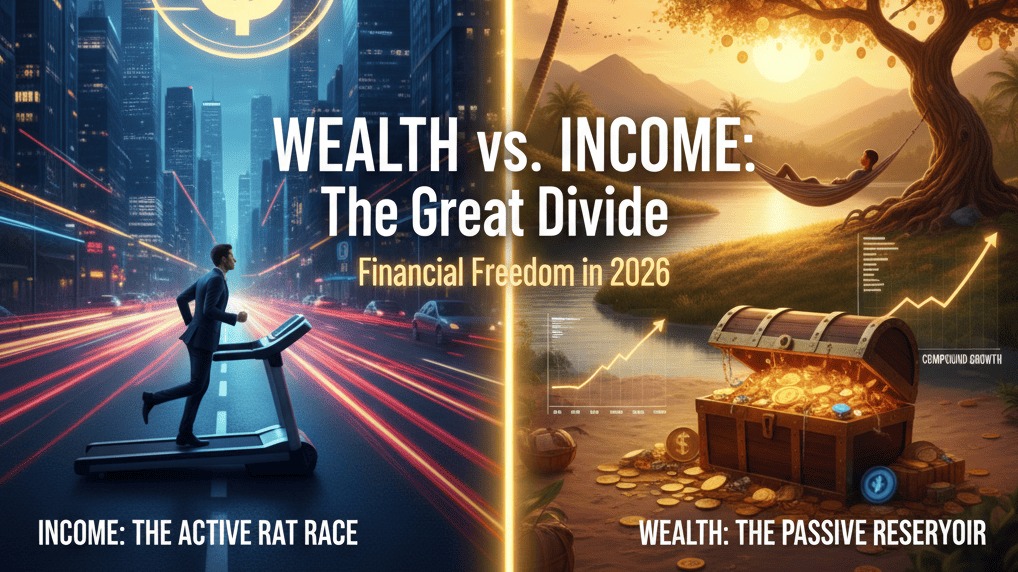
In the quest for financial freedom, most people focus on the wrong number. They celebrate a high salary or a big bonus, but while income is the engine that starts the car, wealth is the destination. Understanding the fundamental difference between these two concepts is the first step toward true financial independence in 2026.
Income: The Flow of Money
Income is the amount of money you receive on a regular basis in exchange for your time, labor, or the use of your capital. It is a "flow" concept.
- Earned Income: Your salary, hourly wages, or commissions.
- Passive Income: Money from rental properties, royalties, or dividends.
- The Catch: Income is temporary. If you stop working or the source dries up, the flow stops. It is also subject to the highest tax rates (especially earned income).
Wealth: The Reservoir of Value
Wealth is the total value of everything you own (assets) minus everything you owe (liabilities). It is a "stock" concept. If income is how much water is flowing through the pipes, wealth is how much water is stored in the tank.
- Examples: Home equity, stock portfolios, retirement accounts, businesses, and intellectual property.
- The Power of Wealth: Wealth provides security. It doesn't require your active presence to grow. Through compound interest, wealth can actually generate its own income, eventually replacing your need for a job.
Why High Income Doesn't Equal Wealth
It is a common myth that a high income automatically makes you wealthy. In reality, many "high earners" are actually living paycheck to paycheck because of Lifestyle Creep—the tendency to increase spending as income rises.
Consider two individuals:
- Person A: Earns $250,000/year but spends $245,000 on luxury cars, high rent, and travel. Their net wealth grows by only $5,000 a year.
- Person B: Earns $70,000/year, lives frugally, and invests $20,000 into a diversified portfolio.
Over a decade, Person B will likely be significantly "wealthier" than Person A, despite earning less than a third of the income. Wealth is what you keep, not what you spend.
How to Turn Income into Wealth
The goal of any savvy financial plan in 2026 should be to convert as much "Earned Income" into "Wealth-Generating Assets" as possible.
- The Gap: Create a wide margin between what you earn and what you spend.
- The Conversion: Take that margin and buy assets (stocks, real estate, Bitcoin, or private equity).
- The Loop: Let those assets generate their own income (dividends/rent), which you then reinvest to buy more assets.