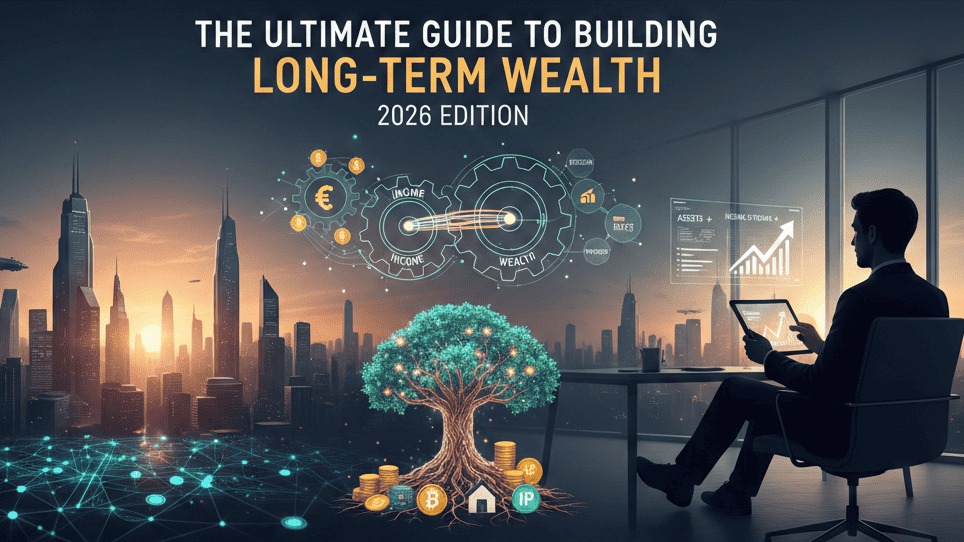
The financial landscape of 2026 is vastly different than it was even five years ago. With AI-driven markets, a decentralized global economy, and the rise of the "solopreneur," the path to riches has changed. However, the foundational physics of wealth remains constant.
Whether you’re just starting your career or looking to optimize your portfolio, this guide breaks down how to build a legacy that lasts.
What is Wealth?
Most people mistake "wealth" for having a large number in a bank account. In reality, wealth is freedom. Wealth is the measure of how long you could maintain your current lifestyle if you stopped working today. It isn't just about the money you have; it’s about the time you own. True wealth provides the "Three Autonomies":
- Location: Where you live.
- Time: How you spend your day.
- Purpose: What you work on.
Wealth vs. Income
This is the most critical distinction in personal finance.
- Income is the fuel; it’s what you earn from labor or investments (e.g., your salary).
- Wealth is the engine; it’s the net value of your accumulated assets.
You can have a $500,000 income and zero wealth if your expenses match your earnings. Conversely, someone with a modest income who consistently invests can become incredibly wealthy over time. Income is a flow; wealth is a reservoir.
Assets vs. Liabilities
To grow wealth, you must understand what Robert Kiyosaki famously simplified:
- Assets: Things that put money into your pocket (Stocks, rental property, intellectual property, automated businesses).
- Liabilities: Things that take money out of your pocket (Car loans, high-interest credit card debt, luxury subscriptions).
In 2026, we also look at Digital Assets. A high-traffic newsletter or a proprietary AI agent can be just as valuable as a piece of real estate.
Investing Basics: The 2026 Approach
In today’s market, "buying and holding" index funds is still the gold standard for most, but the strategy has evolved.
- Compound Interest: The "Eighth Wonder of the World" still works. The formula for the future value of an investment is:
- $$FV = P(1 + r)^n$$
- Where $P$ is the principal, $r$ is the interest rate, and $n$ is the number of periods. The "n" (time) is your greatest ally.
- Diversification: Don't put all your eggs in one basket. Balance your portfolio between traditional markets (S&P 500), hard assets (gold/real estate), and emerging tech.
- Automation: Remove human emotion. Set up "set-it-and-forget-it" contributions to your brokerage accounts.
Multiple Income Streams
Relying on a single paycheck is the biggest risk in the modern economy. Successful wealth-builders usually have at least three of these streams:
- Earned Income: Your primary job.
- Passive Income: Dividends, interest, or rental income.
- Portfolio Income: Capital gains from selling assets.
- Side Income: Consulting, digital sales, or "gig" economy participation.
Common Wealth Mistakes
Even high-earners often fall into these traps:
- Lifestyle Creep: Increasing your spending every time your salary increases.
- Chasing "Moonshots": Putting too much capital into high-risk, speculative "memecoins" or unproven tech without a solid foundation.
- Ignoring Taxes: Not utilizing tax-advantaged accounts (like 401ks or IRAs). Remember: It’s not about what you make, it’s about what you keep.
The Wealth Mindset
Finally, wealth is a psychological game.
- Abundance vs. Scarcity: Wealthy individuals look for opportunities to grow the pie, rather than fighting over slices.
- Delayed Gratification: The ability to choose a better future over a comfortable "now" is the ultimate predictor of financial success.
- Curiosity: In 2026, the most valuable skill is the ability to learn. Markets change, and those who stay curious stay ahead.
Building wealth isn't a sprint; it's a series of intentional habits. Start by auditing your assets, cutting your "dumb" debt, and letting time do the heavy lifting.