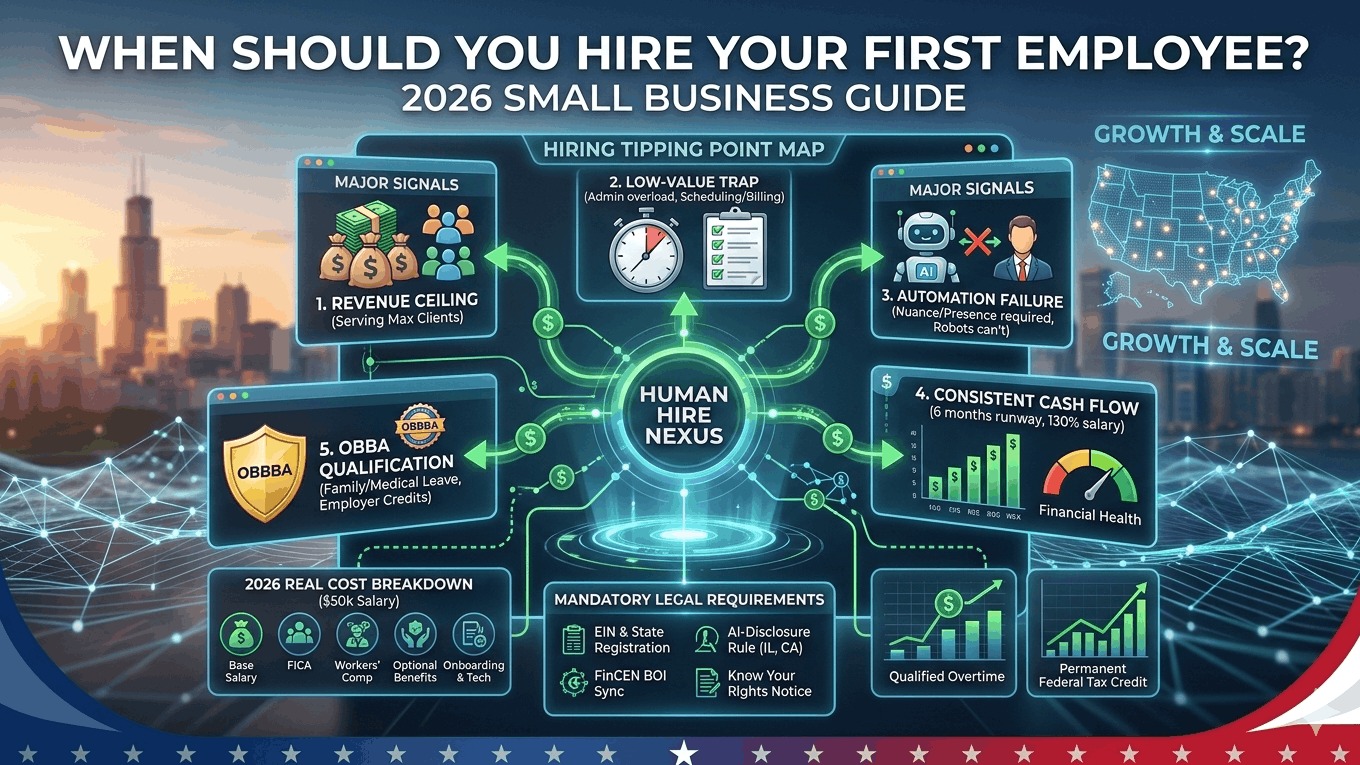
In 2026, the question of when to hire your first employee has shifted from a matter of "capacity" to a matter of "ROI vs. Automation." With the One Big Beautiful Bill Act (OBBBA) introducing new tax credits for small employers, the financial barrier is lower, but the legal complexity is higher.
This guide helps you identify the "Tipping Point" where a human hire becomes more valuable than an AI agent.
1. The "Tipping Point" Checklist
If you check three or more of these boxes, you are officially ready to hire:
- [ ] The Revenue Ceiling: You are turning down paying clients because you physically don't have enough hours to service them.
- [ ] The "Low-Value" Trap: You spend more than 20 hours a week on "admin" (billing, scheduling, basic support) rather than your core skill.
- [ ] Automation Failure: You’ve tried using AI agents (Zapier, ChatGPT, etc.) to handle a task, but it requires a level of "Human Nuance" or physical presence the tech can't provide.
- [ ] Consistent Cash Flow: You have at least 6 months of runway to cover a salary plus an additional 30% for taxes and benefits.
- [ ] The OBBBA Qualification: You are looking to claim the 2026 Family and Medical Leave Credit or other employer incentives that only trigger with a W-2 hire.
2. The Real Cost of a $50,000 Employee (2026)
In 2026, a "salary" is just the starting point. Here is the estimated annual "True Cost" for a US-based employee:
| Expense Category | Percentage / Rate | Annual Cost (on $50k) |
|---|---|---|
| Base Salary | 100% | **$50,000** |
| FICA (Soc. Sec & Medicare) | 7.65% | $3,825 |
| FUTA/SUTA (Unemployment) | ~2–3% (Varies by State) | $1,250 |
| Workers' Comp Insurance | ~1% (White collar) | $500 |
| Benefits (Health/401k) | Optional (Recommended) | $5,000 |
| Onboarding & Tech Stack | One-time | $1,500 |
| TOTAL TRUE COST | ~1.25x - 1.4x Salary | **$62,075** |
3. Mandatory 2026 Legal Requirements
The 2026 regulatory landscape requires three specific actions before your first hire:
- EIN & State Registration: Ensure your Employer Identification Number is linked to your state's Department of Labor for unemployment insurance.
- The "AI-Disclosure" Rule: In 2026, many states (like IL and CA) require you to disclose to candidates if you are using AI tools to screen their resumes or conduct initial interviews.
- FinCEN BOI Sync: Ensure your Beneficial Ownership Information is updated with the federal government, as your status as an "Employer" may change your filing tier.
- Workplace "Know Your Rights" Notice: As of Feb 2026, you must provide a specific written notice to all new hires covering workers' comp, union rights, and the OBBBA's new overtime protections.
4. OBBBA 2026: The "Overtime & Tips" Impact
The One Big Beautiful Bill Act has two major rules for new employers this year:
- Overtime Deduction: Employees can now deduct up to $12,500 of their overtime pay from their own taxes. As an employer, you must accurately report this "Qualified Overtime" on their W-2.
- Family Leave Credit: Small employers can now claim a permanent federal tax credit for wages paid to employees on family or medical leave—a huge win for first-time hirers.
Quotes & Taglines
- "Hire when the cost of your time exceeds the cost of their salary."
- "Your first hire is the architect of your culture."
- "Automation handles the tasks; humans handle the mission."
- "Don't hire a person to do a robot's job."