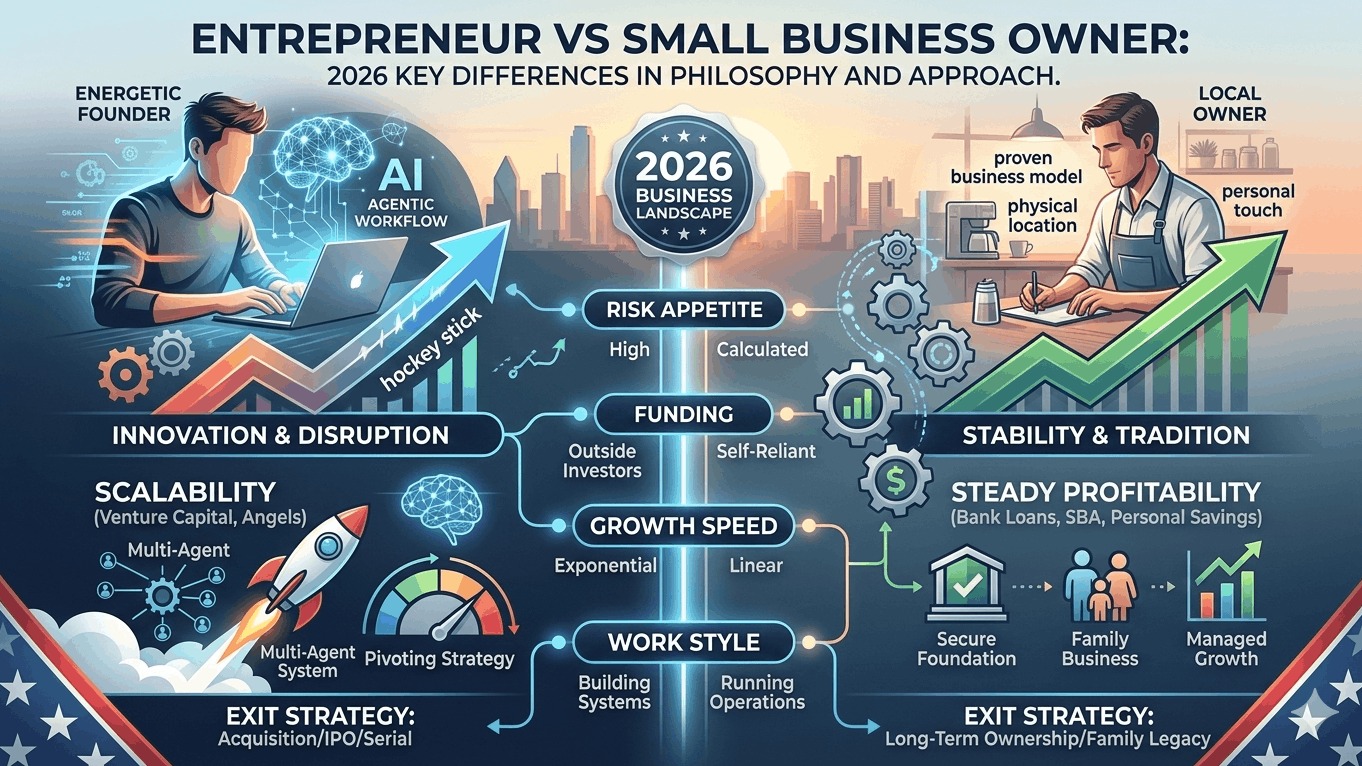
While "entrepreneur" and "small business owner" are often used as synonyms, in the 2026 business landscape, they represent two fundamentally different philosophies. One is an architect of innovation, while the other is a steward of stability.
Understanding which path you are on determines your funding strategy, your risk profile, and your ultimate exit plan.
1. The Core Philosophy: Innovation vs. Tradition
The primary difference lies in the value proposition of the business.
- The Entrepreneur: Usually starts with a brand-new idea or a significant disruption of an existing market. They seek to solve a problem in a way that hasn't been done before (e.g., a startup creating a new AI-driven diagnostic tool).
- The Small Business Owner: Operates within a proven business model. They provide a known product or service to a specific community (e.g., a local HVAC company or a franchise coffee shop).
2. Key Differences at a Glance
| Feature | Entrepreneur | Small Business Owner |
|---|---|---|
| Primary Goal | Rapid scalability and market disruption. | Steady profitability and personal freedom. |
| Risk Appetite | High. Embraces uncertainty for high rewards. | Calculated. Prioritizes stability and security. |
| Funding | Seeks Venture Capital, Angels, or Crowdfunding. | Relies on personal savings, bank loans, or SBA. |
| Growth Speed | "Hockey stick" growth (as fast as possible). | Linear, sustainable, and organic growth. |
| Work Style | Focuses on "Building the Machine" (Systems). | Focuses on "Running the Business" (Operations). |
| Exit Strategy | Acquisition, IPO, or "Serial" exit. | Long-term ownership or family legacy. |
3. Deep Dive: Risk and Scalability
The Risk Profile
In 2026, the Entrepreneur views risk as an inherent part of the product-market fit process. They are comfortable "pivoting" their entire business model if the data suggests a better path.
Conversely, the Small Business Owner views risk as a threat to their livelihood. They use thorough planning and measured steps to protect their existing customer base and ensure consistent cash flow.
The Scalability "Wall"
The Entrepreneur builds for Scalability. This means the business is designed to handle $10 \times$ or $100 \times$ the volume without a $100 \times$ increase in costs. This is often achieved through software, automation, or proprietary systems.
The Small Business Owner often hits a Scaling Wall because their business is tied to their own time or a physical location. To double their revenue, they often have to double their staff or square footage, which maintains the same profit margin.
4. Can You Be Both?
Yes. Many "Entrepreneurs" start as "Small Business Owners" to find their footing. Once they develop a unique system or software that allows their local business to scale nationally, they transition into an entrepreneurial role.
Example: A baker who owns one shop is a Small Business Owner. If that baker develops a unique frozen-dough technology and scales to 500 grocery stores, they have become an Entrepreneur.
Quotes & Taglines
- "The business owner seeks to be the best; the entrepreneur seeks to be the only."
- "Stability is the goal of the owner; scale is the goal of the founder."
- "One works IN the business; the other works ON the business."
- "In 2026, the gap between owner and entrepreneur is bridged by automation."