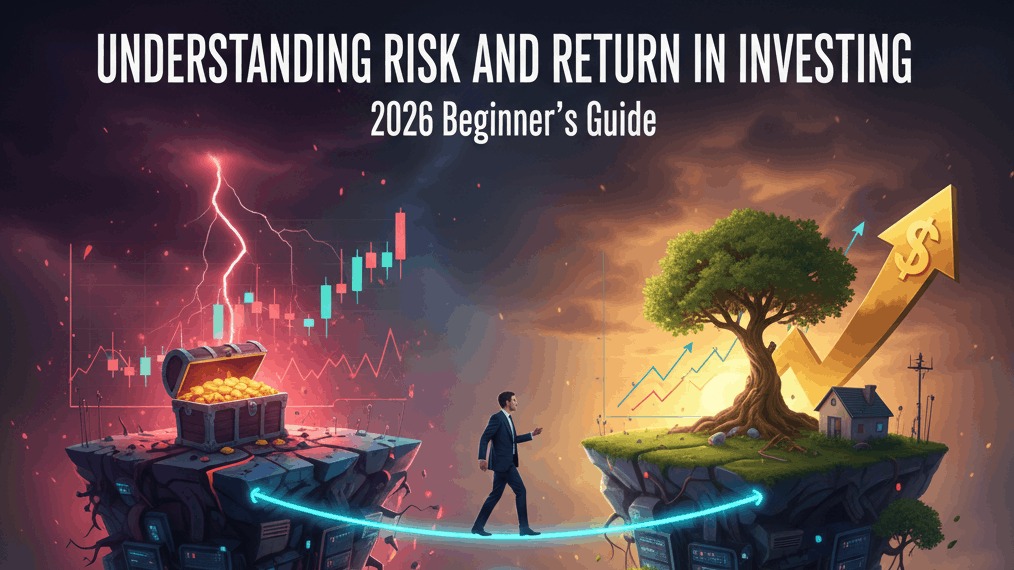
If investing had a "Golden Rule," it would be this: Risk and return are inseparable. Whether you are buying a single share of a tech startup or putting money into a government bond, you are making a calculation. You are asking, "Is the potential profit worth the chance that I might lose my money?"
In 2026, as new asset classes emerge and market speeds increase, mastering the balance of the risk-return trade-off is the most critical skill any investor can possess.
The Risk-Return Trade-off
The risk-return trade-off is the principle that potential return rises with an increase in risk. Low levels of uncertainty (low risk) are associated with low potential returns, whereas high levels of uncertainty (high risk) are associated with high potential returns.
1. Low Risk, Low Return
These are the "safe" havens. Your principal is generally protected, but the growth will be slow—sometimes barely keeping up with inflation.
- Examples: Government Bonds, High-Yield Savings Accounts, Certificates of Deposit (CDs).
2. Moderate Risk, Moderate Return
These assets offer a balance. They fluctuate in value, but they represent established entities with long-term growth potential.
- Examples: Diversified Index Funds, "Blue Chip" stocks (large, stable companies), Real Estate.
3. High Risk, High Return
This is the "fast lane." You could see 50% gains in a month, but you could also see a 50% loss just as quickly.
- Examples: Individual tech startups, Small-cap stocks, Cryptocurrency, Venture Capital.
Types of Investment Risk in 2026
To manage risk, you first have to identify it. In today's market, risk comes in several flavors:
- Market Risk (Systematic Risk): The risk that the entire market will decline due to economic shifts, political unrest, or global events. No amount of diversification can fully eliminate this.
- Business Risk: The risk that a specific company you invested in will fail due to poor management or a superior competitor.
- Inflation Risk (Purchasing Power Risk): The danger that your money will lose value over time. If your "safe" bond pays 3% but inflation is 4%, you are actually losing wealth.
- Liquidity Risk: The risk that you won't be able to sell your asset quickly for its fair market value when you need the cash.
How to Determine Your Risk Tolerance
Your "Risk Tolerance" is your emotional and financial ability to handle a drop in the value of your investments. Ask yourself these three questions:
- What is my Time Horizon? If you need the money in 2 years, your risk tolerance is low. If you don't need it for 30 years, it is high.
- What is my "Sleep Test" limit? If your portfolio dropped 20% tomorrow, would you panic and sell? If yes, you should favor lower-risk assets.
- What are my Goals? If you are already wealthy and just want to preserve it, you have a different risk profile than a 22-year-old trying to build a retirement fund from scratch.
Strategies for Managing the Trade-off
1. Asset Allocation
This is the practice of dividing your portfolio among different asset categories. By mixing "riskier" stocks with "safer" bonds, you can create a portfolio that matches your specific comfort level.
2. The Risk-Reward Ratio
Before making a trade, professionals look at the Risk-Reward Ratio. For example, if you risk $100 to potentially make $300, you have a 1:3 ratio. In 2026, many trading apps provide these calculations automatically to help you avoid "bad bets."
3. Hedging
More advanced investors use hedging (like buying "put options" or gold) to protect their portfolios against sudden downturns. It’s essentially buying insurance for your stocks.
10 Powerful Quotes on Understanding Risk and Return in Investing
- “Return is the reward — risk is the price you pay for it.”
- “The higher the potential return, the greater the uncertainty you must be willing to accept.”
- “Risk and return walk hand in hand — you can’t separate one from the other.”
- “Smart investing isn’t about avoiding risk; it’s about managing it wisely.”
- “Every investment carries risk — the key is knowing which risks are worth taking.”
- “Without risk, there is little opportunity for meaningful growth.”
- “Understanding risk turns fear into informed decisions.”
- “Chasing high returns without measuring risk is a gamble, not a strategy.”
- “Balanced investors respect risk as much as they pursue return.”
- “In investing, success comes from aligning your risk tolerance with your long-term goals.”
Conclusion
Investing is not about avoiding risk—it is about managing it. By understanding that every return has a price, you can stop "gambling" and start strategically building a portfolio that aligns with your life goals. The goal isn't to be fearless; it's to be prepared.