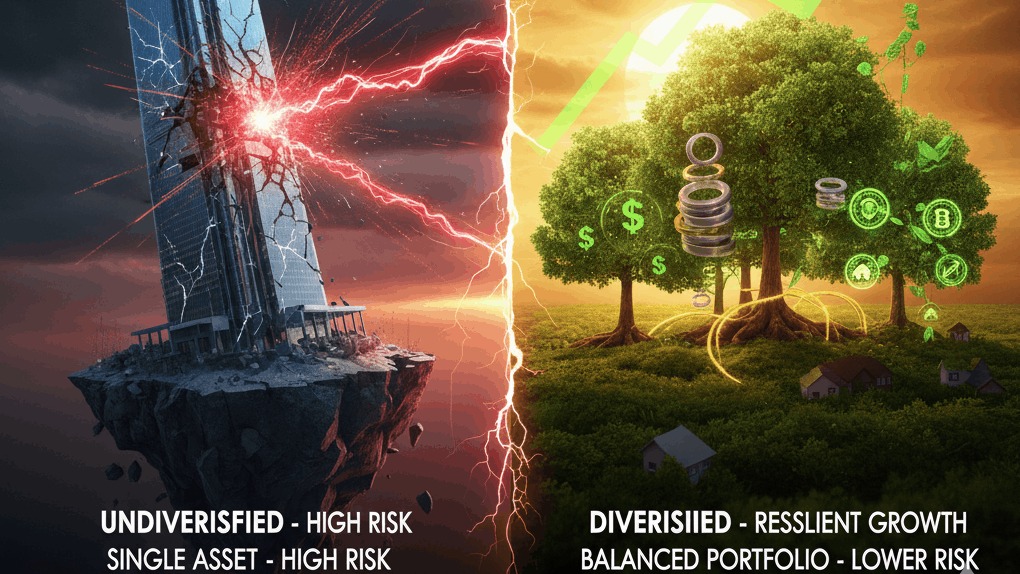
In the world of investing, risk is unavoidable. Whether it’s a sudden tech sector crash, a spike in oil prices, or a global supply chain disruption, markets are inherently volatile. Diversification is the strategic practice of spreading your investments across various financial instruments, industries, and categories to minimize the impact of any single event.
In 2026, where "black swan" events seem to happen more frequently, diversification isn't just a strategy—it's your portfolio’s insurance policy.
The Core Concept: How It Works
Diversification works on the principle of correlation. Different assets react differently to the same economic news.
- When the stock market is booming, bonds might stay flat.
- When inflation rises, gold and real estate often perform better than cash.
- When tech stocks take a hit, healthcare or consumer staples might remain steady.
By holding a mix of these assets, the winners in your portfolio help offset the losers, resulting in a "smoother" ride toward your financial goals.
The 4 Pillars of a Diversified Portfolio
To truly diversify in 2026, you need to think beyond just owning two different stocks. You should diversify across four main dimensions:
1. Asset Class Diversification
This is the most critical level. You should split your money between:
- Equities (Stocks): For high growth.
- Fixed Income (Bonds): For stability and regular interest.
- Cash Equivalents: For liquidity and emergencies.
- Alternative Assets: Such as Real Estate (REITs), Commodities (Gold), or a small percentage of Digital Assets.
2. Industry/Sector Diversification
Avoid "concentration risk." If you only own AI and semiconductor stocks, you aren't diversified—you are betting on a single sector. A healthy portfolio includes Technology, Healthcare, Energy, Finance, and Consumer Goods.
3. Geographical Diversification
Don't limit yourself to your home country. By investing in international markets (Emerging Markets or European indices), you protect yourself against a localized economic downturn in your own nation.
4. Time Diversification (Dollar-Cost Averaging)
Investing all your money on a single day is risky. By investing a set amount every month, you "diversify" the price you pay, buying more when prices are low and less when they are high.
Why Diversification Matters: The Benefits
1. Risk Mitigation
The primary goal isn't necessarily to maximize returns, but to minimize the chance of a catastrophic loss. If one company goes bankrupt but it only represents 1% of your portfolio, your overall wealth remains intact.
2. Reduced Volatility
A diversified portfolio experiences fewer "heart-attack" drops. While a single stock might drop 20% in a day, a diversified index fund rarely moves that drastically, helping you stay calm and avoid panic-selling.
3. The "Free Lunch"
Financial experts call diversification a "free lunch" because it allows you to maintain the same expected return while lowering the overall risk (measured by standard deviation).
Common Mistakes to Avoid
- Over-Diversification: Owning 1,000 different stocks can lead to "diworsification." At a certain point, you are just mimicking the total market and your returns will be capped by the sheer number of laggards in your portfolio.
- The "Illusion" of Diversification: Owning five different "Big Tech" stocks (like Apple, Microsoft, Alphabet, etc.) is not true diversification because they often move in the same direction.
- Ignoring Rebalancing: Over time, your winning stocks will grow to represent a larger portion of your portfolio. You must periodically "rebalance" by selling some winners and buying underperforming assets to maintain your original risk level.
10 Powerful Quotes on What Diversification Is and Why It Matters
- “Diversification is not about chasing more returns — it’s about protecting the ones you earn.”
- “Don’t put all your eggs in one basket; spread them wisely.”
- “Diversification turns uncertainty into balance.”
- “A diversified portfolio is built for stability, not speculation.”
- “Risk is inevitable — concentration is optional.”
- “Diversification doesn’t eliminate risk, but it helps manage it.”
- “The goal isn’t to pick one winner; it’s to avoid one devastating loser.”
- “When one investment struggles, another can help steady the ship.”
- “Smart investors diversify not because they fear loss, but because they respect risk.”
- “Diversification is the quiet strategy that keeps your long-term goals on track.”
Conclusion
Diversification is the ultimate defense against the unpredictable nature of the markets. It ensures that no single mistake or market event can derail your entire financial future. Whether you are a conservative saver or an aggressive grower, a well-spread portfolio is the foundation of long-term success.