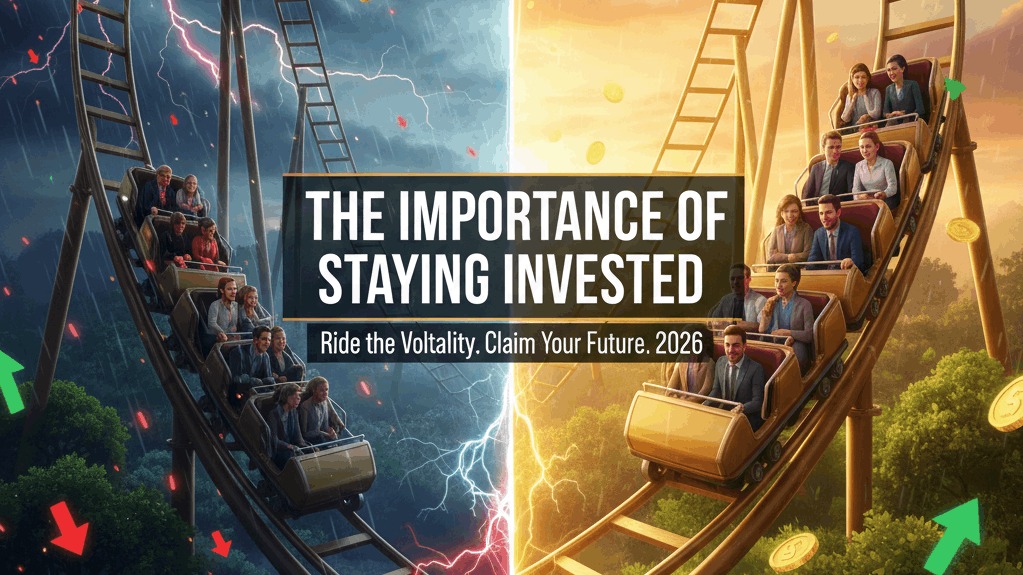
In the heat of a market crash, your instincts will scream at you to "do something." Watching your portfolio turn red is a visceral, uncomfortable experience. However, in the world of finance, the most successful action is often no action at all.
"Staying invested" means maintaining your positions through both the bull markets (ups) and the bear markets (downs). In 2026, where algorithmic trading can cause sudden "flash crashes," the discipline to remain in the market is what separates wealthy investors from those who simply trade money back and forth.
1. Time in the Market vs. Timing the Market
The biggest mistake investors make is trying to predict when the market will hit its bottom or its peak. This is known as Market Timing, and even the most advanced AI models struggle to do it consistently.
The alternative is Time in the Market. This strategy relies on the historical fact that markets have an upward bias. Despite wars, recessions, and pandemics, the global economy has always grown over long periods.
2. The High Cost of Missing the "Best Days"
Market growth is not a slow, steady climb. It usually happens in short, explosive bursts. Often, the market's "best days" occur immediately after its "worst days."
If you panic-sell during a downturn, you risk missing the recovery. missing just a handful of the market's best days can catastrophically reduce your total returns over a decade.
Stat Check: A classic study showed that if you invested $10,000 in the S&P 500 and stayed invested for 20 years, you’d have a significant sum. However, if you missed just the 10 best days of those 20 years, your final balance would be cut nearly in half.
3. The Compounding Snowball
Staying invested allows Compound Interest to do the heavy lifting. Compounding is the process where your investment earnings are reinvested to generate their own earnings.
When you withdraw your money during a dip, you aren't just losing your current value; you are "killing the seeds" of your future wealth. You reset the compounding clock to zero.
4. Emotional Discipline in 2026
In 2026, we are bombarded with "financial doom-scrolling" via social media and news alerts. To stay invested, you need a psychological toolkit:
- Zoom Out: Look at 10-year or 20-year charts rather than daily or weekly ones.
- Automate Your Strategy: If your investments happen automatically via DCA (Dollar-Cost Averaging), you are less likely to intervene emotionally.
- Have a "Cash Buffer": If you know you have 6 months of living expenses in a savings account, you won't feel the need to sell your stocks to pay for a sudden emergency.
When SHOULD You Sell?
Staying invested doesn't mean "blind loyalty." There are legitimate reasons to sell:
- Rebalancing: If your stocks have grown so much that they now represent 90% of your portfolio (when you wanted 70%), sell some to buy bonds.
- Fundamental Change: If a company you own has completely changed its business model or is involved in massive fraud, it might be time to exit.
- Life Goals Met: If you’ve reached your "number" and are ready to retire or buy that house, selling is the logical next step.
10 Powerful Quotes on The Importance of Staying Invested
- “The greatest returns often come to those who simply refuse to quit.”
- “Staying invested through uncertainty is where real growth begins.”
- “Time rewards patience — especially in the market.”
- “The market tests your emotions, but it rewards your discipline.”
- “Leaving too soon can cost more than never starting.”
- “Volatility is temporary — compounding is powerful.”
- “Consistency in the market beats constant entry and exit.”
- “The longer you stay invested, the more you let time work in your favor.”
- “Success in investing isn’t about perfect timing — it’s about lasting commitment.”
- “Staying invested turns short-term noise into long-term progress.”
Conclusion
The market is a machine designed to transfer money from the impatient to the patient. By staying invested, you aren't just holding stocks; you are holding onto your future freedom. When the market gets rocky, remember: the only way to get hurt on a roller coaster is to jump off in the middle of the ride.