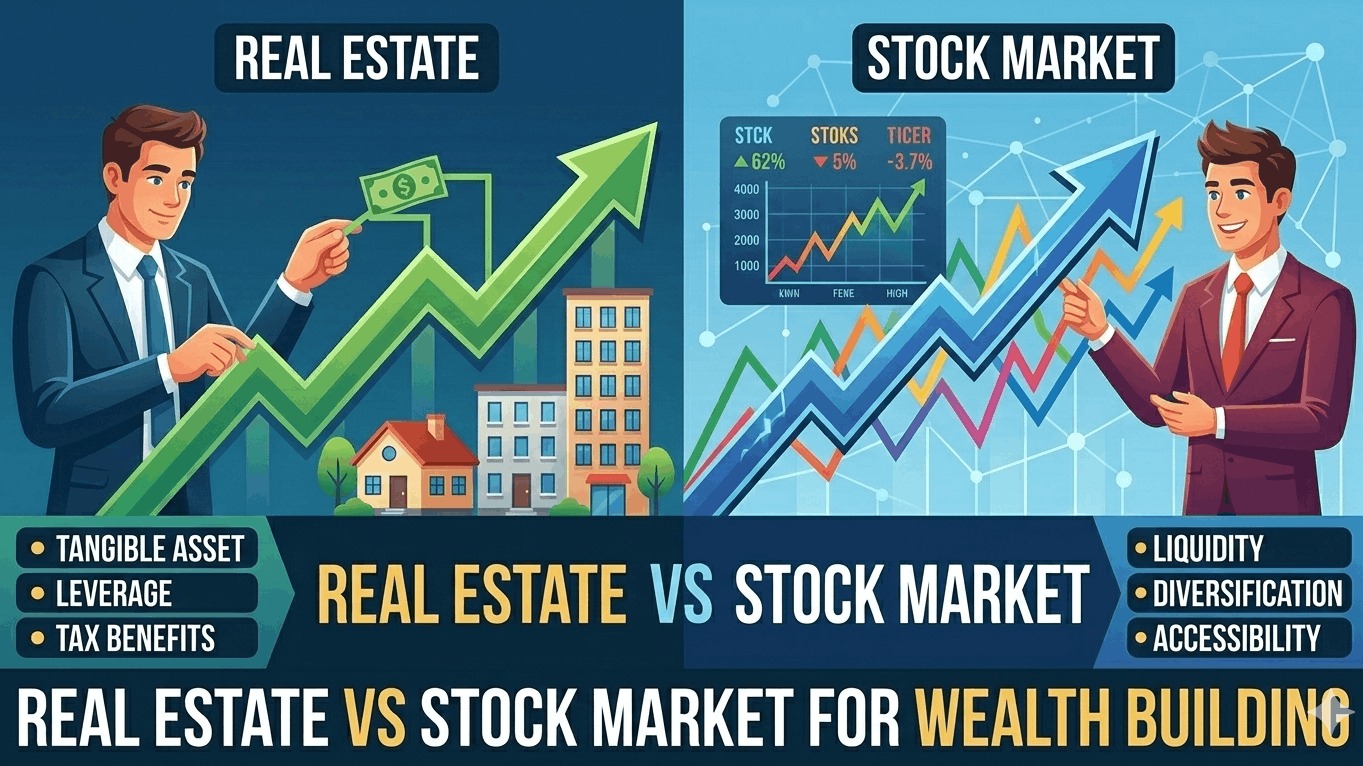
In March 2026, the debate between real estate and the stock market has reached a new level of nuance. With the S&P 500 projected to return approximately 6.7% annually and U.S. Core Real Estate forecasted at 8.0% for 2026, investors are weighing the "liquidity of the screen" against the "leverage of the dirt."
While both are proven wealth-building vehicles, they function like different engines in a portfolio. One is built for high-speed compounding; the other is built for heavy-duty leverage and stability.
1. The Core Comparison (2026 Outlook)
| Feature | Real Estate (Physical) | Stock Market (S&P 500) |
|---|---|---|
| Projected 2026 Return | ~8.0% (Total Return) | ~6.7% (Large Cap) |
| Starting Capital | High ($20k – $100k+) | Low ($1 – $100) |
| Liquidity | Low (Weeks to Months) | Very High (Same Day) |
| Leverage | High (4:1 or 5:1) | Low (Margin is Risky) |
| Management | Moderate to High | Low to Zero |
| Tax Advantages | Exceptional (Depreciation/1031) | Moderate (LTCG/Tax-Advantaged Accts) |
2. Why Real Estate Wins: The Power of Leverage
The defining advantage of real estate is the ability to use Other People’s Money (OPM).
- The Leveraged Math: In 2026, if you buy a $500,000 property with $100,000 down (20%), and the property appreciates by a modest 3%, you haven't made 3% on your money—you’ve made 15% ($15,000 gain on $100,000 cash).
- Debt Paydown: While you sleep, your tenant pays the mortgage. Every month, your net worth grows as your debt decreases, even if the property value stays flat.
- Inflation Hedge: Real estate is a "real asset." As the 2026 "Costco Economy" pushes prices up, your fixed-rate mortgage stays the same while your rents and property value typically rise.
3. Why the Stock Market Wins: Compounding & Liquidity
The stock market’s greatest weapon is frictionless compounding and the ease of diversification.
- The Compounding Machine: Reinvesting dividends in a broad-market ETF (like VTI or VOO) allows your wealth to grow exponentially without you lifting a finger.
- Zero Barrier to Entry: You can start building a "stock portfolio" with the spare change from your coffee. In 2026, apps have made fractional shares and automated "round-ups" the standard for young investors.
- No "Bad Tenant" Risk: You don't have to worry about a leaky roof or an eviction. Your "employees" are the CEOs and workers of the world’s most profitable companies.
4. The 2026 Tax Landscape
Following the tax updates of 2025, real estate continues to offer a more robust shield for high-income earners.
- Real Estate: 100% bonus depreciation allows you to front-load tax breaks, often resulting in "tax-free" rental income.
- Stocks: The 2026 tax code maintains favorable Long-Term Capital Gains rates (0%, 15%, or 20%) for assets held over a year, but it lacks the "paper loss" magic of depreciation.