Here are 10 of the most insightful quotes attributed to William Cullen Bryant, and the logic behind them.
1. On Conflict and Power
Here the free spirit of mankind, at length, Throws its last fetters off; and who shall placeA limit to the giant's unchained strength, Or curb his swiftness in the forward race!
The Meaning: This is a warning about escalation: once violence becomes the grammar of a conflict, everyone starts speaking it fluently. The deeper point is that the tools you use to win also train the world in how to fight you next time.
2. On Faith and Meaning
Ah, why Should we, in the world's riper years, neglect God's ancient sanctuaries, and adore Only among the crowd and under roofs That our frail hands have raised?
The Meaning: This line from William Cullen Bryant compresses a lived tension into a single readable moment. Read it slowly: it is not asking you to agree, but to notice where the same pattern shows up in your own life. If you take it seriously, it becomes a test—what would you change if this were reliably true for you?
3. On Courage
Glorious are the woods in their latest gold and crimson, Yet our full-leaved willows are in the freshest green. Such a kindly autumn, so mercifully dealing With the growths of summer, I never yet have seen.
The Meaning: This line from William Cullen Bryant compresses a lived tension into a single readable moment. Read it slowly: it is not asking you to agree, but to notice where the same pattern shows up in your own life. If you take it seriously, it becomes a test—what would you change if this were reliably true for you?
4. On Perspective
When April winds Grew soft, the maple burst into a flush Of scarlet flowers. The tulip tree, high up, Opened in airs of June her multitude Of golden chalices to humming-birds And silken-wing'd insects of the sky.
The Meaning: This line from William Cullen Bryant compresses a lived tension into a single readable moment. Read it slowly: it is not asking you to agree, but to notice where the same pattern shows up in your own life. If you take it seriously, it becomes a test—what would you change if this were reliably true for you?
5. On Truth and Integrity
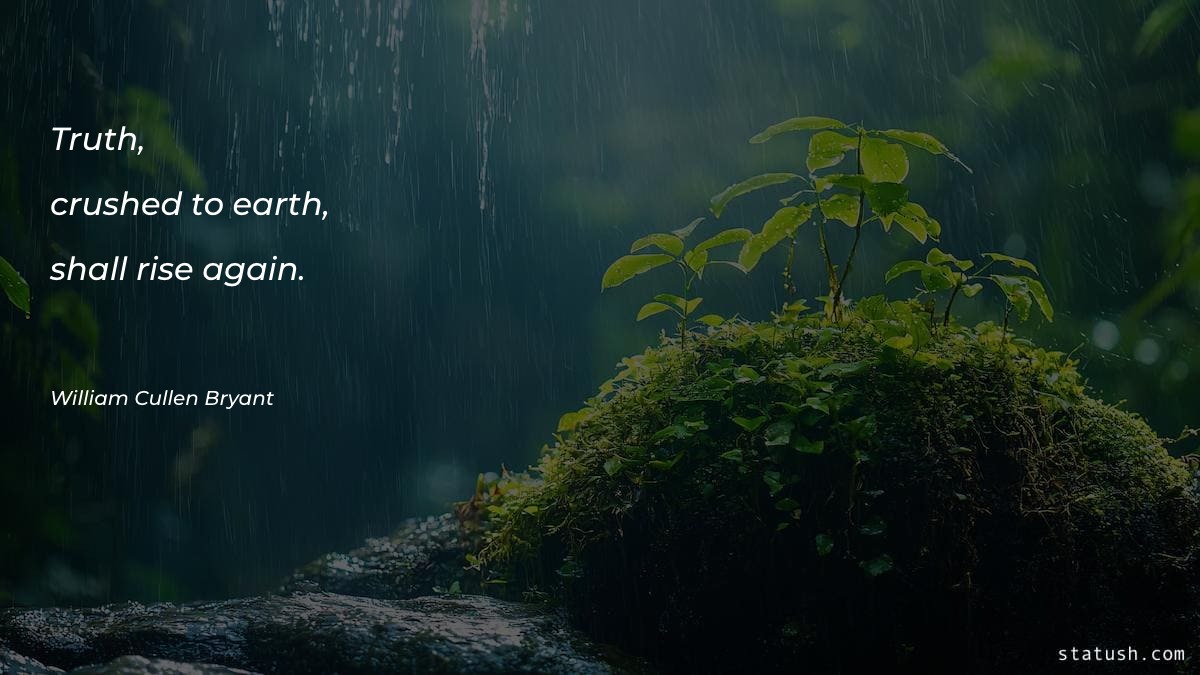
Truth, crushed to earth, shall rise again; The eternal years of God are hers; But Error, wounded, writhes with pain, And dies among his worshippers.
The Meaning: Truth here is less about moral purity and more about contact with reality. The line suggests that self-deception is expensive: it buys comfort today and confusion tomorrow. Clarity is often uncomfortable, but it is navigable.
6. On Relationships
He who, from zone to zone, Guides through the boundless sky thy certain flight, In the long way that I must tread alone, Will lead my steps aright.
The Meaning: This line from William Cullen Bryant compresses a lived tension into a single readable moment. Read it slowly: it is not asking you to agree, but to notice where the same pattern shows up in your own life. If you take it seriously, it becomes a test—what would you change if this were reliably true for you?
7. On Truth and Integrity
The stormy March has come at last, With winds and clouds and changing skies; I hear the rushing of the blast That through the snowy valley flies.
The Meaning: Truth here is less about moral purity and more about contact with reality. The line suggests that self-deception is expensive: it buys comfort today and confusion tomorrow. Clarity is often uncomfortable, but it is navigable.
8. On Action
Thine eyes are springs in whose serene And silent waters heaven is seen; Their lashes are the herbs that look On their young figures in the brook.
The Meaning: This line from William Cullen Bryant compresses a lived tension into a single readable moment. Read it slowly: it is not asking you to agree, but to notice where the same pattern shows up in your own life. If you take it seriously, it becomes a test—what would you change if this were reliably true for you?
9. On Love and Devotion
Loveliest of lovely things are they, On earth, that soonest pass away. The rose that lives its little hour Is prized beyond the sculptured flower.
The Meaning: This line treats emotion as something that steers decisions more than arguments do. The meaning is practical: if you ignore what you feel, you may still act—but often on autopilot. Naming the feeling is the first step toward choosing it, rather than being dragged by it.
10. On Growth
These are the gardens of the Desert, these The unshorn fields, boundless and beautiful, For which the speech of England has no name—The Prairies.
The Meaning: This line from William Cullen Bryant compresses a lived tension into a single readable moment. Read it slowly: it is not asking you to agree, but to notice where the same pattern shows up in your own life. If you take it seriously, it becomes a test—what would you change if this were reliably true for you?