Here are 10 of the most insightful quotes attributed to Wayne Dyer, and the logic behind them.
1. On Time and Memory
Whatever you've been until today is already over, and while you can almost always learn from it, and sometimes change effects that are continuing into the present, you cannot undo what you have done.
The Meaning: Time is treated as something you cannot store—only spend. The meaning is that urgency and patience are both strategies; the quote asks which one matches the stakes. If you feel rushed, check whether the deadline is real or inherited.
2. On Love and Devotion
There is no scarcity of opportunity to make a living at what you love; there's only scarcity of resolve to make it happen.
The Meaning: This line treats emotion as something that steers decisions more than arguments do. The meaning is practical: if you ignore what you feel, you may still act—but often on autopilot. Naming the feeling is the first step toward choosing it, rather than being dragged by it.
3. On Truth and Integrity
Simply put, you believer that things or people make you unhappy, but this is not accurate. You make yourself unhappy.
The Meaning: Truth here is less about moral purity and more about contact with reality. The line suggests that self-deception is expensive: it buys comfort today and confusion tomorrow. Clarity is often uncomfortable, but it is navigable.
4. On Perspective
When you dance, your purpose is not to get to a certain place on the floor. It's to enjoy each step along the way.
The Meaning: This line from Wayne Dyer compresses a lived tension into a single readable moment. Read it slowly: it is not asking you to agree, but to notice where the same pattern shows up in your own life. If you take it seriously, it becomes a test—what would you change if this were reliably true for you?
5. On Thought and Judgment
What we think determines what happens to us, so if we want to change our lives, we need to stretch our minds.
The Meaning: This line from Wayne Dyer compresses a lived tension into a single readable moment. Read it slowly: it is not asking you to agree, but to notice where the same pattern shows up in your own life. If you take it seriously, it becomes a test—what would you change if this were reliably true for you?
6. On Relationships
I cannot always control what goes on outside. But I can always control what goes on inside.
The Meaning: This line from Wayne Dyer compresses a lived tension into a single readable moment. Read it slowly: it is not asking you to agree, but to notice where the same pattern shows up in your own life. If you take it seriously, it becomes a test—what would you change if this were reliably true for you?
7. On Time
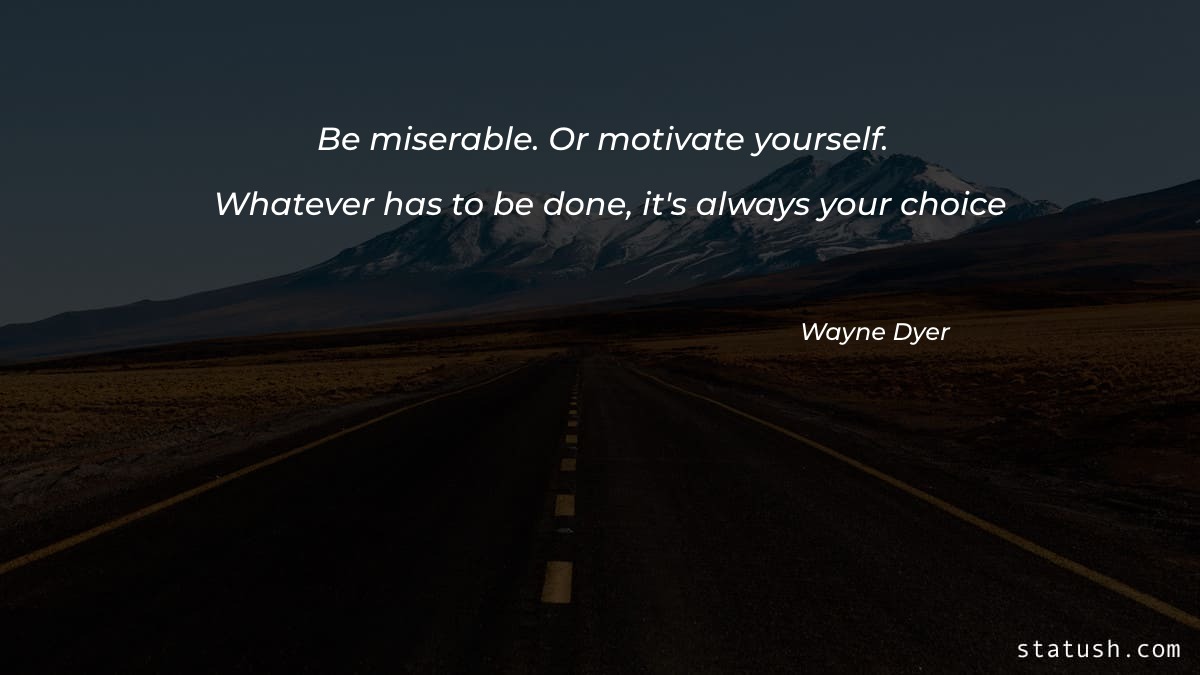
Be miserable. Or motivate yourself. Whatever has to be done, it's always your choice.
The Meaning: This line from Wayne Dyer compresses a lived tension into a single readable moment. Read it slowly: it is not asking you to agree, but to notice where the same pattern shows up in your own life. If you take it seriously, it becomes a test—what would you change if this were reliably true for you?
8. On People and Relationships
Maxim for life: You get treated in life the way you teach people to treat you.
The Meaning: Knowledge is framed as something that changes behavior, not something you collect like trophies. If a sentence is true but does not shift what you notice or do, it has not finished its work.
9. On Love and Devotion
My belief is that the truth is a truth until you organize it, and then becomes a lie. I don't think that Jesus was teaching Christianity, Jesus was teaching kindness, love, concern, and peace. What I tell people is don't be Christian be Christ like. Don't be Buddhist be Buddha like.
The Meaning: This line treats emotion as something that steers decisions more than arguments do. The meaning is practical: if you ignore what you feel, you may still act—but often on autopilot. Naming the feeling is the first step toward choosing it, rather than being dragged by it.
10. On Growth
Everything you are against weakens you. Everything you are for empowers you.
The Meaning: This line from Wayne Dyer compresses a lived tension into a single readable moment. Read it slowly: it is not asking you to agree, but to notice where the same pattern shows up in your own life. If you take it seriously, it becomes a test—what would you change if this were reliably true for you?