Here are 10 of the most insightful quotes attributed to Thomas Jefferson, and the logic behind them.
1. On Truth and Integrity
Friendship is but another name for an alliance with the follies and the misfortunes of others. Our own share of miseries is sufficient: why enter then as volunteers into those of another?
The Meaning: Truth here is less about moral purity and more about contact with reality. The line suggests that self-deception is expensive: it buys comfort today and confusion tomorrow. Clarity is often uncomfortable, but it is navigable.
2. On Success and Effort
I hope we shall crush in its birth the aristocracy of our monied corporations which dare already to challenge our government to a trial by strength, and bid defiance to the laws of our country.
The Meaning: This reframes outcomes as feedback rather than verdicts. Success can hide weak processes; failure can reveal strong ones—if you study it. The meaning is to keep your identity separate from any single result.
3. On People and Relationships
But friendship is precious, not only in the shade, but in the sunshine of life, and thanks to a benevolent arrangement the greater part of life is sunshine.
The Meaning: This line from Thomas Jefferson compresses a lived tension into a single readable moment. Read it slowly: it is not asking you to agree, but to notice where the same pattern shows up in your own life. If you take it seriously, it becomes a test—what would you change if this were reliably true for you?
4. On People and Relationships
I never considered a difference of opinion in politics, in religion, in philosophy, as cause for withdrawing from a friend.
The Meaning: This line from Thomas Jefferson compresses a lived tension into a single readable moment. Read it slowly: it is not asking you to agree, but to notice where the same pattern shows up in your own life. If you take it seriously, it becomes a test—what would you change if this were reliably true for you?
5. On Hope and Vision
I hope our wisdom will grow with our power, and teach us, that the less we use our power the greater it will be.
The Meaning: Knowledge is framed as something that changes behavior, not something you collect like trophies. If a sentence is true but does not shift what you notice or do, it has not finished its work.
6. On Learning
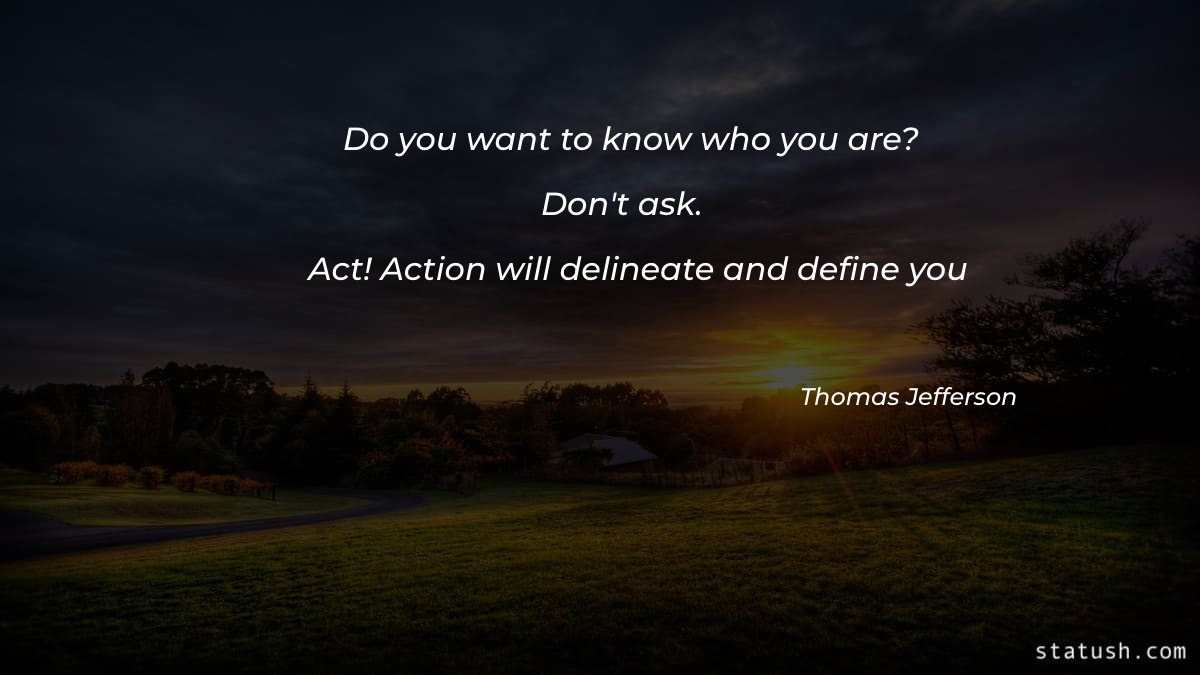
Do you want to know who you are? Don't ask. Act! Action will delineate and define you.
The Meaning: Knowledge is framed as something that changes behavior, not something you collect like trophies. If a sentence is true but does not shift what you notice or do, it has not finished its work.
7. On Truth and Integrity
I'm a great believer in luck and I find the harder I work, the more I have of it.
The Meaning: Truth here is less about moral purity and more about contact with reality. The line suggests that self-deception is expensive: it buys comfort today and confusion tomorrow. Clarity is often uncomfortable, but it is navigable.
8. On Thought and Judgment
Reason and free inquiry are the only effectual agents against error.
The Meaning: Freedom is rarely the absence of limits; it is the ability to choose your constraints. The meaning is that responsibility and freedom are paired: the more you own, the more options you can steer.
9. On Truth
Don't talk about what you have done or what you are going to do.
The Meaning: This line from Thomas Jefferson compresses a lived tension into a single readable moment. Read it slowly: it is not asking you to agree, but to notice where the same pattern shows up in your own life. If you take it seriously, it becomes a test—what would you change if this were reliably true for you?
10. On Truth and Integrity
Honesty is the first chapter in the book of wisdom.
The Meaning: Truth here is less about moral purity and more about contact with reality. The line suggests that self-deception is expensive: it buys comfort today and confusion tomorrow. Clarity is often uncomfortable, but it is navigable.