Here are 10 of the most insightful quotes attributed to Rosa Parks, and the logic behind them.
1. On Time and Memory
While the likes of King and Rosa Parks are now celebrated for their acts of defiance, their protests were no less controversial at the time, even within the civil-rights movement.
The Meaning: Time is treated as something you cannot store—only spend. The meaning is that urgency and patience are both strategies; the quote asks which one matches the stakes. If you feel rushed, check whether the deadline is real or inherited.
2. On People and Relationships
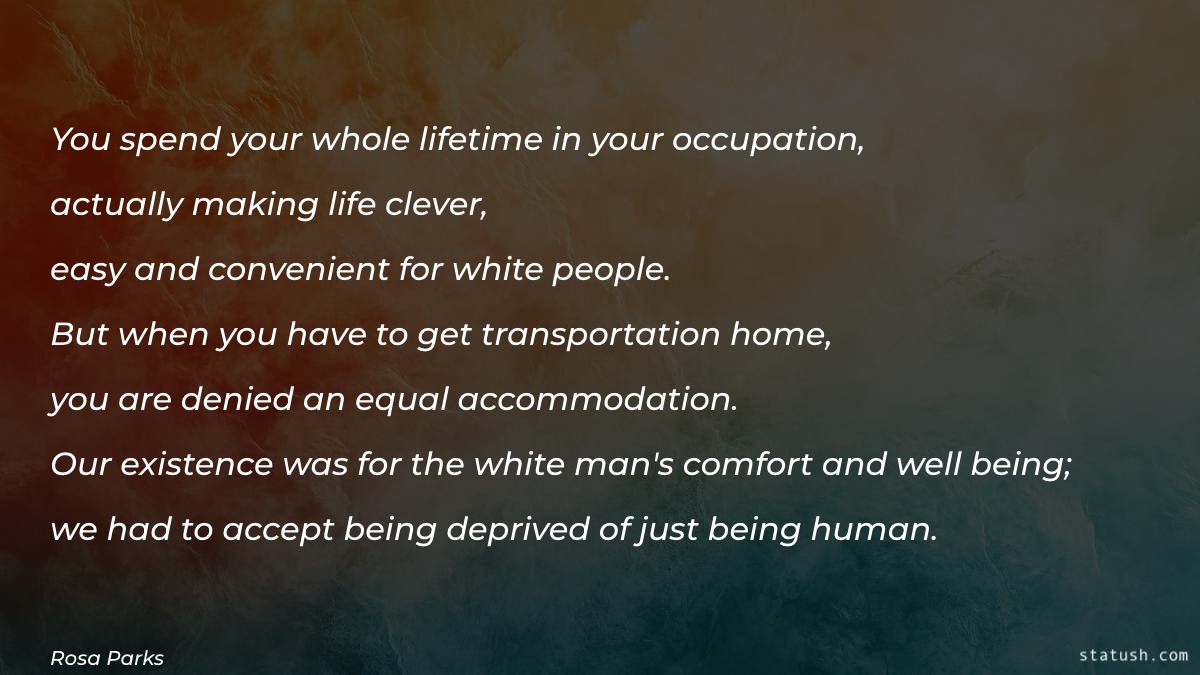
Actually, no one can understand the action of Mrs. Parks unless he realizes that eventually the cup of endurance runs over, and the human personality cries out, 'I can take it no longer.'
The Meaning: This line from Rosa Parks compresses a lived tension into a single readable moment. Read it slowly: it is not asking you to agree, but to notice where the same pattern shows up in your own life. If you take it seriously, it becomes a test—what would you change if this were reliably true for you?
3. On Courage
One element of imperial history is that events tend to be seen as caused by extraordinary personalities acting on one another without showing us the social roots and contexts of those actions.
The Meaning: This line from Rosa Parks compresses a lived tension into a single readable moment. Read it slowly: it is not asking you to agree, but to notice where the same pattern shows up in your own life. If you take it seriously, it becomes a test—what would you change if this were reliably true for you?
4. On Perspective
I'd see the bus pass every day... But to me, that was a way of life; we had no choice but to accept what was the custom. The bus was among the first ways I realized there was a black world and a white world.
The Meaning: This line from Rosa Parks compresses a lived tension into a single readable moment. Read it slowly: it is not asking you to agree, but to notice where the same pattern shows up in your own life. If you take it seriously, it becomes a test—what would you change if this were reliably true for you?
5. On Truth and Integrity
But when I had to face that decision, I didn't hesitate to do so because I felt that we had endured that too long. The more we gave in, the more we complied with that kind of treatment, the more oppressive it became.
The Meaning: Truth here is less about moral purity and more about contact with reality. The line suggests that self-deception is expensive: it buys comfort today and confusion tomorrow. Clarity is often uncomfortable, but it is navigable.
6. On People and Relationships
From my upbringing and the Bible I learned people should stand up for rights just as the children of Israel stood up to the Pharaoh.
The Meaning: Knowledge is framed as something that changes behavior, not something you collect like trophies. If a sentence is true but does not shift what you notice or do, it has not finished its work.
7. On Fear and Courage
I have learned over the years that when one's mind is made up, this diminishes fear; knowing what must be done does away with fear.
The Meaning: This separates fear from paralysis. Fear can be accurate information; the failure mode is when it becomes your only information. The point is to act with fear present, not to wait until fear disappears.
8. On Truth and Integrity
Since I have always been a strong believer in God, I knew that He was with me, and only He could get me through that next step.
The Meaning: Truth here is less about moral purity and more about contact with reality. The line suggests that self-deception is expensive: it buys comfort today and confusion tomorrow. Clarity is often uncomfortable, but it is navigable.
9. On Freedom
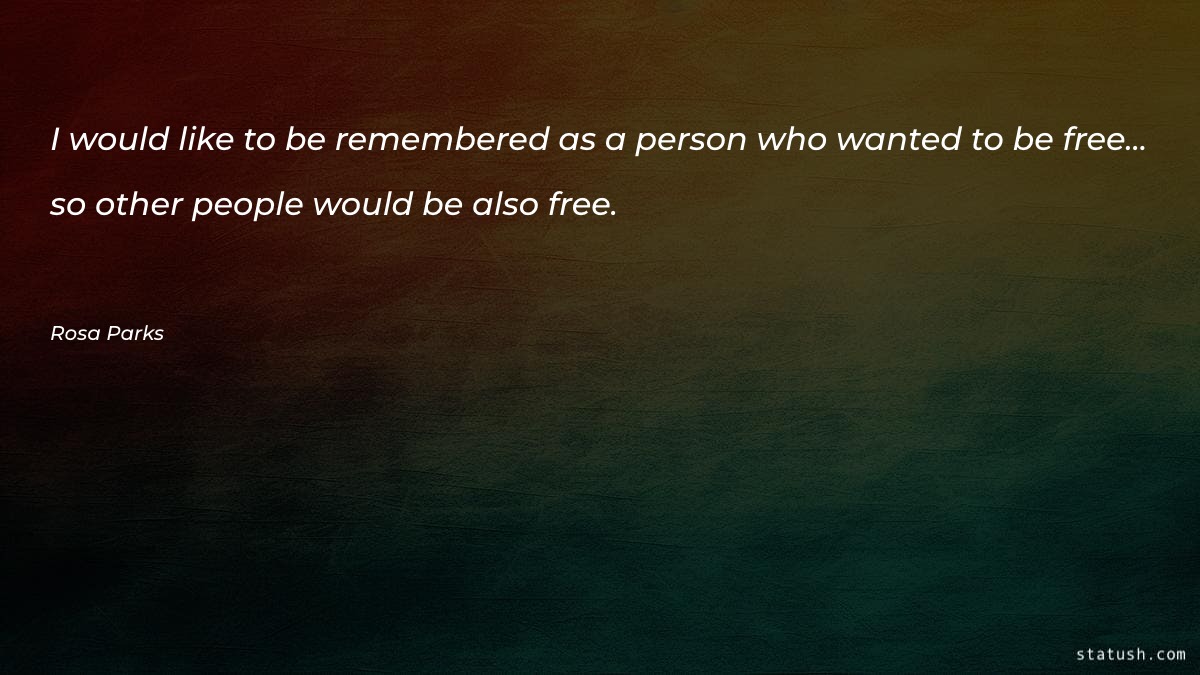
I would like to be known as a person who is concerned about freedom and equality and justice and prosperity for all people.
The Meaning: Knowledge is framed as something that changes behavior, not something you collect like trophies. If a sentence is true but does not shift what you notice or do, it has not finished its work.
10. On Fear and Courage
We didn't have any civil rights. It was just a matter of survival, of existing from one day to the next. I remember going to sleep as a girl hearing the Klan ride at night and hearing a lynching and being afraid the house would burn down.
The Meaning: This separates fear from paralysis. Fear can be accurate information; the failure mode is when it becomes your only information. The point is to act with fear present, not to wait until fear disappears.