Here are 10 of the most insightful quotes attributed to Robert Frost, and the logic behind them.
1. On Love and Devotion
Before I built a wall I'd ask to know What I was walling in or walling out, And to whom I was like to give offence. Something there is that doesn't love a wall, That wants it down.
The Meaning: This line treats emotion as something that steers decisions more than arguments do. The meaning is practical: if you ignore what you feel, you may still act—but often on autopilot. Naming the feeling is the first step toward choosing it, rather than being dragged by it.
2. On Love and Devotion
My Sorrow, when she's here with me, Thinks these dark days of autumn rain Are beautiful as days can be; She loves the bare, the withered tree; She walks the sodden pasture lane.
The Meaning: This line treats emotion as something that steers decisions more than arguments do. The meaning is practical: if you ignore what you feel, you may still act—but often on autopilot. Naming the feeling is the first step toward choosing it, rather than being dragged by it.
3. On Love and Devotion
Ah, when to the heart of man Was it ever less than a treason To go with the drift of things, To yield with a grace to reason, And bow and accept the end Of a love or a season?
The Meaning: This line treats emotion as something that steers decisions more than arguments do. The meaning is practical: if you ignore what you feel, you may still act—but often on autopilot. Naming the feeling is the first step toward choosing it, rather than being dragged by it.
4. On Perspective
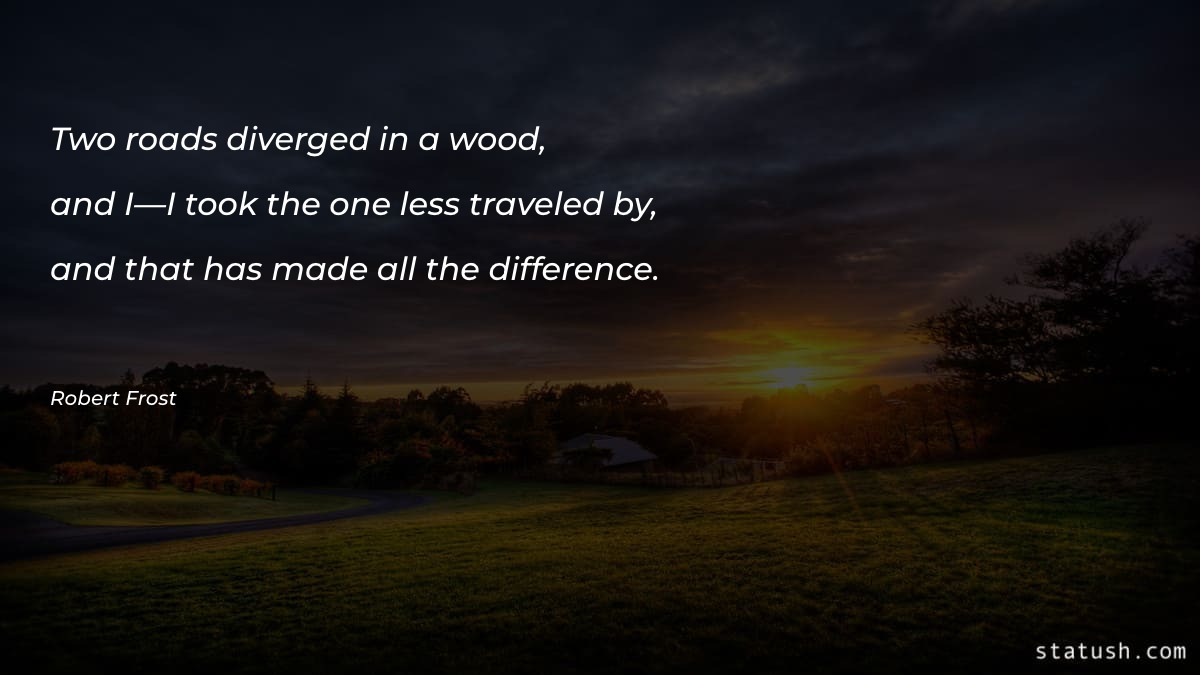
I shall be telling this with a sigh Somewhere ages and ages hence: Two roads diverged in a wood, and I — I took the one less traveled by, And that has made all the difference.
The Meaning: This line from Robert Frost compresses a lived tension into a single readable moment. Read it slowly: it is not asking you to agree, but to notice where the same pattern shows up in your own life. If you take it seriously, it becomes a test—what would you change if this were reliably true for you?
5. On Thought and Judgment
My dear, It’s who first thought the thought. You’re searching, Joe, For things that don’t exist; I mean beginnings. Ends and beginnings—there are no such things. There are only middles.
The Meaning: This line from Robert Frost compresses a lived tension into a single readable moment. Read it slowly: it is not asking you to agree, but to notice where the same pattern shows up in your own life. If you take it seriously, it becomes a test—what would you change if this were reliably true for you?
6. On Love and Devotion
Something there is that doesn’t love a wall, That sends the frozen-ground-swell under it, And spills the upper boulders in the sun; And makes gaps even two can pass abreast.
The Meaning: This line treats emotion as something that steers decisions more than arguments do. The meaning is practical: if you ignore what you feel, you may still act—but often on autopilot. Naming the feeling is the first step toward choosing it, rather than being dragged by it.
7. On Time
Her pleasure will not let me stay. She talks and I am fain to list: She's glad the birds are gone away, She's glad her simple worsted gray Is silver now with clinging mist.
The Meaning: This line from Robert Frost compresses a lived tension into a single readable moment. Read it slowly: it is not asking you to agree, but to notice where the same pattern shows up in your own life. If you take it seriously, it becomes a test—what would you change if this were reliably true for you?
8. On Learning
The bird would cease and be as other birds But that he knows in singing not to sing. The question that he frames in all but words Is what to make of a diminished thing.
The Meaning: Knowledge is framed as something that changes behavior, not something you collect like trophies. If a sentence is true but does not shift what you notice or do, it has not finished its work.
9. On People and Relationships
Tell me about it if it's something human. Let me into your grief. I'm not so much Unlike other folks as your standing there Apart would make me out. Give me my chance.
The Meaning: This line from Robert Frost compresses a lived tension into a single readable moment. Read it slowly: it is not asking you to agree, but to notice where the same pattern shows up in your own life. If you take it seriously, it becomes a test—what would you change if this were reliably true for you?
10. On Growth
I'm going out to clean the pasture spring; I'll only stop to rake the leaves away (And wait to watch the water clear, I may): I sha'n't be gone long. — You come too.
The Meaning: This line from Robert Frost compresses a lived tension into a single readable moment. Read it slowly: it is not asking you to agree, but to notice where the same pattern shows up in your own life. If you take it seriously, it becomes a test—what would you change if this were reliably true for you?