Here are 10 of the most insightful quotes attributed to Oscar Wilde, and the logic behind them.
1. On Fear and Courage
I cannot understand your nature. If my nature had been made to suit your comprehension rather than my own requirements, I am afraid I would have made a very poor figure in the world.
The Meaning: This separates fear from paralysis. Fear can be accurate information; the failure mode is when it becomes your only information. The point is to act with fear present, not to wait until fear disappears.
2. On Time and Memory
For to disagree with three-fourths of the British public on all points is one of the first elements of sanity, one of the deepest consolations in all moments of spiritual doubt.
The Meaning: Time is treated as something you cannot store—only spend. The meaning is that urgency and patience are both strategies; the quote asks which one matches the stakes. If you feel rushed, check whether the deadline is real or inherited.
3. On Learning
To make a good salad is to be a brilliant diplomatist – the problem is so entirely the same in both cases. To know exactly how much oil one must put with one's vinegar.
The Meaning: Knowledge is framed as something that changes behavior, not something you collect like trophies. If a sentence is true but does not shift what you notice or do, it has not finished its work.
4. On Perspective
Why, what a wonderful piece of luck! Here is a red rose! I have never seen any rose like it in all my life. It is so beautiful that I am sure it has a long Latin name.
The Meaning: This line from Oscar Wilde compresses a lived tension into a single readable moment. Read it slowly: it is not asking you to agree, but to notice where the same pattern shows up in your own life. If you take it seriously, it becomes a test—what would you change if this were reliably true for you?
5. On Creativity
Art finds her own perfection within, and not outside of herself. She is not to be judged by any external standard of resemblance. She is a veil, rather than a mirror.
The Meaning: This line from Oscar Wilde compresses a lived tension into a single readable moment. Read it slowly: it is not asking you to agree, but to notice where the same pattern shows up in your own life. If you take it seriously, it becomes a test—what would you change if this were reliably true for you?
6. On Creativity
The more we study Art, the less we care for Nature. What Art really reveals to us is Nature's lack of design, her curious crudities, her extraordinary monotony, her absolutely unfinished condition.
The Meaning: This line from Oscar Wilde compresses a lived tension into a single readable moment. Read it slowly: it is not asking you to agree, but to notice where the same pattern shows up in your own life. If you take it seriously, it becomes a test—what would you change if this were reliably true for you?
7. On Thought and Judgment
Most modern calendars mar the sweet simplicity of our lives by reminding us that each day that passes is the anniversary of some perfectly uninteresting event.
The Meaning: This line from Oscar Wilde compresses a lived tension into a single readable moment. Read it slowly: it is not asking you to agree, but to notice where the same pattern shows up in your own life. If you take it seriously, it becomes a test—what would you change if this were reliably true for you?
8. On People and Relationships
People who count their chickens before they are hatched act very wisely because chickens run about so absurdly that it's impossible to count them accurately...
The Meaning: This line from Oscar Wilde compresses a lived tension into a single readable moment. Read it slowly: it is not asking you to agree, but to notice where the same pattern shows up in your own life. If you take it seriously, it becomes a test—what would you change if this were reliably true for you?
9. On Creativity
And, after all, what is a fashion? From the artistic point of view, it is usually a form of ugliness so intolerable that we have to alter it every six months.
The Meaning: This line from Oscar Wilde compresses a lived tension into a single readable moment. Read it slowly: it is not asking you to agree, but to notice where the same pattern shows up in your own life. If you take it seriously, it becomes a test—what would you change if this were reliably true for you?
10. On Love and Devotion
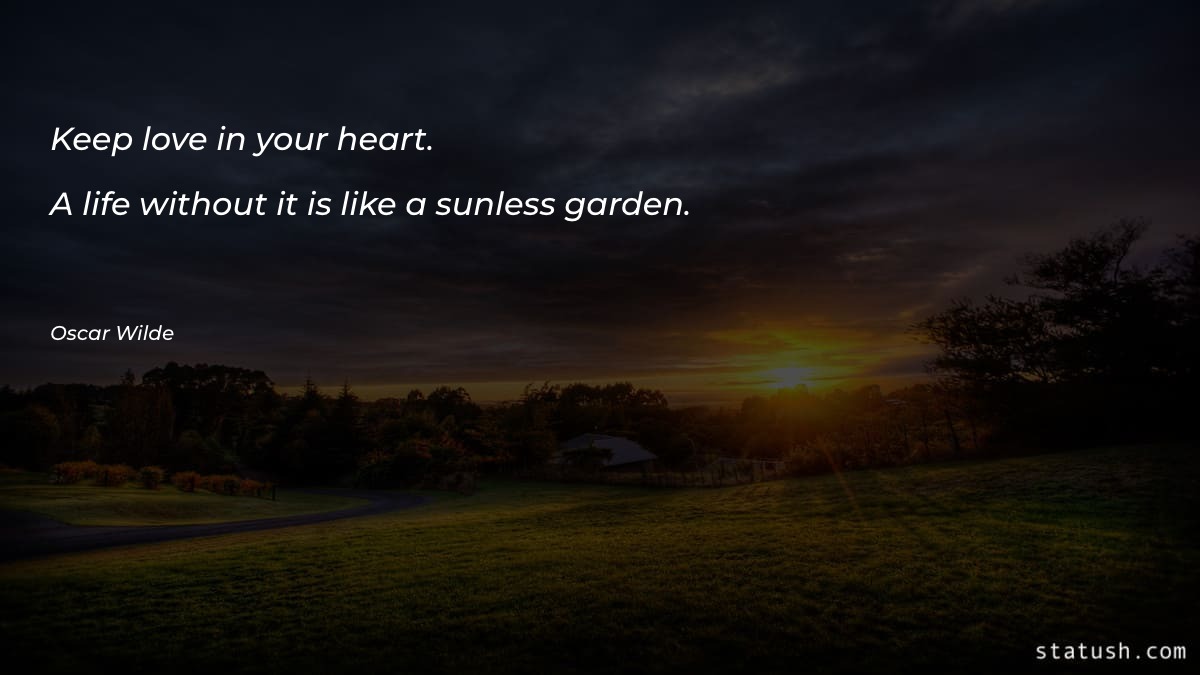
Keep love in your heart. A life without it is like a sunless garden when the flowers are dead. The consciousness of loving and being loved brings warmth and richness to life that nothing else can bring.
The Meaning: This line treats emotion as something that steers decisions more than arguments do. The meaning is practical: if you ignore what you feel, you may still act—but often on autopilot. Naming the feeling is the first step toward choosing it, rather than being dragged by it.