Here are 10 of the most insightful quotes attributed to Marie Curie, and the logic behind them.
1. On Freedom
Even so, a well-organized society should assure to such workers the efficient means of accomplishing their task, in a life freed from material care and freely consecrated to research.
The Meaning: Freedom is rarely the absence of limits; it is the ability to choose your constraints. The meaning is that responsibility and freedom are paired: the more you own, the more options you can steer.
2. On Time and Memory
Suffice it to say that in 1885, she went to the employment office to look for work, due to the financial difficulties her family was experiencing at the time, and found a job as a governess.
The Meaning: Time is treated as something you cannot store—only spend. The meaning is that urgency and patience are both strategies; the quote asks which one matches the stakes. If you feel rushed, check whether the deadline is real or inherited.
3. On Courage
... The activity of the specimens thus served as a basis of rough qualitative and quantitative analysis, analogous in some respects to the indication of the spectroscope.
The Meaning: This line from Marie Curie compresses a lived tension into a single readable moment. Read it slowly: it is not asking you to agree, but to notice where the same pattern shows up in your own life. If you take it seriously, it becomes a test—what would you change if this were reliably true for you?
4. On Perspective
The name radium was a very happy inspiration of the discoverers, for this substance in the pure state possesses the property of radio-activity to an astonishing degree.
The Meaning: This line from Marie Curie compresses a lived tension into a single readable moment. Read it slowly: it is not asking you to agree, but to notice where the same pattern shows up in your own life. If you take it seriously, it becomes a test—what would you change if this were reliably true for you?
5. On Truth and Integrity
Life is not easy for any of us. But what of that? We must have perseverance and above all confidence in ourselves. We must believe that we are gifted for something, and that this thing, at whatever cost, must be attained.
The Meaning: Truth here is less about moral purity and more about contact with reality. The line suggests that self-deception is expensive: it buys comfort today and confusion tomorrow. Clarity is often uncomfortable, but it is navigable.
6. On Relationships
In the 1970s we were rediscovering women whose lives had been dropped out of history or distorted, like Susan B. Anthony, Harriet Tubman, Emily Dickinson, Marie Curie, Ida B. Wells-Barnett, Hannah Senesch, Ethel Rosenberg.
The Meaning: This line from Marie Curie compresses a lived tension into a single readable moment. Read it slowly: it is not asking you to agree, but to notice where the same pattern shows up in your own life. If you take it seriously, it becomes a test—what would you change if this were reliably true for you?
7. On Truth and Integrity
Neither do I believe that the spirit of adventure runs any risk of disappearing in our world. If I see anything vital around me, it is precisely that spirit of adventure, which seems indestructible and is akin to curiosity.
The Meaning: Truth here is less about moral purity and more about contact with reality. The line suggests that self-deception is expensive: it buys comfort today and confusion tomorrow. Clarity is often uncomfortable, but it is navigable.
8. On Love and Devotion
Marie Curie was at heart a Baconian, boiling tons of crude uranium ore to demolish the dogma of the indestructibility of atoms.
The Meaning: This line treats emotion as something that steers decisions more than arguments do. The meaning is practical: if you ignore what you feel, you may still act—but often on autopilot. Naming the feeling is the first step toward choosing it, rather than being dragged by it.
9. On Fear and Courage
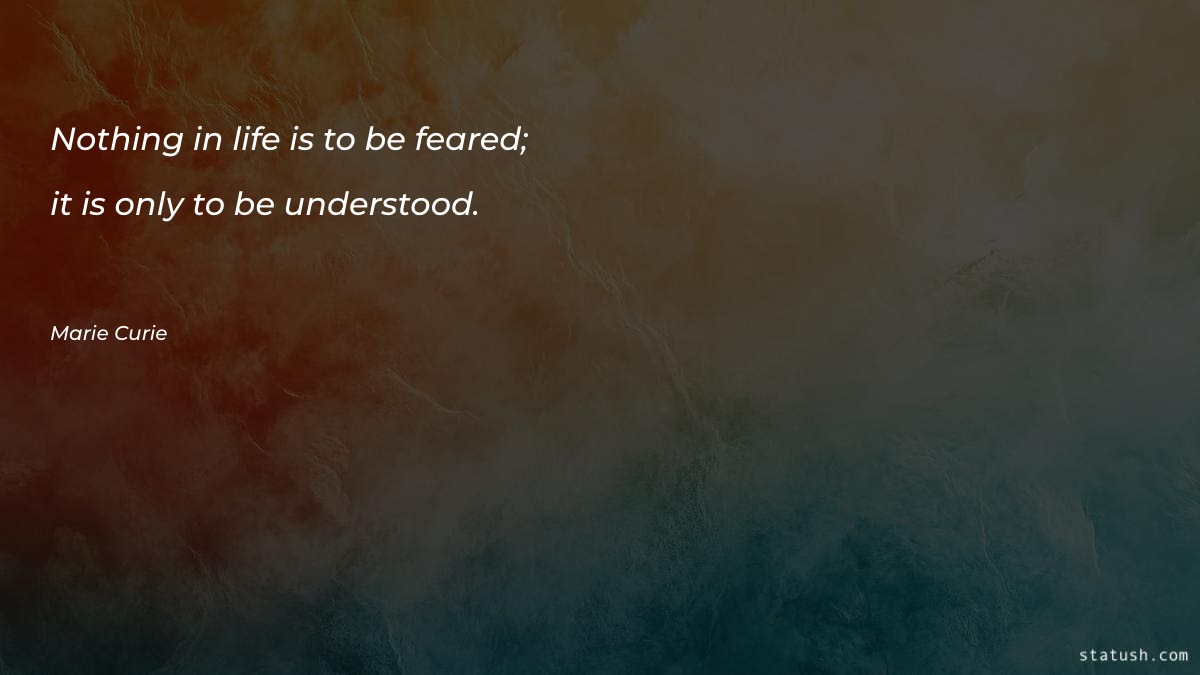
Nothing in life is to be feared, it is only to be understood. Now is the time to understand more, so that we may fear less.
The Meaning: Time is treated as something you cannot store—only spend. The meaning is that urgency and patience are both strategies; the quote asks which one matches the stakes. If you feel rushed, check whether the deadline is real or inherited.
10. On Thought and Judgment
I am one of those who think like Nobel, that humanity will draw more good than evil from new discoveries.
The Meaning: This line from Marie Curie compresses a lived tension into a single readable moment. Read it slowly: it is not asking you to agree, but to notice where the same pattern shows up in your own life. If you take it seriously, it becomes a test—what would you change if this were reliably true for you?