Here are 10 of the most insightful quotes attributed to Mahatma Gandhi, and the logic behind them.
1. On Thought and Judgment
It is unwise to be too sure of one's own wisdom. It is healthy to be reminded that the strongest might weaken and the wisest might err.
The Meaning: Knowledge is framed as something that changes behavior, not something you collect like trophies. If a sentence is true but does not shift what you notice or do, it has not finished its work.
2. On Clarity
The difference between what we do and what we are capable of doing would suffice to solve most of the world's problems.
The Meaning: This line from Mahatma Gandhi compresses a lived tension into a single readable moment. Read it slowly: it is not asking you to agree, but to notice where the same pattern shows up in your own life. If you take it seriously, it becomes a test—what would you change if this were reliably true for you?
3. On Truth and Integrity
Our greatness lies not so much in being able to remake the world as being able to remake ourselves.
The Meaning: Truth here is less about moral purity and more about contact with reality. The line suggests that self-deception is expensive: it buys comfort today and confusion tomorrow. Clarity is often uncomfortable, but it is navigable.
4. On Perspective
Strength does not come from physical capacity. It comes from an indomitable will.
The Meaning: This line from Mahatma Gandhi compresses a lived tension into a single readable moment. Read it slowly: it is not asking you to agree, but to notice where the same pattern shows up in your own life. If you take it seriously, it becomes a test—what would you change if this were reliably true for you?
5. On Thought and Judgment
Happiness is when what you think, what you say, and what you do are in harmony.
The Meaning: This line from Mahatma Gandhi compresses a lived tension into a single readable moment. Read it slowly: it is not asking you to agree, but to notice where the same pattern shows up in your own life. If you take it seriously, it becomes a test—what would you change if this were reliably true for you?
6. On Love and Devotion
Forgiveness is choosing to love. It is the first skill of self-giving love.
The Meaning: This line treats emotion as something that steers decisions more than arguments do. The meaning is practical: if you ignore what you feel, you may still act—but often on autopilot. Naming the feeling is the first step toward choosing it, rather than being dragged by it.
7. On Time
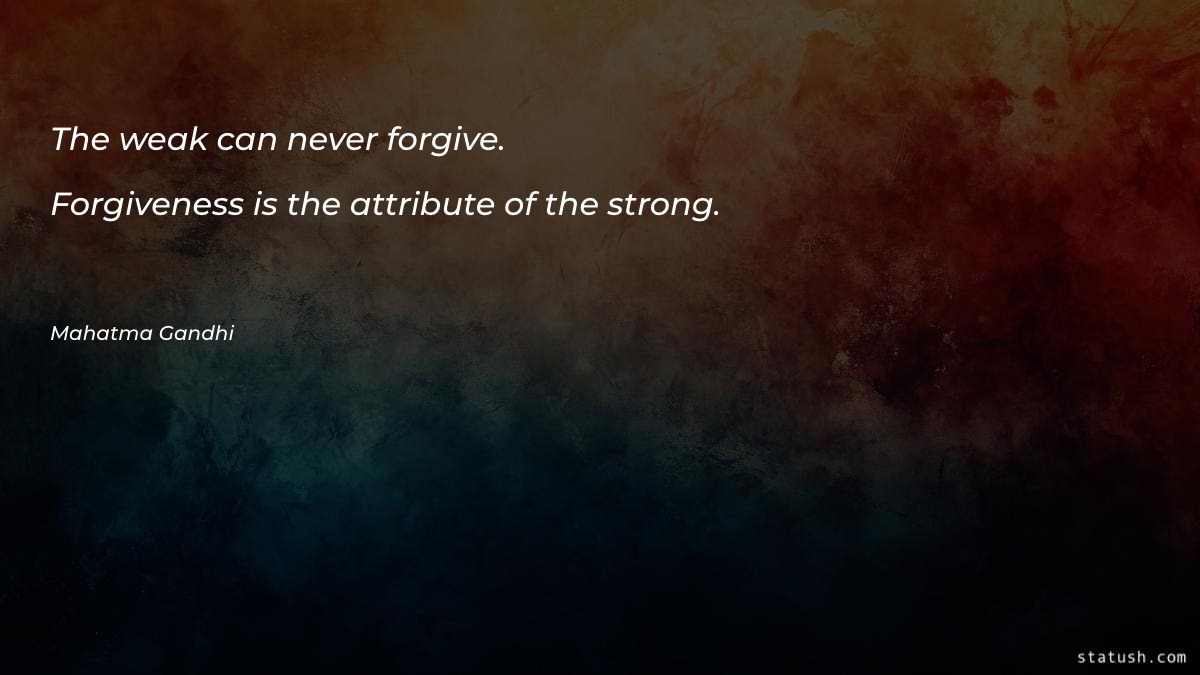
The weak can never forgive. Forgiveness is the attribute of the strong.
The Meaning: This line from Mahatma Gandhi compresses a lived tension into a single readable moment. Read it slowly: it is not asking you to agree, but to notice where the same pattern shows up in your own life. If you take it seriously, it becomes a test—what would you change if this were reliably true for you?
8. On Faith and Meaning
It is the quality of our work which will please God, not the quantity.
The Meaning: This line from Mahatma Gandhi compresses a lived tension into a single readable moment. Read it slowly: it is not asking you to agree, but to notice where the same pattern shows up in your own life. If you take it seriously, it becomes a test—what would you change if this were reliably true for you?
9. On Freedom
Freedom is not worth having if it does not connote freedom to err.
The Meaning: Freedom is rarely the absence of limits; it is the ability to choose your constraints. The meaning is that responsibility and freedom are paired: the more you own, the more options you can steer.
10. On Growth
Be the change that you want to see in the world.
The Meaning: This line from Mahatma Gandhi compresses a lived tension into a single readable moment. Read it slowly: it is not asking you to agree, but to notice where the same pattern shows up in your own life. If you take it seriously, it becomes a test—what would you change if this were reliably true for you?