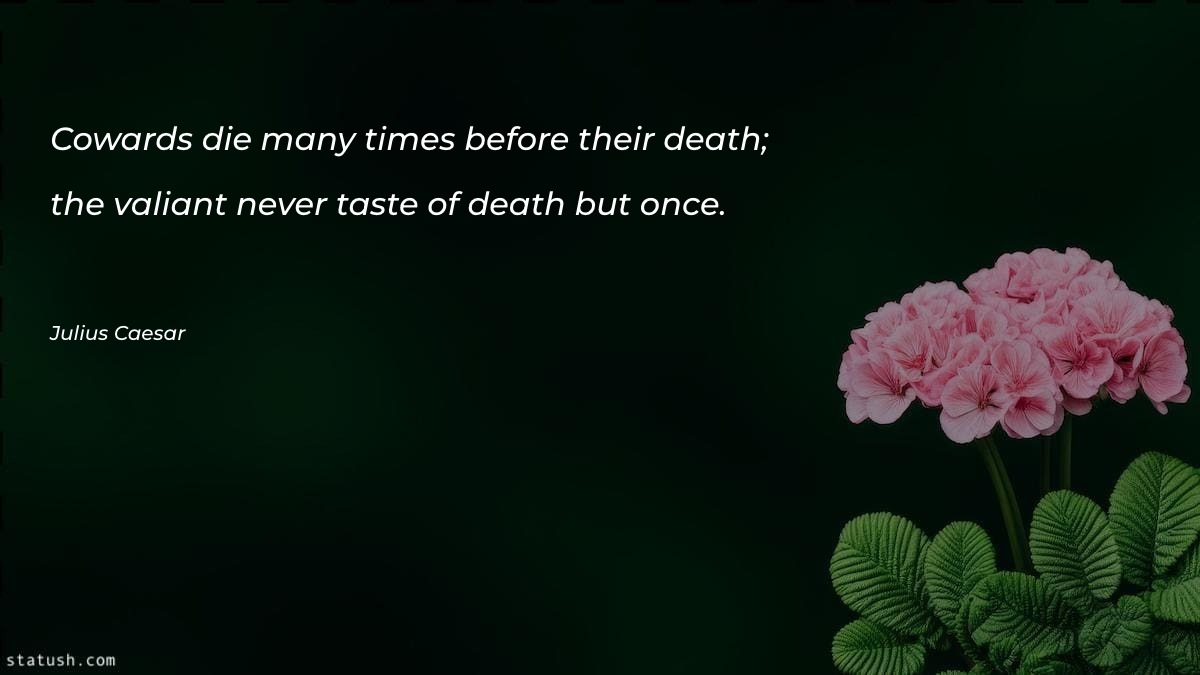
Here are 10 of the most insightful quotes attributed to Julius Caesar, and the logic behind them.
1. On Character
He was full of the ideas taught in the schools of Greece against tyranny; the assassination of every man who actually stood above the laws was regarded as a legitimate action.
The Meaning: This line from Julius Caesar compresses a lived tension into a single readable moment. Read it slowly: it is not asking you to agree, but to notice where the same pattern shows up in your own life. If you take it seriously, it becomes a test—what would you change if this were reliably true for you?
2. On Mortality
Consuesse enim deos immortales, quo gravius homines ex commutatione rerum doleant, quos pro scelere eorum ulcisci velint, his secundiores interdum res et diuturniorem impunitatem concedere.
The Meaning: This line from Julius Caesar compresses a lived tension into a single readable moment. Read it slowly: it is not asking you to agree, but to notice where the same pattern shows up in your own life. If you take it seriously, it becomes a test—what would you change if this were reliably true for you?
3. On Fear and Courage
Rather, the citizenry, infused with fear and blinded by patriotism, will offer up all of their rights unto the leader and gladly so. How do I know? For this is what I have done. And I am Caesar.
The Meaning: This separates fear from paralysis. Fear can be accurate information; the failure mode is when it becomes your only information. The point is to act with fear present, not to wait until fear disappears.
4. On Perspective
[Of England] the coastal areas are inhabited by invaders who crossed from Belgica…settled there…all kept the names of the tribes from where they originated.
The Meaning: This line from Julius Caesar compresses a lived tension into a single readable moment. Read it slowly: it is not asking you to agree, but to notice where the same pattern shows up in your own life. If you take it seriously, it becomes a test—what would you change if this were reliably true for you?
5. On Conflict and Power
Caesar addressed the sol- diers, appealing to their loyalty, with tears, and ripping the garments from his breast. As translated by Catherine Edwards (2000)
The Meaning: This is a warning about escalation: once violence becomes the grammar of a conflict, everyone starts speaking it fluently. The deeper point is that the tools you use to win also train the world in how to fight you next time.
6. On Time and Memory
Sed fortuna, quae plurimum potest cum in reliquis rebus tum praecipue in bello, parvis momentis magnas rerum commutationes efficit; ut tum accidit.
The Meaning: Time is treated as something you cannot store—only spend. The meaning is that urgency and patience are both strategies; the quote asks which one matches the stakes. If you feel rushed, check whether the deadline is real or inherited.
7. On Time
With him I can, indeed, compare you [Mark Antony] as to your desire to reign; but in all other respects you are in no degree to be compared to him.
The Meaning: This line from Julius Caesar compresses a lived tension into a single readable moment. Read it slowly: it is not asking you to agree, but to notice where the same pattern shows up in your own life. If you take it seriously, it becomes a test—what would you change if this were reliably true for you?
8. On Thought and Judgment
We may still draw back but, once across that little bridge, we shall have to fight it out As he stood, in two minds, an apparition of superhuman size and beauty was seen sitting on the river bank playing a reed pipe.
The Meaning: This line from Julius Caesar compresses a lived tension into a single readable moment. Read it slowly: it is not asking you to agree, but to notice where the same pattern shows up in your own life. If you take it seriously, it becomes a test—what would you change if this were reliably true for you?
9. On Truth
Ἑλληνιστὶ πρὸς τοὺς παρόντας ἐκβοήσας, Ἀνερρίφθω κύβος, [anerrhíphtho kúbos] διεβίβαζε τὸν στρατόν. He [Caesar] declared in Greek with loud voice to those who were present 'Let the die be cast' and led the army across.
The Meaning: This line from Julius Caesar compresses a lived tension into a single readable moment. Read it slowly: it is not asking you to agree, but to notice where the same pattern shows up in your own life. If you take it seriously, it becomes a test—what would you change if this were reliably true for you?
10. On Success and Effort
Acer, et indomitus: quo spes, quoque ira vocasset, Ferre manum, et nunquam temerando parcere ferro:Successus urgere suos: instare favori Numinis: impellens quicquid sibi summa petenti Obstaret: gaudensque viam fecisse ruina.
The Meaning: This reframes outcomes as feedback rather than verdicts. Success can hide weak processes; failure can reveal strong ones—if you study it. The meaning is to keep your identity separate from any single result.