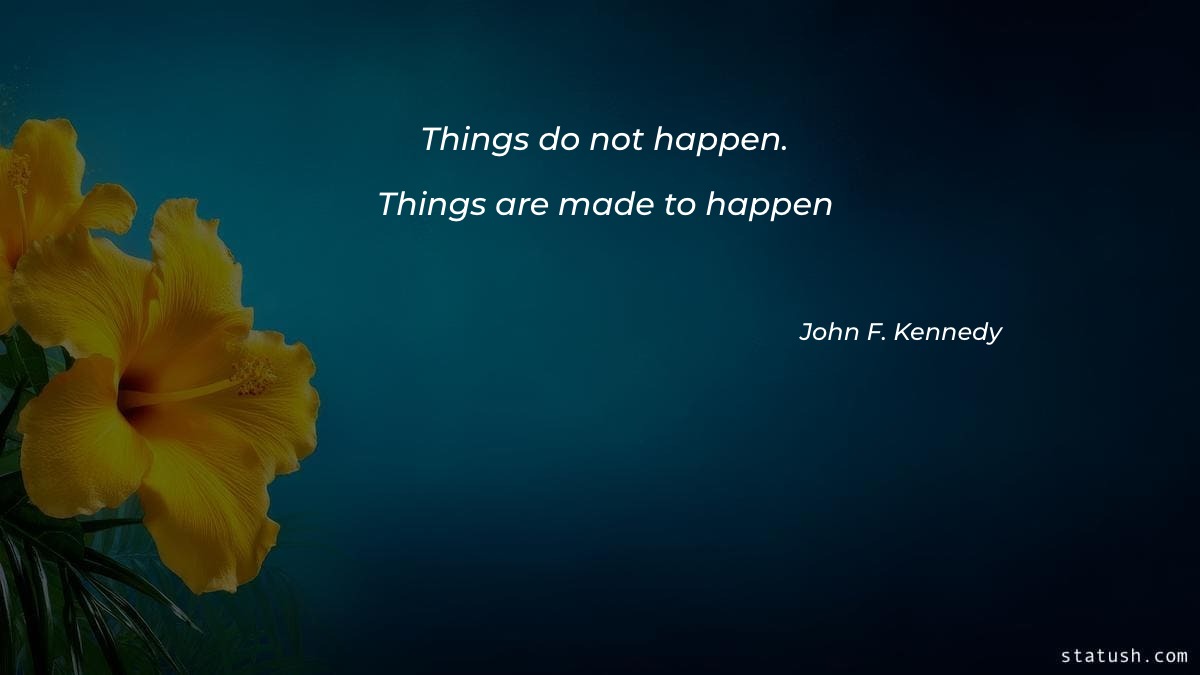
Here are 10 of the most insightful quotes attributed to John F. Kennedy, and the logic behind them.
1. On Thought and Judgment
I can assure you that every degree of mind and spirit that I possess will be devoted to the long-range interests of the United States and to the cause of freedom around the world.
The Meaning: Freedom is rarely the absence of limits; it is the ability to choose your constraints. The meaning is that responsibility and freedom are paired: the more you own, the more options you can steer.
2. On Fear and Courage
Their platform, made up of left-over Democratic planks, has the courage of our old convictions. Their pledge is a pledge to the status quo — and today there can be no status quo.
The Meaning: This separates fear from paralysis. Fear can be accurate information; the failure mode is when it becomes your only information. The point is to act with fear present, not to wait until fear disappears.
3. On Courage
We have all seen these circus elephants complete with tusks, ivory in their head and thick skins, who move around the circus ring and grab the tail of the elephant ahead of them.
The Meaning: This line from John F. Kennedy compresses a lived tension into a single readable moment. Read it slowly: it is not asking you to agree, but to notice where the same pattern shows up in your own life. If you take it seriously, it becomes a test—what would you change if this were reliably true for you?
4. On Hope and Vision
Are we willing to match the Russian sacrifice of the present for the future — or must we sacrifice our future in order to enjoy the present? That is the question of the New Frontier.
The Meaning: This line from John F. Kennedy compresses a lived tension into a single readable moment. Read it slowly: it is not asking you to agree, but to notice where the same pattern shows up in your own life. If you take it seriously, it becomes a test—what would you change if this were reliably true for you?
5. On Discipline
I have just received the following wire from my generous daddy: Dear Jack – Don’t buy a single vote more than necessary – I’ll be damned if I am going to pay for a landslide.
The Meaning: This line from John F. Kennedy compresses a lived tension into a single readable moment. Read it slowly: it is not asking you to agree, but to notice where the same pattern shows up in your own life. If you take it seriously, it becomes a test—what would you change if this were reliably true for you?
6. On Conflict and Power
These are the real issues which should decide this campaign. And they are not religious issues — for war and hunger and ignorance and despair know no religious barriers.
The Meaning: This is a warning about escalation: once violence becomes the grammar of a conflict, everyone starts speaking it fluently. The deeper point is that the tools you use to win also train the world in how to fight you next time.
7. On Conflict and Power
I look forward to a great future for America - a future in which our country will match its military strength with our moral restraint, its wealth with our wisdom, its power with our purpose.
The Meaning: This is a warning about escalation: once violence becomes the grammar of a conflict, everyone starts speaking it fluently. The deeper point is that the tools you use to win also train the world in how to fight you next time.
8. On Action
But the question is how we will compromise and with whom. For it is easy to seize upon unnecessary concessions, not as means of legitimately resolving conflicts but as methods of going along.
The Meaning: This line from John F. Kennedy compresses a lived tension into a single readable moment. Read it slowly: it is not asking you to agree, but to notice where the same pattern shows up in your own life. If you take it seriously, it becomes a test—what would you change if this were reliably true for you?
9. On Truth
That requires only one kind of defense policy, a policy summed up in a single word first. I do not mean first, if, I do not mean first, but, I do not mean first, when, but I mean First, period.
The Meaning: This line from John F. Kennedy compresses a lived tension into a single readable moment. Read it slowly: it is not asking you to agree, but to notice where the same pattern shows up in your own life. If you take it seriously, it becomes a test—what would you change if this were reliably true for you?
10. On Growth
As we face the coming challenge, we too, shall wait upon the Lord, and ask that he renew our strength. Then shall we be equal to the test. Then we shall not be weary. And then we shall prevail.
The Meaning: This line from John F. Kennedy compresses a lived tension into a single readable moment. Read it slowly: it is not asking you to agree, but to notice where the same pattern shows up in your own life. If you take it seriously, it becomes a test—what would you change if this were reliably true for you?