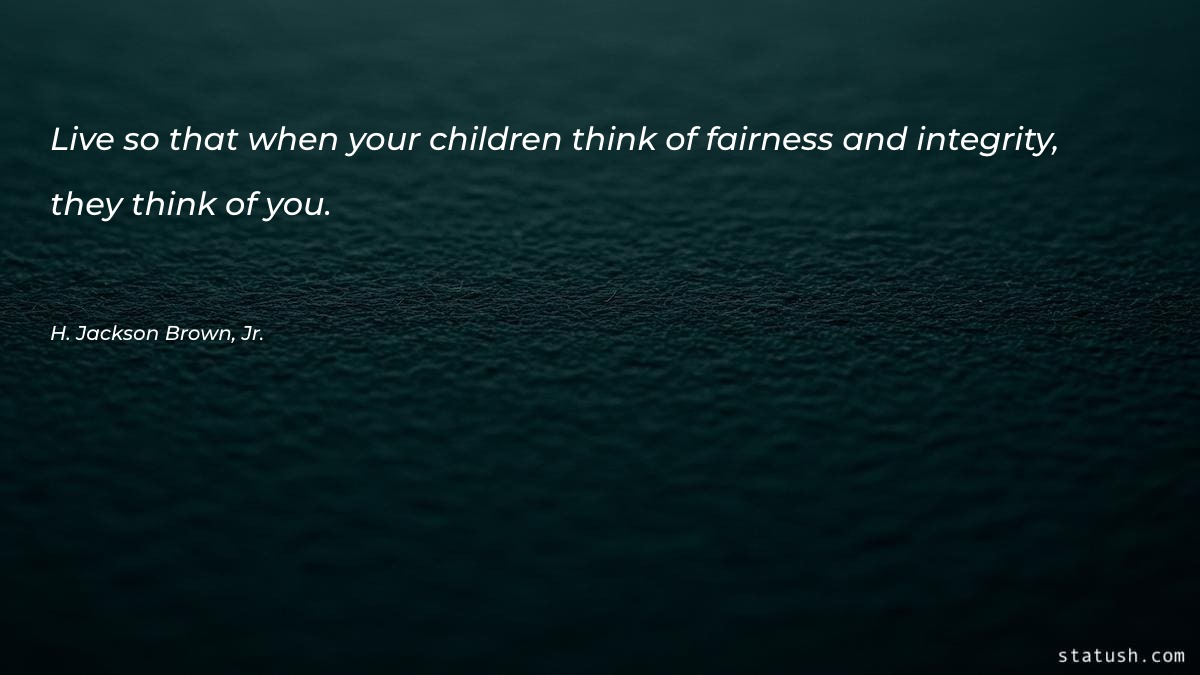
Here are 10 of the most insightful quotes attributed to H. Jackson Brown, Jr., and the logic behind them.
1. On Creativity
With the law books filled with a great assortment of crimes, a prosecutor stands a fair chance of finding at least a technical violation of some act on the part of almost anyone.
The Meaning: This line from H. Jackson Brown, Jr. compresses a lived tension into a single readable moment. Read it slowly: it is not asking you to agree, but to notice where the same pattern shows up in your own life. If you take it seriously, it becomes a test—what would you change if this were reliably true for you?
2. On Creativity
As to ethics, the parties seem to me as much on a parity as the pot and the kettle. But want of knowledge or innocent intent is not ordinarily available to diminish patent protection.
The Meaning: Knowledge is framed as something that changes behavior, not something you collect like trophies. If a sentence is true but does not shift what you notice or do, it has not finished its work.
3. On Freedom
They are dangerous to civil liberty because the prosecutor has no definite standards to determine what constitutes a subversive activity, such as we have for murder or larceny.
The Meaning: Freedom is rarely the absence of limits; it is the ability to choose your constraints. The meaning is that responsibility and freedom are paired: the more you own, the more options you can steer.
4. On Creativity
It was these dead men whom these living chose to be their partners in this great conspiratorial brotherhood, and the crimes that they did together they must pay for one by one.
The Meaning: This line from H. Jackson Brown, Jr. compresses a lived tension into a single readable moment. Read it slowly: it is not asking you to agree, but to notice where the same pattern shows up in your own life. If you take it seriously, it becomes a test—what would you change if this were reliably true for you?
5. On Conflict and Power
Nothing in our Constitution is plainer than that declaration of a war is entrusted only to Congress. Of course, a state of war may in fact exist without a formal declaration.
The Meaning: This is a warning about escalation: once violence becomes the grammar of a conflict, everyone starts speaking it fluently. The deeper point is that the tools you use to win also train the world in how to fight you next time.
6. On Time and Memory
When the Court has gone too far, it has provoked reactions which have set back the cause it is designed to advance and has sometimes called down upon itself severe rebuke.
The Meaning: Time is treated as something you cannot store—only spend. The meaning is that urgency and patience are both strategies; the quote asks which one matches the stakes. If you feel rushed, check whether the deadline is real or inherited.
7. On Freedom
No penance would ever expiate the sin against free government of holding that a President can escape control of executive powers by law through assuming his military role.
The Meaning: Freedom is rarely the absence of limits; it is the ability to choose your constraints. The meaning is that responsibility and freedom are paired: the more you own, the more options you can steer.
8. On Action
To promote uniformity of policy and action, to establish some standards of performance, and to make available specialized help, some degree of centralized administration was found necessary.
The Meaning: This line from H. Jackson Brown, Jr. compresses a lived tension into a single readable moment. Read it slowly: it is not asking you to agree, but to notice where the same pattern shows up in your own life. If you take it seriously, it becomes a test—what would you change if this were reliably true for you?
9. On Thought and Judgment
I am entitled to say of that opinion what any discriminating reader must think of it — that it was as foggy as the statute the [[Attorney General was asked to interpret.
The Meaning: This line from H. Jackson Brown, Jr. compresses a lived tension into a single readable moment. Read it slowly: it is not asking you to agree, but to notice where the same pattern shows up in your own life. If you take it seriously, it becomes a test—what would you change if this were reliably true for you?
10. On Faith and Meaning
Civil liberties had their origin and must find their ultimate guaranty in the faith of the people. If that faith should be lost, five or nine men in Washington could not long supply its want.
The Meaning: This line from H. Jackson Brown, Jr. compresses a lived tension into a single readable moment. Read it slowly: it is not asking you to agree, but to notice where the same pattern shows up in your own life. If you take it seriously, it becomes a test—what would you change if this were reliably true for you?