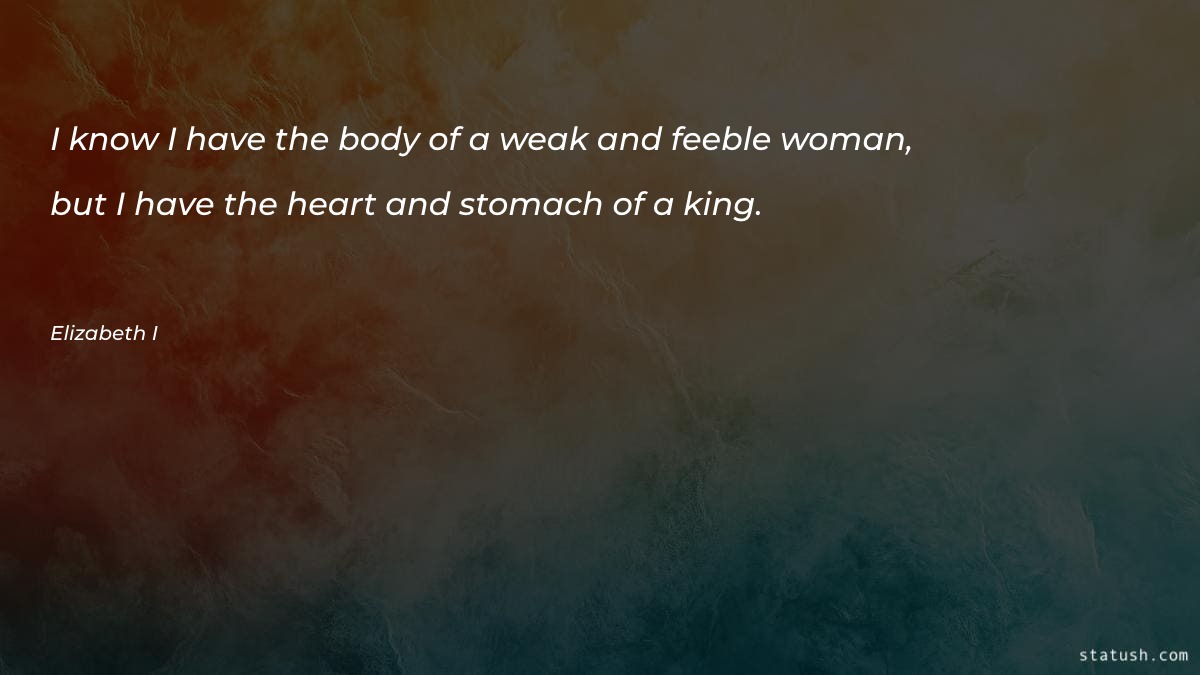
Here are 10 of the most insightful quotes attributed to Elizabeth I, and the logic behind them.
1. On Character
Whatever's lost, it first was won; We will not struggle nor impugn. Perhaps the cup was broken here, That Heaven's new wine might show more clear. I praise Thee while my days go on.
The Meaning: This line from Elizabeth I compresses a lived tension into a single readable moment. Read it slowly: it is not asking you to agree, but to notice where the same pattern shows up in your own life. If you take it seriously, it becomes a test—what would you change if this were reliably true for you?
2. On Love and Devotion
Instruct me how to thank thee! Oh, to shoot My soul's full meaning into future years, That they should lend it utterance, and salute Love that endures, from life that disappears!
The Meaning: This line treats emotion as something that steers decisions more than arguments do. The meaning is practical: if you ignore what you feel, you may still act—but often on autopilot. Naming the feeling is the first step toward choosing it, rather than being dragged by it.
3. On Courage
1992 is not a year on which I shall look back with undiluted pleasure. In the words of one of my more sympathetic correspondents, it has turned out to be an 'Annus Horribilis'.
The Meaning: This line from Elizabeth I compresses a lived tension into a single readable moment. Read it slowly: it is not asking you to agree, but to notice where the same pattern shows up in your own life. If you take it seriously, it becomes a test—what would you change if this were reliably true for you?
4. On Perspective
Thou hast thy calling to some palace-floor, Most gracious singer of high poems! where The dancers will break footing, from the care Of watching up thy pregnant lips for more.
The Meaning: This line from Elizabeth I compresses a lived tension into a single readable moment. Read it slowly: it is not asking you to agree, but to notice where the same pattern shows up in your own life. If you take it seriously, it becomes a test—what would you change if this were reliably true for you?
5. On Fear and Courage
Speak low to me, my Saviour, low and sweet, From out the hallelujahs, sweet and low, Lest I should fear, and fall, and miss Thee so, Who art not missed by any that entreat.
The Meaning: This separates fear from paralysis. Fear can be accurate information; the failure mode is when it becomes your only information. The point is to act with fear present, not to wait until fear disappears.
6. On Relationships
Do ye hear the children weeping, O my brothers, Ere the sorrow comes with years? They are leaning their young heads against their mothers—And that cannot stop their tears.
The Meaning: This line from Elizabeth I compresses a lived tension into a single readable moment. Read it slowly: it is not asking you to agree, but to notice where the same pattern shows up in your own life. If you take it seriously, it becomes a test—what would you change if this were reliably true for you?
7. On Creativity
I say, it's a cheat to start something called the Social Party. I liked the old Labour Party. The best thing is a good old Tory government with a strong Labour opposition.
The Meaning: This line from Elizabeth I compresses a lived tension into a single readable moment. Read it slowly: it is not asking you to agree, but to notice where the same pattern shows up in your own life. If you take it seriously, it becomes a test—what would you change if this were reliably true for you?
8. On Learning
Must is not a word to be used to princes! Little man, little man, if your father had lived, ye durst not have said so much: but thou knowest I must die, and that maketh thee so presumptuous.
The Meaning: Knowledge is framed as something that changes behavior, not something you collect like trophies. If a sentence is true but does not shift what you notice or do, it has not finished its work.
9. On Faith and Meaning
Here's ivy! — take them, as I used to do Thy flowers, and keep them where they shall not pine. Instruct thine eyes to keep their colours true, And tell thy soul, their roots are left in mine.
The Meaning: This line from Elizabeth I compresses a lived tension into a single readable moment. Read it slowly: it is not asking you to agree, but to notice where the same pattern shows up in your own life. If you take it seriously, it becomes a test—what would you change if this were reliably true for you?
10. On Success and Effort
The trade was so successful that it was replicated in the Barbary states of North Africa, where again English armaments were traded for gold and sugar (hence Elizabeth’s infamously bad teeth).
The Meaning: This reframes outcomes as feedback rather than verdicts. Success can hide weak processes; failure can reveal strong ones—if you study it. The meaning is to keep your identity separate from any single result.