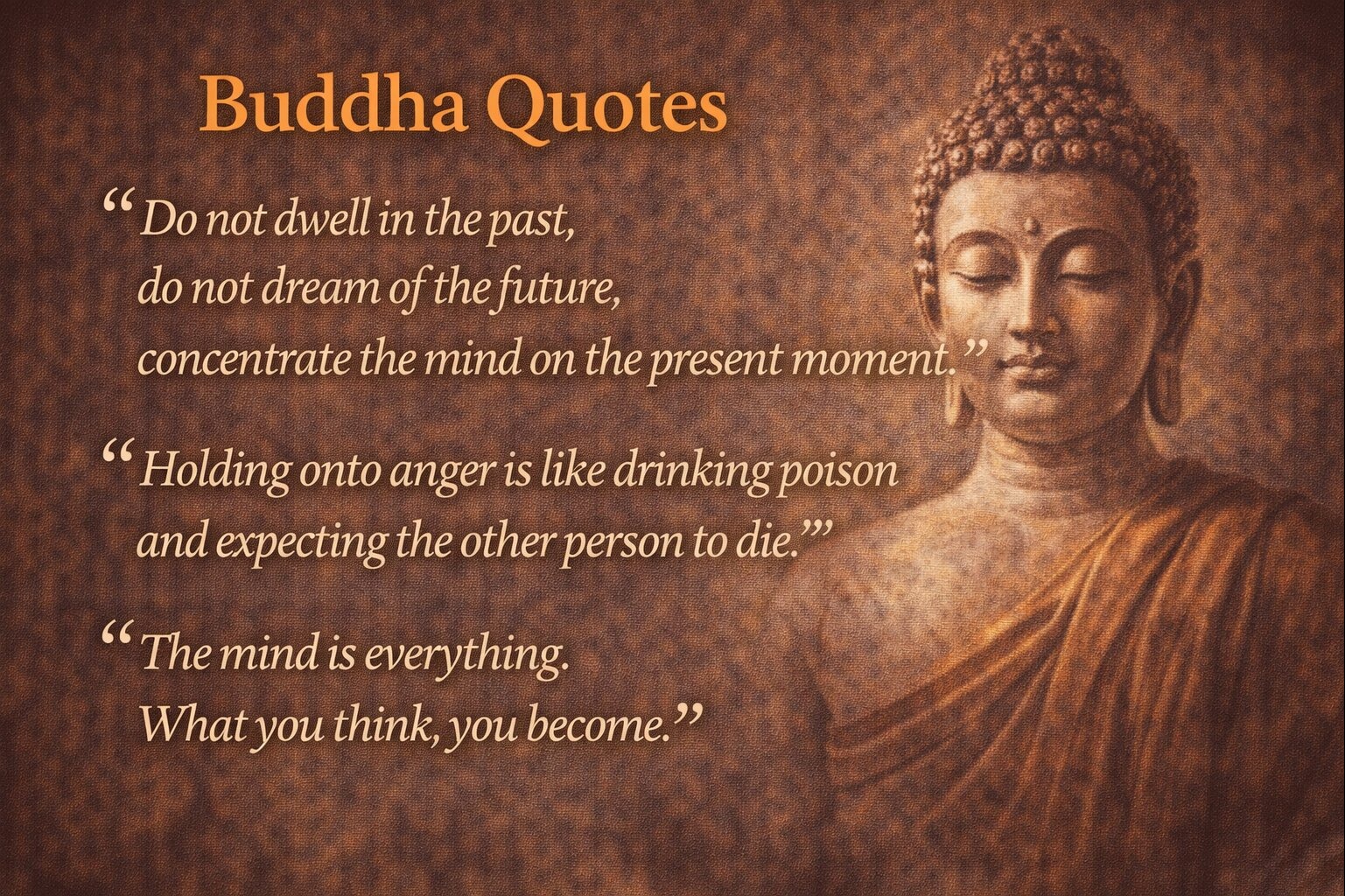
Here are 10 of the most insightful quotes attributed to Buddha, and the logic behind them.
1. On Character
That bhikkhu who has cut off passion in its entirety, like one picking a lotus, both flower and stalk, leaves this shore and the far shore as a snake leaves its old worn-out skin.
The Meaning: This line from Buddha compresses a lived tension into a single readable moment. Read it slowly: it is not asking you to agree, but to notice where the same pattern shows up in your own life. If you take it seriously, it becomes a test—what would you change if this were reliably true for you?
2. On Learning
Indeed, wisdom is born of meditation; without meditation wisdom is lost. Knowing this twofold path of gain and loss of wisdom, one should conduct oneself so that wisdom may increase.
The Meaning: Knowledge is framed as something that changes behavior, not something you collect like trophies. If a sentence is true but does not shift what you notice or do, it has not finished its work.
3. On Wealth and Value
Leaving behind son and wife, and father and mother, and wealth and grain, and relatives, and sensual pleasures to the limit, one should wander solitary as a rhinoceros horn.
The Meaning: This line from Buddha compresses a lived tension into a single readable moment. Read it slowly: it is not asking you to agree, but to notice where the same pattern shows up in your own life. If you take it seriously, it becomes a test—what would you change if this were reliably true for you?
4. On Perspective
That bhikkhu who has cut off craving in its entirety, like one drying up a fast-flowing stream, leaves this shore and the far shore as a snake leaves its old worn-out skin.
The Meaning: This line from Buddha compresses a lived tension into a single readable moment. Read it slowly: it is not asking you to agree, but to notice where the same pattern shows up in your own life. If you take it seriously, it becomes a test—what would you change if this were reliably true for you?
5. On Thought and Judgment
Develop the mind of equilibrium. You will always be getting praise and blame, but do not let either affect the poise of the mind: follow the calmness, the absence of pride.
The Meaning: This line from Buddha compresses a lived tension into a single readable moment. Read it slowly: it is not asking you to agree, but to notice where the same pattern shows up in your own life. If you take it seriously, it becomes a test—what would you change if this were reliably true for you?
6. On Success and Effort
It is because they wish to help others to achieve success that they take their vow to acquire Buddha lands. Their vow to acquire Buddha lands in not founded on emptiness.
The Meaning: This reframes outcomes as feedback rather than verdicts. Success can hide weak processes; failure can reveal strong ones—if you study it. The meaning is to keep your identity separate from any single result.
7. On Truth and Integrity
Faith is the best wealth for a man in this world. Righteousness when well practised brings happiness. Truth is the sweetest of flavours. They say the life of one living by wisdom is the best.
The Meaning: Truth here is less about moral purity and more about contact with reality. The line suggests that self-deception is expensive: it buys comfort today and confusion tomorrow. Clarity is often uncomfortable, but it is navigable.
8. On Action
It comprises rice, barley, wheat, kidney beans, beans, lentils, etc., clarified butter, oil, honey, molasses, treacle, sugar cane, coarse sugar, etc.; food prepared with these is proper food.
The Meaning: This line from Buddha compresses a lived tension into a single readable moment. Read it slowly: it is not asking you to agree, but to notice where the same pattern shows up in your own life. If you take it seriously, it becomes a test—what would you change if this were reliably true for you?
9. On Learning
Let my skin and sinews and bones dry up, together with all the flesh and blood of my body! I welcome it! But I will not move from this spot until I have attained the supreme and final wisdom.
The Meaning: Knowledge is framed as something that changes behavior, not something you collect like trophies. If a sentence is true but does not shift what you notice or do, it has not finished its work.
10. On Conflict and Power
Monks, a lay follower should not engage in five types of business. Which five? Business in weapons, business in human beings, business in meat, business in intoxicants, and business in poison.
The Meaning: This is a warning about escalation: once violence becomes the grammar of a conflict, everyone starts speaking it fluently. The deeper point is that the tools you use to win also train the world in how to fight you next time.