Here are 10 of the most insightful quotes attributed to Bryant H. McGill, and the logic behind them.
1. On Fear and Courage
Change will never happen when people lack the ability and courage to see themselves for who they are.
The Meaning: This separates fear from paralysis. Fear can be accurate information; the failure mode is when it becomes your only information. The point is to act with fear present, not to wait until fear disappears.
2. On Clarity
Ambition is not what a man would do, but what a man does, for ambition without action is fantasy.
The Meaning: This line from Bryant H. McGill compresses a lived tension into a single readable moment. Read it slowly: it is not asking you to agree, but to notice where the same pattern shows up in your own life. If you take it seriously, it becomes a test—what would you change if this were reliably true for you?
3. On Fear and Courage
An intelligent person is never afraid or ashamed to find errors in his understanding of things.
The Meaning: This separates fear from paralysis. Fear can be accurate information; the failure mode is when it becomes your only information. The point is to act with fear present, not to wait until fear disappears.
4. On Perspective
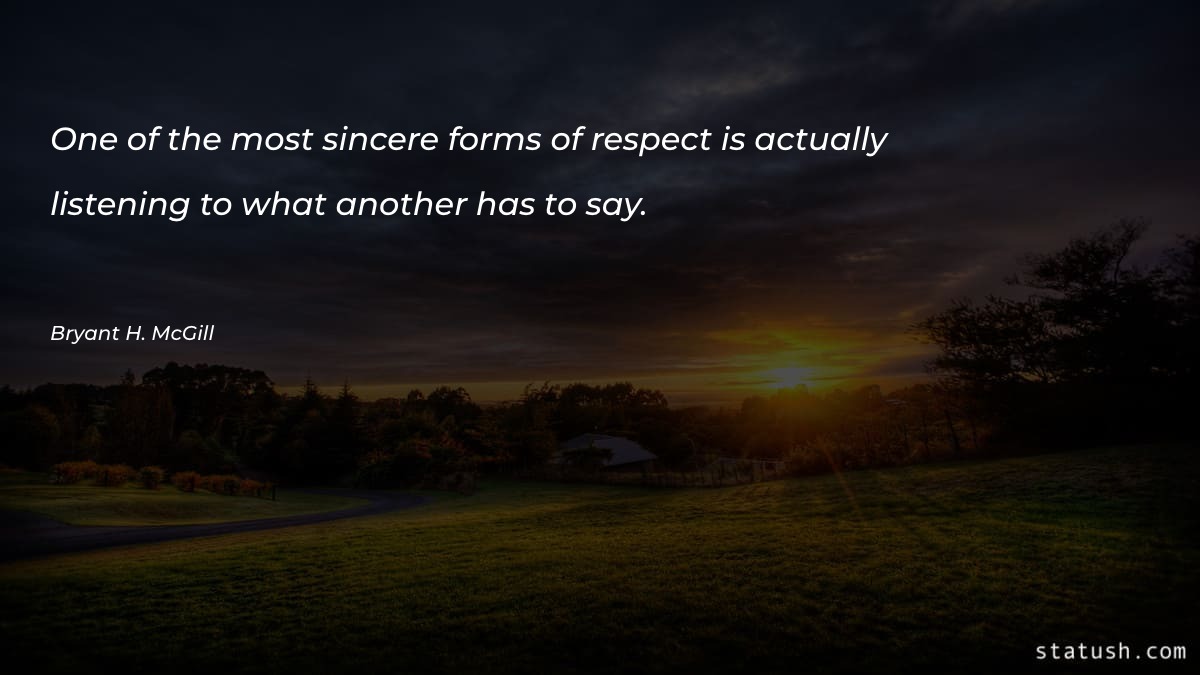
One of the most sincere forms of respect is actually listening to what another has to say.
The Meaning: This line from Bryant H. McGill compresses a lived tension into a single readable moment. Read it slowly: it is not asking you to agree, but to notice where the same pattern shows up in your own life. If you take it seriously, it becomes a test—what would you change if this were reliably true for you?
5. On Discipline
It is better to have a fair intellect that is well used than a powerful one that is idle.
The Meaning: This line from Bryant H. McGill compresses a lived tension into a single readable moment. Read it slowly: it is not asking you to agree, but to notice where the same pattern shows up in your own life. If you take it seriously, it becomes a test—what would you change if this were reliably true for you?
6. On Thought and Judgment
The supreme lesson of any education should be to think for yourself and to be yourself.
The Meaning: This line from Bryant H. McGill compresses a lived tension into a single readable moment. Read it slowly: it is not asking you to agree, but to notice where the same pattern shows up in your own life. If you take it seriously, it becomes a test—what would you change if this were reliably true for you?
7. On Time and Memory
Do you want to know what you are? You are a creator. At every moment you are creating.
The Meaning: Time is treated as something you cannot store—only spend. The meaning is that urgency and patience are both strategies; the quote asks which one matches the stakes. If you feel rushed, check whether the deadline is real or inherited.
8. On Love and Devotion
There is no love without forgiveness, and there is no forgiveness without love.
The Meaning: This line treats emotion as something that steers decisions more than arguments do. The meaning is practical: if you ignore what you feel, you may still act—but often on autopilot. Naming the feeling is the first step toward choosing it, rather than being dragged by it.
9. On Truth
Curiosity is one of the great secrets of happiness.
The Meaning: This line from Bryant H. McGill compresses a lived tension into a single readable moment. Read it slowly: it is not asking you to agree, but to notice where the same pattern shows up in your own life. If you take it seriously, it becomes a test—what would you change if this were reliably true for you?
10. On Learning
Suffering is one of life's great teachers.
The Meaning: Knowledge is framed as something that changes behavior, not something you collect like trophies. If a sentence is true but does not shift what you notice or do, it has not finished its work.