The Architect of Objectivism: Ayn Rand Quotes and Their Meaning
Ayn Rand was one of the most polarizing and influential thinkers of the 20th century. Having fled the Soviet Union, she became a fierce advocate for "Objectivism"—a philosophy centered on rational individualism, laissez-faire capitalism, and the "virtue of selfishness."
To Rand, the mind was the ultimate tool for survival, and the individual's pursuit of their own happiness was the highest moral purpose. Here is the meaning behind her most provocative and enduring ideas.
1. On Personal Integrity
"The question isn't who is going to let me; it's who is going to stop me."
The Meaning:
This is the ultimate anthem of self-reliance. Rand believed that individuals should not look for "permission" from society, the government, or their peers to pursue their dreams. It shifts the focus from external validation to internal will. If you have a rational goal, the only relevant factor is your own determination to clear the path.
2. On the Power of the Mind
"Reason is not automatic. Those who deny it cannot be conquered by it. Do not count on them. Leave them alone."
The Meaning:
Rand championed logic above all else. She argued that thinking is a choice—a "volitional act." Not everyone chooses to be rational, and Rand’s advice was simple: don't waste your energy trying to argue with those who have abandoned reason. Your duty is to your own clarity, not to the enlightenment of the unwilling.
3. On the Morality of Achievement
"My philosophy, in essence, is the concept of man as a heroic being, with his own happiness as the moral purpose of his life, with productive achievement as his noblest activity, and reason as his only absolute."
The Meaning:
Rand rejected the idea that self-sacrifice is the greatest virtue. Instead, she believed that "productive achievement"—creating something of value—is how a human being honors their existence. To be "heroic" in Rand’s eyes is to be a person who takes responsibility for their own life and refuses to be a burden to others.
4. On Individual Rights
"The smallest minority on earth is the individual. Those who deny individual rights cannot claim to be defenders of minorities."
The Meaning:
Rand was deeply wary of "collectivism" (the idea that the group is more important than the person). She argued that if you don't protect the rights of a single individual, you cannot effectively protect any group. True justice begins with the sovereignty of the lone human being against the pressure of the "herd."
5. On the Nature of Wealth
"Money is only a tool. It will take you wherever you wish, but it will not replace you as the driver."
The Meaning:
Contrary to the "greedy" caricature often painted of her, Rand viewed money as a medium of exchange for human effort and intelligence. She warned that wealth is useless if the person possessing it has no character or direction. Money can buy opportunities, but it cannot buy a soul, a purpose, or a brain.
6. On Compromise
"In any compromise between food and poison, it is only death that can win. In any compromise between good and evil, it is only evil that can profit."
The Meaning:
Rand was a "moral absolutist." She believed that "meeting in the middle" on matters of fundamental principle was a disaster. If you know something is right, and you "compromise" with something you know is wrong, you have simply allowed the "wrong" to gain a foothold. To her, integrity meant standing firm on the truth.
7. On Happiness
"Learn to value yourself, which means: fight for your happiness."
The Meaning:
Rand believed that happiness is not a gift or an accident; it is an achievement. It requires the courage to say "I want this" and the discipline to go get it. If you do not value yourself, you will allow others to dictate your life. Fighting for your happiness is the ultimate act of self-respect.
8. On Avoiding Reality
"We can evade reality, but we cannot evade the consequences of evading reality."
The Meaning:
You can pretend that a problem doesn't exist, or that the laws of logic don't apply to you, but facts do not care about your feelings. Eventually, the bill comes due. Rand’s philosophy is a call to face the world as it actually is, rather than how we wish it to be.
9. On Creative Independence
"The creator lives for his work. He needs no one else. His primary goal is within himself."
The Meaning:
In her novel The Fountainhead, Rand explored the idea of the "first-hander." A first-hander creates because they love the work itself, not for the fame or the approval of others. If you depend on the applause of the crowd, you are their slave. If you work for your own high standards, you are free.
10. On Purpose
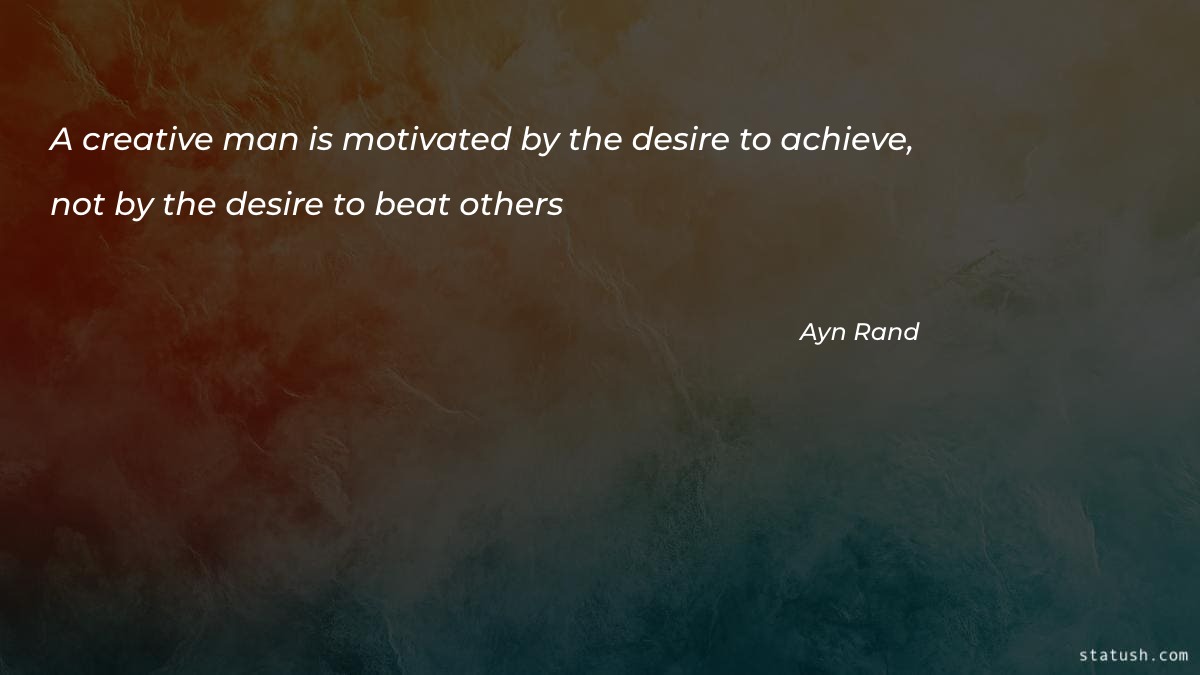
"A creative man is motivated by the desire to achieve, not by the desire to beat others."
The Meaning:
Rand distinguished between healthy ambition and petty envy. A truly successful person is focused on the "object"—the bridge they are building, the code they are writing, the art they are making. If your primary goal is just to "win" against others, you are still letting others define your worth.
The Randian Pillar of Objectivism
| The Principle | The Core Idea |
|---|---|
| Rationality | Use your brain; it’s your only tool for survival. |
| Productivity | Your work is your contribution to your own life. |
| Self-Interest | You are not a sacrificial animal for others. |
| Integrity | Never sacrifice your convictions to a "social" consensus. |
Ayn Rand’s words remain a powerful challenge to the status quo. Whether one agrees with her or not, she forces us to ask: Who is the master of my life? She reminds us that the word "I" is the most important word in the human language.