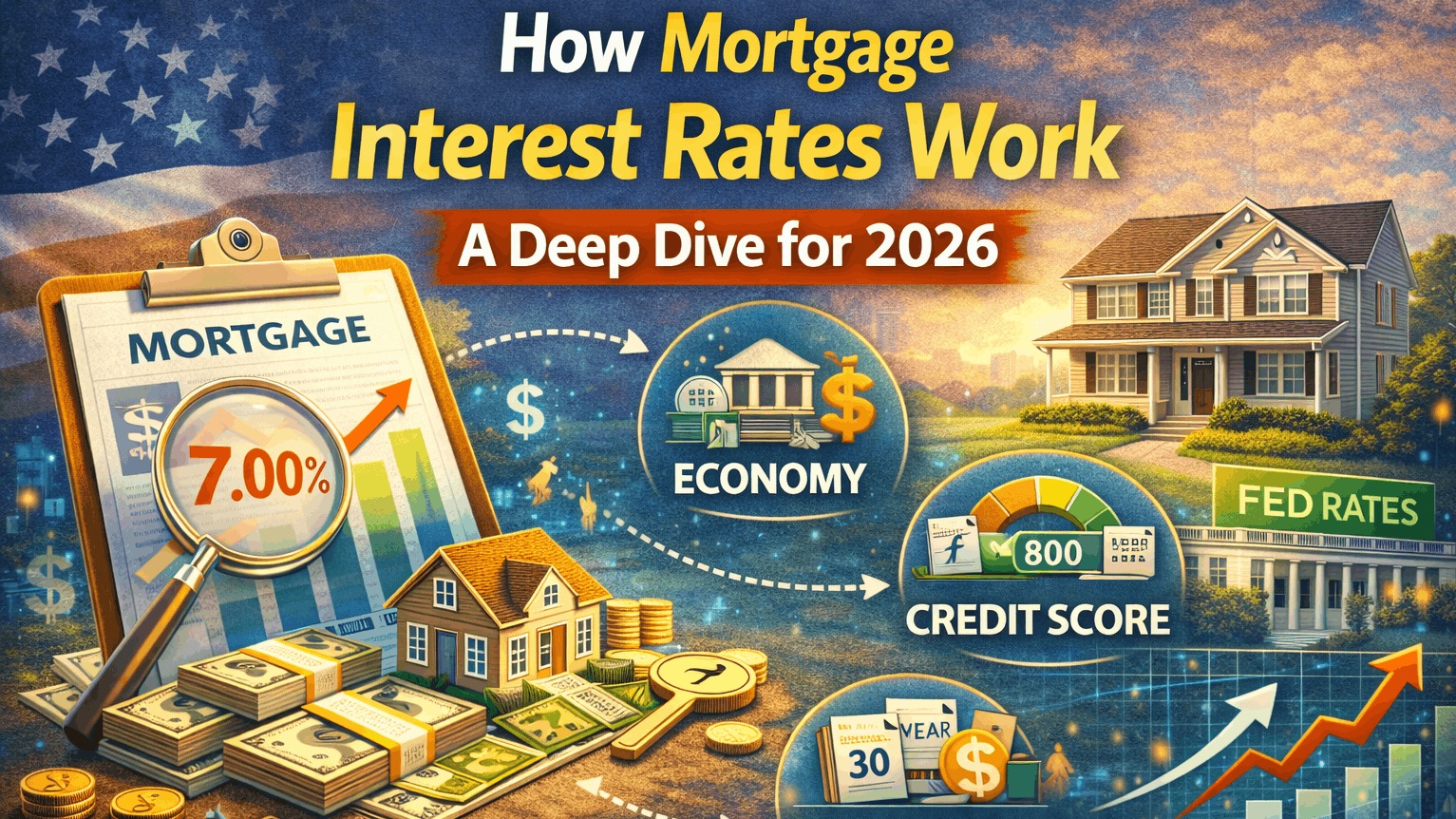
When you take out a mortgage, the interest rate is the "price" you pay to borrow that money. While it might look like a simple percentage, that number is actually the result of a complex calculation involving global bond markets, federal policy, and your own financial habits.
In 2026, with 30-year fixed rates stabilizing near 6.00%, understanding these mechanics is more important than ever for American homebuyers.
1. The Forces That Set the Base Rate
Lenders don’t just pick a number out of thin air. They base their rates on several external benchmarks.
The 10-Year Treasury Yield
The single most important factor for mortgage rates is the 10-year U.S. Treasury note. Investors view mortgages as a similar type of long-term investment to government bonds. When the yield on the 10-year Treasury goes up (currently around 4.13%), mortgage rates almost always follow.
The Federal Reserve (The Fed)
The Fed sets the Federal Funds Rate (currently 3.64%). While this doesn't directly dictate mortgage rates, it influences the overall cost of money for banks. When the Fed signals "rate cuts," it creates an environment where mortgage rates can fall.
Inflation and the Economy
Interest rates are the primary tool used to fight inflation. When inflation is high, rates stay high to cool down spending. As inflation approaches the Fed's 2.1% target in 2026, we are seeing the downward pressure that has brought rates back from their 8% peaks.
2. Your "Personal" Rate: Why Your Quote Is Unique
Once the base market rate is established, lenders apply "adjustments" based on your specific profile.
- Credit Score (The Ladder): Lenders use tiers. A score of 740+ typically unlocks the lowest possible "prime" rate. A score in the 660–680 range might see a rate that is 0.50% to 0.75% higher due to perceived risk.
- Loan-to-Value (LTV) Ratio: This is determined by your down payment. If you put 20% down, you have an LTV of 80%. Higher down payments reduce the lender's risk, often resulting in a slightly lower interest rate.
- Debt-to-Income (DTI): Lenders prefer a DTI below 43%. If your debts are high relative to your income, you may be charged a "risk premium" on your rate.
3. How You Actually Pay It: Amortization
Even with a "fixed" rate, the way you pay interest changes every month through a process called amortization.
In a standard 30-year mortgage, your monthly payment remains the same, but the ratio of principal to interest shifts:
- Early Years: Most of your payment goes toward Interest. This is because the interest is calculated based on your high remaining balance.
- Later Years: As the balance drops, the interest charge shrinks, and more of your money goes toward the Principal (the actual house).
Pro Tip: Making just one extra payment per year toward your principal can shave nearly 4 years off a 30-year loan and save you tens of thousands in interest.