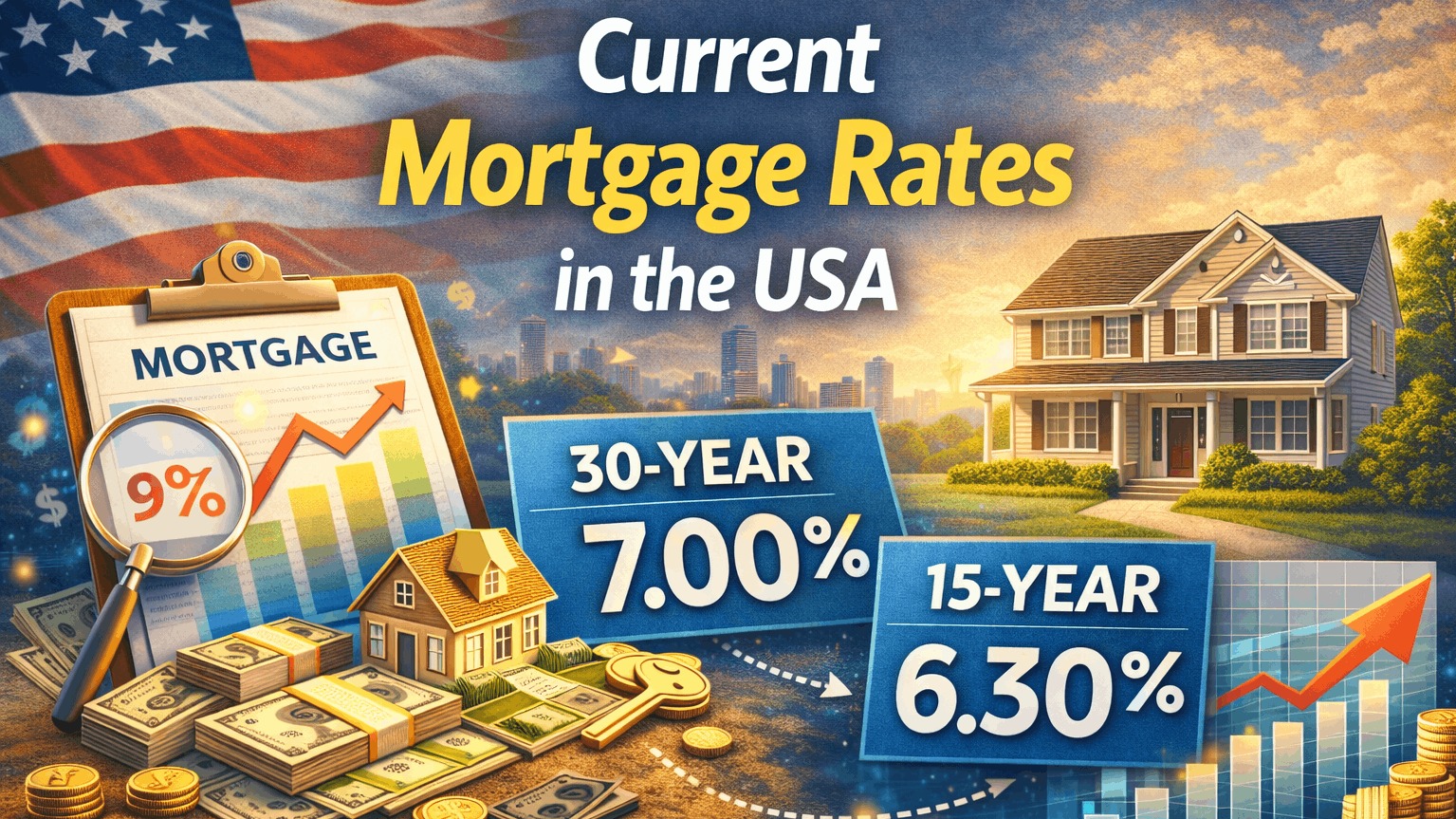
The U.S. housing market has entered a pivotal phase in 2026. After years of record-high borrowing costs that peaked near 8% in late 2023, mortgage rates have finally trended downward, hovering around a critical psychological threshold. For many American homebuyers, the current landscape offers the best affordability window since 2022.
1. Today’s Mortgage Rate Snapshot (March 2026)
As of March, 2026, national mortgage rates have stabilized following a period of high volatility. While a $200 billion mortgage-backed securities purchase plan earlier this year injected liquidity into the market and briefly pushed rates below the 6% mark, recent geopolitical tensions in the Middle East have caused a slight rebound.
Current National Averages
| Loan Product | Interest Rate | APR |
|---|---|---|
| 30-Year Fixed | 6.00% – 6.11% | 6.18% |
| 15-Year Fixed | 5.43% – 5.53% | 5.64% |
| 30-Year FHA | 5.65% | 5.71% |
| 30-Year VA | 5.86% | 5.92% |
| 20-Year Fixed | 5.94% | 6.02% |
Note: These are national averages. Your individual rate will depend on your credit score, down payment size, and debt-to-income (DTI) ratio.
2. Why Rates Are Moving: The 2026 Drivers
Several macroeconomic factors are currently tugging at mortgage rates, creating a "tug-of-war" between downward trends and short-term spikes.
The Federal Reserve and "The Pause"
The Fed held the benchmark federal funds rate steady at 3.5% to 3.75% during its January 2026 meeting. While the Fed does not set mortgage rates directly, its influence on the 10-year Treasury yield—the primary benchmark for 30-year mortgages—is profound. Analysts expect one to two rate cuts later in 2026, which could pull mortgage rates further down toward the 5.75% range.
Government Intervention
In early 2026, a significant federal move to purchase $200 billion in mortgage-backed securities (MBS) successfully lowered yields. This intervention was designed to improve housing affordability and has already made roughly 4.8 million homeowners eligible for refinancing.
Geopolitical Impact
The recent conflict in Iran has introduced fresh volatility. Historically, global instability leads to a "flight to safety" in the bond market, but concerns over rising oil prices and inflation have recently pushed yields—and consequently mortgage rates—slightly higher in the first week of March.
3. The Real Cost: Monthly Payment Comparison
To understand how a 6% rate changes your life compared to the 7% or 8% rates of previous years, look at the math for a $400,000 home with a 20% down payment ($320,000 loan):
- At 7.5% (2023 Peak): ~$2,237/month
- At 6.0% (Today): ~$1,919/month
- Monthly Savings: $318
4. 2026 Mortgage Forecast: Where Are We Headed?
Housing economists from Fannie Mae, the Mortgage Bankers Association (MBA), and NAR generally agree that 2026 will be a year of "stabilization."
- Short-Term (Spring 2026): Rates are expected to fluctuate between 5.9% and 6.2% as the market reacts to inflation data and the transition to a new Federal Reserve Chair in May 2026.
- Long-Term (End of 2026): Most institutional forecasts put the year-end average at approximately 5.9%.
- Optimistic View: Morgan Stanley strategists suggest a potential dip to 5.50% by mid-year if the 10-year Treasury yield falls to 3.75%.