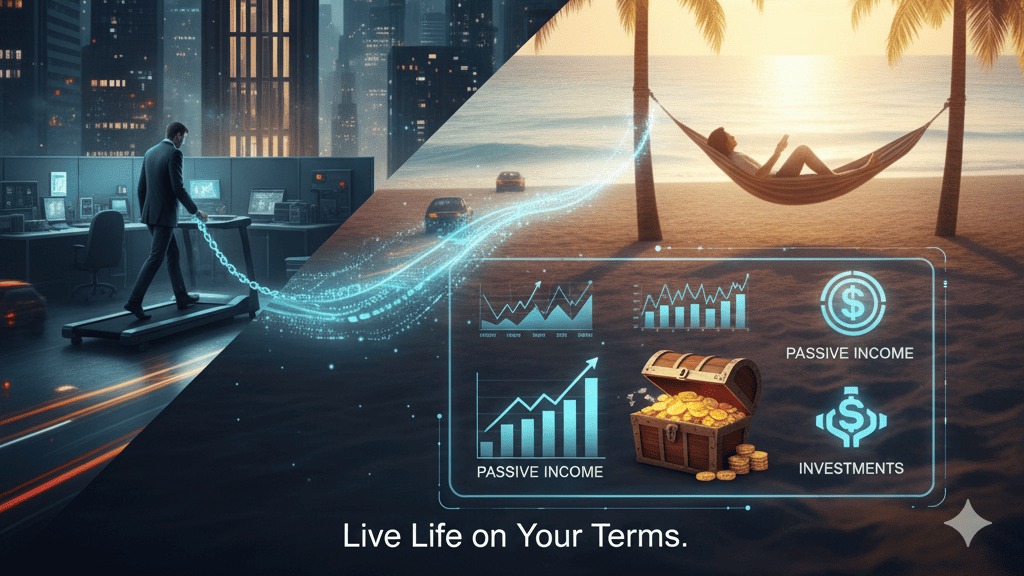
Imagine a life where your Monday mornings feel like Saturday mornings. A life where your income is decoupled from your time, and you have the freedom to pursue your passions, travel the world, or simply spend more time with loved ones, unburdened by the daily grind. This isn't a pipe dream; it's financial freedom, and in 2026, it's more attainable than ever for those willing to commit to a strategic, disciplined path.
This guide is your blueprint to breaking free from the traditional 9-to-5, building robust passive income streams, and designing a life of purpose, not just paychecks.
Phase 1: The Foundation – Know Your Numbers (and Your "Why")
1. Calculate Your "Freedom Number"
This is the single most important number you need. It’s the total amount of money you need invested, generating enough passive income to cover your living expenses.
- How to Calculate:
- Annual Expenses: Tally all your current annual living expenses (rent, food, insurance, entertainment, travel, etc.).
- Multiply by 25: Using the "4% Rule" (a conservative withdrawal rate), multiply your annual expenses by 25.
- Example: If your annual expenses are $40,000, your Freedom Number is $40,000 x 25 = $1,000,000.
- Why it Matters: Without this target, you're shooting in the dark.
2. Define Your "Freedom Life"
What does "escaping the 9-5" truly mean to you? Is it early retirement, working part-time on a passion project, or digital nomadism?
- Visualise: Create a vision board or journal entry detailing your ideal day, week, and year once financially free. This emotional connection will fuel your discipline.
Phase 2: Accelerate Your Ascent – Supercharge Savings & Income
3. Maximize Your Savings Rate
This is the single biggest lever you have. The higher your savings rate, the faster you'll reach your Freedom Number.
- Target: Aim for 50% or more of your income. Yes, it's aggressive, but so is escaping the 9-5 early.
- Strategy: Automate savings before spending. Treat your investment accounts as the first "bill" you pay.
4. Boost Your Current Income (The "Internal Raise" & Side Hustles)
You don't have to quit your job yet to make more money.
- Internal Raise: Use strategies like AI upskilling, solving "pillar problems," or intrapreneurship within your current role (as discussed in "Increase Income Without Changing Jobs") to negotiate a higher salary or performance bonuses.
- High-Leverage Side Hustles: Focus on side gigs that are scalable or build valuable assets (e.g., freelance consulting in your niche, creating digital products, starting a niche online business). Aim for side income that can eventually grow into your primary income source.
5. Ruthlessly Optimize Expenses
Every dollar saved is a dollar that doesn't need to be replaced by passive income.
- Audit Subscriptions: Cancel unused services.
- Minimize Big 3: Housing, transportation, and food are typically the biggest expenses. Can you downsize, optimize commutes, or meal prep more efficiently?
Phase 3: The Engine – Build Robust Passive Income Streams
This is the core of financial freedom: money working for you, not you working for money.
6. Invest in Low-Cost Index Funds & ETFs
This is the bedrock for most financial freedom seekers. It offers broad market exposure, diversification, and historically strong returns with minimal effort.
- Strategy: Consistently invest in total stock market index funds (e.g., VTSAX) or S&P 500 ETFs (e.g., SPY, VOO). Reinvest dividends.
- The Power of Compounding: Let time and consistent investment do the heavy lifting.
7. Diversify with Real Estate (REITs or Direct Ownership)
Real estate can provide steady cash flow and appreciation, but direct ownership comes with management headaches.
- REITs (Real Estate Investment Trusts): Invest in publicly traded companies that own income-generating real estate. Easier to manage, liquid.
- Rental Properties: Can offer higher returns and tax benefits, but require more capital and active management (unless you hire a property manager).
8. Build a Scalable Online Business (Product or Service)
This is often the fastest path to significant passive income if executed well.
- Digital Products: E-books, online courses, templates, stock assets. Create once, sell repeatedly.
- Software-as-a-Service (SaaS): Develop a simple app or tool that solves a specific problem.
- Affiliate Marketing/Niche Content: Build an audience around a topic and recommend products, earning commissions.
Phase 4: The Transition – From 9-to-5 to Free
9. Create a "Glide Path"
Don't jump ship cold turkey. Plan a gradual transition.
- Buffer Fund: Accumulate a "Freedom Fund" — 1-2 years of living expenses separate from your invested capital. This allows you to walk away from your job with peace of mind.
- Test Your Passive Income: Ensure your side income streams are consistently covering a significant portion (or all) of your expenses before making the leap.
- Part-Time Transition: If possible, negotiate a part-time schedule with your current employer to ease into your new lifestyle.
10. Stay Invested & Adapt
Financial freedom isn't a destination; it's an ongoing state of mind and strategy.
- Protect Your Capital: Regularly review your asset allocation.
- Continue Learning: The economic landscape changes. Stay updated on new investment opportunities and income strategies.
- Give Back: True freedom often involves contributing to something larger than yourself.