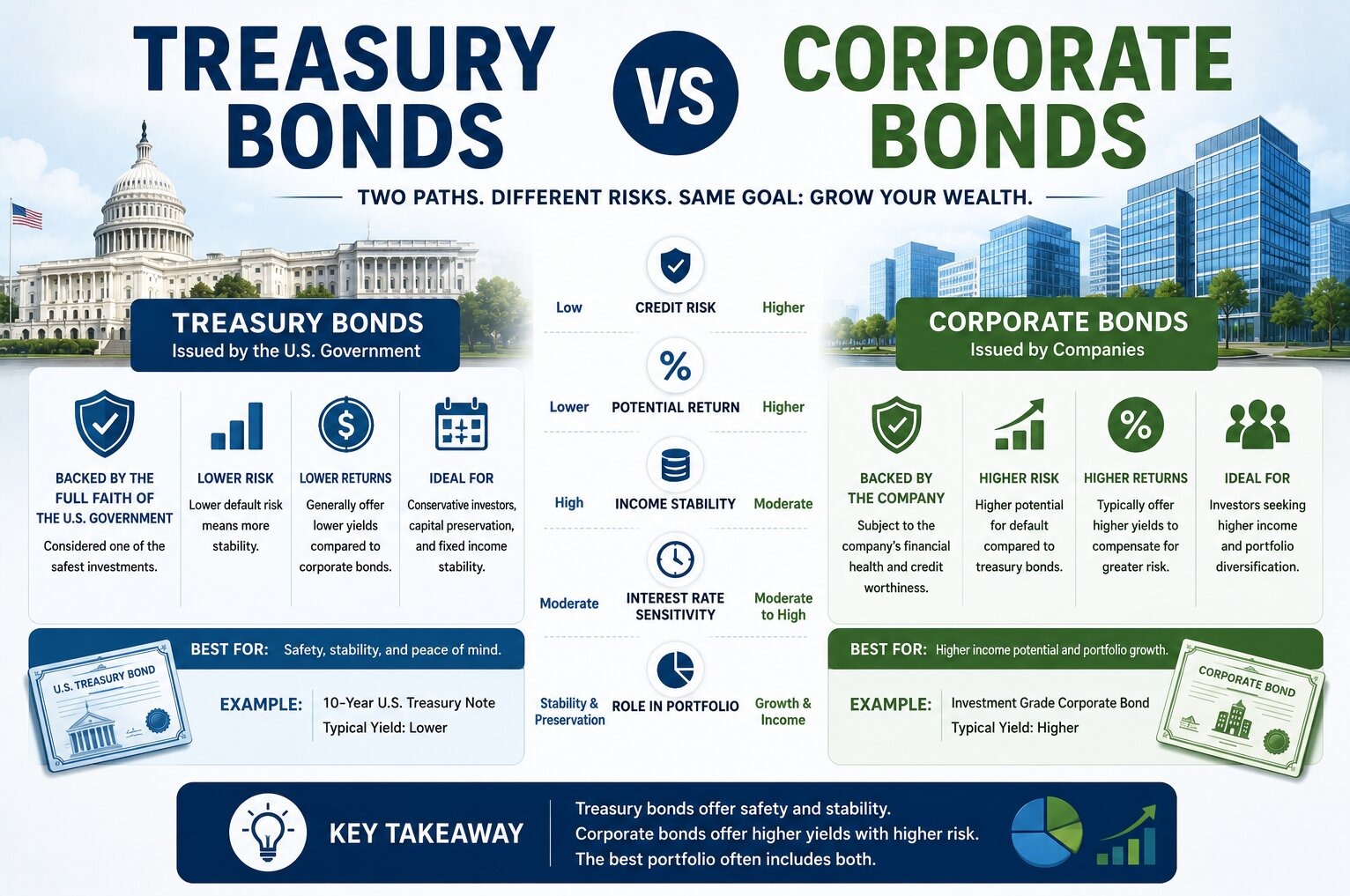
When people first start learning about bonds, one of the biggest questions they encounter is:
“Should I invest in treasury bonds or corporate bonds?”
Both are common fixed-income investments, but they serve different purposes and come with different levels of risk, return, and stability.
At a basic level:
- Treasury bonds are generally safer
- Corporate bonds usually offer higher returns
But like most investing decisions, the best option depends on your goals, risk tolerance, and overall portfolio strategy.
And honestly, understanding the difference between these two bond categories helps investors make much smarter decisions about balancing growth, income, and stability over time.
What Are Treasury Bonds?
Treasury bonds are bonds issued by national governments.
For example:
- U.S. Treasury bonds are issued by the U.S. government
- Other countries issue their own sovereign bonds
When investors buy treasury bonds, they are essentially lending money to the government.
In return, the government agrees to:
- Pay periodic interest
- Return the principal at maturity
Treasury bonds are often considered among the safest investments because governments generally have strong ability to repay debt.
What Are Corporate Bonds?
Corporate bonds are issued by companies instead of governments.
Businesses issue bonds to raise money for purposes like:
- Expansion
- Acquisitions
- Infrastructure
- Debt refinancing
- Operations
Corporate bonds typically offer higher interest rates than treasury bonds because they carry greater risk.
Companies can experience:
- Financial problems
- Falling revenue
- Bankruptcy
- Cash flow issues
That added uncertainty increases yields.
The Core Difference
The biggest distinction comes down to risk.
| Feature | Treasury Bonds | Corporate Bonds |
|---|---|---|
| Issuer | Government | Companies |
| Risk Level | Lower | Higher |
| Interest Rates | Lower | Higher |
| Default Risk | Very low (usually) | Varies by company |
| Stability | Higher | Lower |
Investors are generally compensated for taking additional corporate risk through higher yields.
How Treasury Bonds Work
Suppose you buy:
- A 10-year treasury bond
- Face value = $1,000
- Interest rate = 4%
Annual interest payments would equal:
Annual Interest = Principal * Interest Rate
So:
Annual Interest = 1000 * 0.04 = 40
You would receive:
- $40 annually
- Original $1,000 at maturity
Treasury bonds usually provide predictable income with relatively lower default risk.
Why Treasury Bonds Are Considered Safer
Governments generally have more financial flexibility than individual companies.
They may:
- Collect taxes
- Issue new debt
- Adjust monetary policy
Because of this, treasury bonds in financially stable countries are often viewed as “safe haven” investments during economic uncertainty.
During stock market crashes or recessions, investors frequently move money into treasury bonds seeking stability.
Why Corporate Bonds Offer Higher Yields
Corporate bonds carry higher risk because companies can fail.
To attract investors, corporations usually offer:
- Higher coupon rates
- Better yields
This extra yield is often called a credit spread.
The riskier the company appears, the higher the yield investors typically demand.
Credit Ratings Matter
Corporate bonds vary enormously in quality.
Credit rating agencies evaluate issuers based on:
- Debt levels
- Cash flow
- Profitability
- Financial stability
Investment-Grade Bonds
These are issued by financially stronger companies.
Characteristics:
- Lower default risk
- Lower yields
- Greater stability
High-Yield Bonds
Also called “junk bonds.”
Characteristics:
- Higher yields
- Greater default risk
- Higher volatility
Understanding financial strength also connects with How to Evaluate Company Financial Statements.
Interest Rate Risk Affects Both
Both treasury and corporate bond prices can change when interest rates move.
When Interest Rates Rise
Existing bonds with lower rates become less attractive.
As a result:
- Bond prices generally fall
When Interest Rates Fall
Older bonds with higher rates become more valuable.
As a result:
- Bond prices generally rise
This inverse relationship affects nearly all bond markets.
Treasury Bonds During Economic Uncertainty
Treasury bonds often perform relatively well during:
- Recessions
- Financial crises
- Stock market crashes
Why?
Because investors frequently prioritize safety during uncertainty.
This “flight to safety” behavior can increase treasury bond demand and support prices.
Corporate Bonds and Economic Growth
Corporate bonds tend to perform better when:
- Economic growth is strong
- Companies remain profitable
- Default risk declines
During healthy economic conditions, investors often become more comfortable accepting additional corporate risk for higher yields.
Tax Considerations
Tax treatment varies depending on:
- Country
- Bond type
- Account structure
Some government bonds may receive special tax advantages in certain regions.
Investors should always consider after-tax returns rather than focusing only on headline yields.
You can explore broader tax planning concepts in Tax-Efficient Investing Strategies.
Treasury Bonds vs Corporate Bonds for Beginners
Treasury Bonds May Be Better For:
- Conservative investors
- Capital preservation
- Lower volatility
- Stable income
- Retirement stability
Corporate Bonds May Be Better For:
- Higher income goals
- Greater return potential
- Moderate risk tolerance
- Diversification beyond government debt
Many investors actually combine both types within a balanced portfolio.
Real-World Example
Imagine two investors.
Investor A
- Buys only treasury bonds
- Receives lower yields
- Experiences greater stability
Investor B
- Buys only high-yield corporate bonds
- Receives higher income
- Faces greater default and market risk
During strong economic periods, Investor B may outperform.
During recessions or credit crises, Investor A may experience significantly less volatility and stress.
Diversification Within Bond Investing
Even within bonds, diversification matters.
A balanced bond portfolio may include:
- Treasury bonds
- Investment-grade corporate bonds
- Municipal bonds
- International bonds
This helps reduce dependence on any single issuer or market condition.
You can learn more about diversification in How to Reduce Investment Risk.
Bond Funds vs Individual Bonds
Beginners often invest through:
- Bond mutual funds
- Bond ETFs
These options provide:
- Diversification
- Easier management
- Broad exposure
Individual bonds offer more control but require additional research and monitoring.
Common Mistakes Investors Make
| Mistake | Potential Risk |
|---|---|
| Chasing highest yields blindly | Higher default risk |
| Ignoring credit quality | Unexpected losses |
| Assuming all bonds are safe | Misunderstanding risk |
| No diversification | Concentrated exposure |
| Ignoring interest rate risk | Bond price declines |
Bonds and Portfolio Allocation
The right balance between treasury and corporate bonds depends on:
- Age
- Risk tolerance
- Financial goals
- Time horizon
More conservative investors may prefer heavier treasury allocations, while growth-oriented income investors may include more corporate bonds.
This connects naturally with Investment Portfolio Allocation by Age.
Treasury Bonds vs Corporate Bonds Summary
| Feature | Treasury Bonds | Corporate Bonds |
|---|---|---|
| Safety | Higher | Lower |
| Yield | Lower | Higher |
| Volatility | Lower | Higher |
| Default Risk | Minimal (usually) | Varies |
| Best For | Stability | Higher income |
Neither option is automatically better.
They simply serve different roles within a portfolio.
Final Thoughts
Treasury bonds and corporate bonds are both important tools in investing, but they provide different balances of risk and reward.
Treasury bonds prioritize:
- Safety
- Stability
- Lower volatility
Corporate bonds prioritize:
- Higher yields
- Greater income potential
- Increased return opportunities
The best choice often depends on what matters most to the investor: maximum stability or higher income potential.
And honestly, many experienced investors eventually realize the smartest approach is not choosing one side exclusively. It’s understanding how both types of bonds can work together to create a stronger, more balanced portfolio overall.