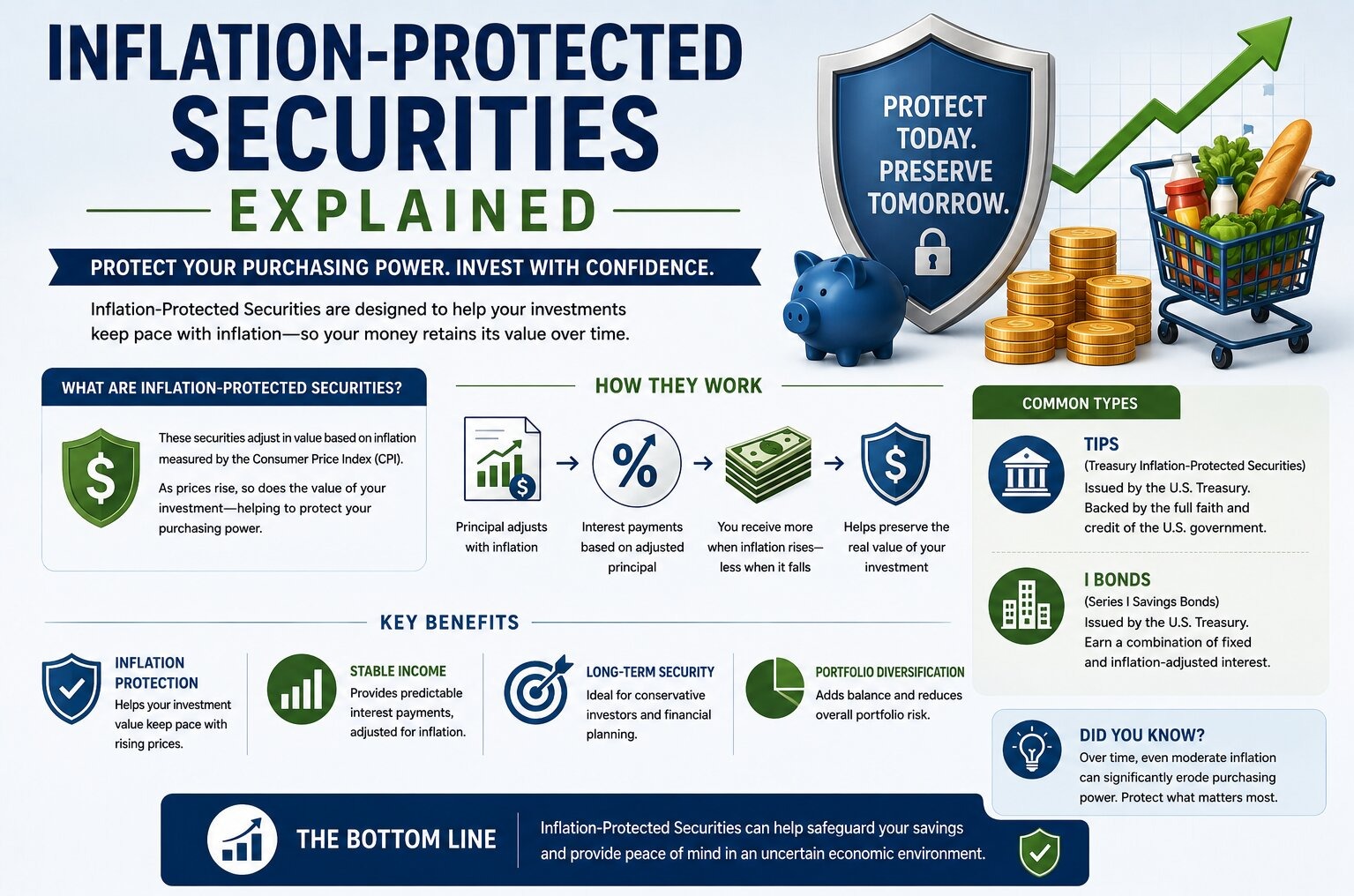
Inflation is one of the most underestimated threats in investing.
At first, inflation may not seem very dangerous because the effects often happen gradually. Prices rise little by little, year after year. But over long periods, inflation quietly reduces purchasing power and can seriously affect savings and investment returns.
For example:
- Money sitting idle loses value over time
- Fixed income payments may buy less in the future
- Retirement savings may not stretch as far as expected
This is why many investors look for ways to protect their portfolios against inflation.
One popular solution is inflation-protected securities.
These investments are specifically designed to help preserve purchasing power when inflation rises.
And honestly, inflation protection becomes much more important once people realize that earning returns alone is not enough. What really matters is how much purchasing power those returns maintain over time.
What Are Inflation-Protected Securities?
Inflation-protected securities are investments whose value adjusts based on inflation.
The goal is straightforward:
- When inflation rises, the investment adjusts upward
- This helps preserve the investor’s real purchasing power
The most well-known example is Treasury Inflation-Protected Securities (TIPS) in the United States.
Other countries offer similar inflation-linked government bonds.
How Inflation Affects Investments
Before understanding inflation-protected securities, it helps to understand why inflation matters.
Suppose inflation averages 3% annually.
If your savings earn only 1%, your real purchasing power declines.
The basic real return relationship looks like this:
Real Return = Nominal Return - Inflation Rate
Example:
Real Return = 5% - 3% = 2%
Even investments generating positive returns may lose purchasing power if inflation rises too quickly.
How Inflation-Protected Securities Work
Inflation-protected securities adjust either:
- Principal value
- Interest payments
- Or both
As inflation increases:
- The bond’s principal rises
- Interest payments increase because they are calculated from the adjusted principal
This helps investors maintain purchasing power more effectively than traditional fixed bonds.
Simple Example
Imagine:
- Initial bond principal = $1,000
- Inflation adjustment = 5%
The adjusted principal becomes:
Adjusted Principal = 1000 * 1.05 = 1050
If the bond pays 2% interest:
- Interest is now calculated using the higher adjusted principal
So rising inflation increases both:
- Principal value
- Future interest payments
Why Investors Buy Inflation-Protected Securities
These investments are especially useful during periods of:
- Rising inflation
- Economic uncertainty
- Currency purchasing power concerns
Common Goals Include
| Goal | Why It Matters |
|---|---|
| Preserve purchasing power | Protect long-term wealth |
| Stabilize retirement income | Offset rising living costs |
| Reduce inflation risk | Diversify portfolio |
| Improve fixed-income protection | Support conservative investing |
Inflation-Protected Securities vs Traditional Bonds
Traditional bonds generally pay fixed interest amounts.
That creates a problem:
- Inflation rises
- Fixed payments lose purchasing power
Inflation-protected securities adjust for inflation instead.
| Feature | Traditional Bonds | Inflation-Protected Securities |
|---|---|---|
| Principal Adjustment | Fixed | Inflation-adjusted |
| Inflation Protection | Limited | Stronger |
| Interest Payments | Fixed | Adjusted upward with inflation |
| Stability During Inflation | Lower | Higher |
When Inflation-Protected Securities Perform Well
These securities often perform best when:
- Inflation rises unexpectedly
- Investors become concerned about purchasing power
- Central banks increase inflation expectations
During high inflation environments, traditional bonds can struggle because fixed payments lose value in real terms.
Inflation-protected bonds help offset some of that pressure.
When They May Underperform
Inflation-protected securities are not always superior.
They may underperform when:
- Inflation stays low
- Interest rates rise sharply
- Economic growth weakens
- Investors prefer higher-yield alternatives
In low-inflation periods, traditional bonds may sometimes provide better overall returns.
Inflation and Retirement Planning
Inflation becomes especially important for retirees.
Why?
Because retirement may last decades.
If living costs rise steadily while income remains fixed, purchasing power can decline significantly over time.
Inflation-protected securities can help support:
- Stable retirement income
- Long-term purchasing power
- Reduced inflation anxiety
This aligns closely with broader portfolio planning concepts in Investment Portfolio Allocation by Age.
Inflation-Protected Securities and Diversification
These securities often work best as part of a diversified portfolio rather than a complete replacement for stocks or traditional bonds.
A balanced portfolio may include:
- Stocks for growth
- Bonds for stability
- Inflation-protected securities for purchasing power defense
Diversification helps reduce dependence on any single economic outcome.
You can explore this further in How to Reduce Investment Risk.
Real-World Example
Imagine two retirees.
Retiree A
- Holds only traditional fixed bonds
- Receives fixed payments for years
Retiree B
- Holds some inflation-protected securities
- Income adjusts partially with inflation
If inflation rises sharply over time, Retiree B may preserve purchasing power more effectively.
That difference becomes increasingly important across long retirement periods.
Inflation-Protected ETFs and Funds
Many investors access inflation-protected securities through:
- Mutual funds
- ETFs
- Government bond funds
Advantages include:
- Diversification
- Simplicity
- Easier management
Individual bonds offer more direct ownership but require more active management.
Risks Investors Should Understand
Inflation-protected securities still carry risks.
Interest Rate Risk
Bond prices can still decline when interest rates rise.
Lower Initial Yields
These securities sometimes offer lower starting yields compared to traditional bonds because of their inflation protection feature.
Tax Complexity
In some countries, inflation adjustments may create taxable income even before maturity.
Investors should understand local tax rules carefully.
You can explore broader tax planning in Tax-Efficient Investing Strategies.
Inflation Expectations Matter
Markets constantly adjust based on expected inflation.
Sometimes investors buy inflation-protected securities heavily because they fear future inflation. Other times, inflation concerns fade and demand weakens.
This means market pricing can fluctuate based on economic expectations, not just actual inflation numbers.
Common Mistakes Investors Make
| Mistake | Potential Problem |
|---|---|
| Ignoring inflation completely | Reduced purchasing power |
| Assuming all bonds protect against inflation | Misunderstanding fixed income |
| Overallocating to inflation protection | Reduced diversification |
| Chasing inflation fears emotionally | Poor timing decisions |
| Forgetting interest rate risk | Bond price volatility |
Inflation-Protected Securities vs Stocks
Stocks also provide some inflation protection over long periods because companies can sometimes raise prices and grow earnings.
However:
- Stocks are more volatile
- Inflation-protected bonds are generally more stable
Many investors use both for balanced protection.
Practical Tips for Beginners
Think Long Term
Inflation protection matters most over longer time horizons.
Use Inflation Protection as One Piece of a Portfolio
These securities work best alongside other diversified investments.
Avoid Emotional Reactions to Headlines
Inflation fears can become exaggerated during economic uncertainty.
Focus on Real Returns
What matters is not just earning returns, but maintaining purchasing power after inflation.
Final Thoughts
Inflation-protected securities help investors defend against one of the quietest but most persistent financial risks: the gradual loss of purchasing power.
By adjusting for inflation, these investments can provide:
- More stable real income
- Better purchasing power protection
- Greater diversification within fixed-income portfolios
They are especially useful for conservative investors and retirees concerned about long-term living costs.
And honestly, inflation investing is really about perspective. It reminds investors that growing money is only part of the goal. Preserving what that money can actually buy in the future matters just as much.