In the investing landscape of 2026, where AI-driven market swings and "higher-for-longer" interest rates are the new normal, the margin for error has narrowed. While the tools to invest have become easier to use, the psychological traps remain as dangerous as ever.
Whether you are navigating the U.S. markets or emerging economies, avoiding these common pitfalls is the first step toward long-term success.
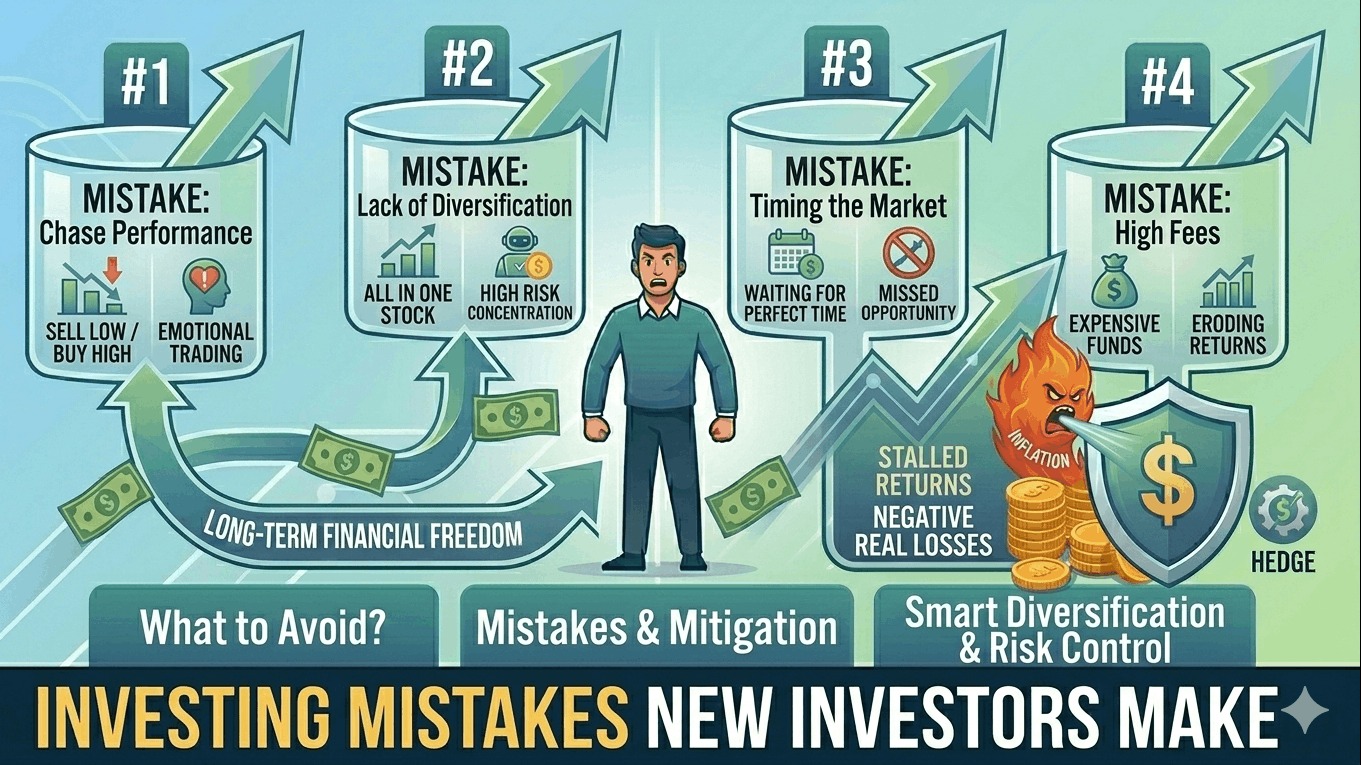
1. Chasing "The Magnificent" (The Momentum Trap)
A recurring mistake in 2026 is Momentum Chasing—buying into assets simply because they have surged over the past few years.
- The Context: Many new investors are still piling into mega-cap AI and tech giants that dominated 2023–2025.
- The Risk: By the time an asset is "trending" on social media or news cycles, the "easy money" has often already been made. Buying at the peak of a cycle leaves you vulnerable to a "reversion to the mean," where prices pull back to historical averages.
- The Fix: Shift focus to Valuation. Ask yourself: "Am I buying this because it’s a good company, or because the price went up yesterday?" In 2026, market returns are broadening out to mid-cap and international sectors; don't get stuck in a one-sector bubble.
2. Panic Selling During "Mini-Corrections"
Data from 2025 showed that roughly 35% of new investors exited the market or paused their contributions during a brief 12% dip.
- The Mistake: This is known as Loss Aversion. Humans feel the pain of a loss twice as strongly as the joy of a gain. Beginners often sell at the bottom to "stop the bleeding," only to miss the inevitable recovery.
- Real-World Example: An investor who sold during the 2025 dip locked in a 12% loss. Those who stayed invested saw an average 18% increase by the end of the year.
- The Fix: Use Dollar-Cost Averaging (DCA). By investing a fixed amount every month regardless of price, you automatically buy more shares when prices are low and fewer when they are high.
3. The "Foundational" Gap: No Emergency Fund
One of the most "mechanical" mistakes is investing money that you actually need for your life.
- The Scenario: A new investor puts their entire $5,000 savings into the stock market. Three months later, their car needs a $2,000 repair. Because they have no cash, they are forced to sell their stocks—possibly at a loss—to pay the mechanic.
- The Statistic: In 2025, nearly 28% of surveyed investors had to liquidate their portfolios prematurely to cover emergency expenses, breaking their “compounding chain.”
- The Fix: Build a three-to-six month emergency fund in a High-Yield Savings Account before you buy your first stock. This makes you a "voluntary" investor, not a "forced" seller.
4. "The WhatsApp/Telegram Tip" (Social Herding)
In the age of digital influencers, many beginners fall for Herding Behavior—following investment advice from unverified social media groups or "finfluencers."
- The Trap: Tips often focus on speculative small-cap stocks or "guaranteed" crypto schemes. These are often "Pump and Dump" cycles where early entrants exit at the expense of new retail investors.
- The Rule: If you can't explain how a company makes money in two sentences, you aren't investing; you’re gambling.
- The Fix: Stick to regulated, transparent vehicles like Index Funds or SEBI-registered/SEC-compliant products. Verify the "moat" (competitive advantage) of any individual company before buying.
5. Ignoring the "Silent Killers": Fees and Inflation
New investors often focus on Nominal Returns (the percentage gain shown in the app) while ignoring the costs that eat their wealth.
- The Fee Monster: A traditional fund with a 1.5% expense ratio might seem small, but over 20 years, it can cost you over $100,000 in lost gains compared to a low-cost ETF with a 0.1% fee.
- The Inflation Trap: In 2026, with inflation at approximately 3%, a "safe" investment returning 4% is only giving you a 1% real return.
- The Fix: Always calculate your Real Return (Return - Inflation - Taxes - Fees). If that number is negative, your purchasing power is actually shrinking.