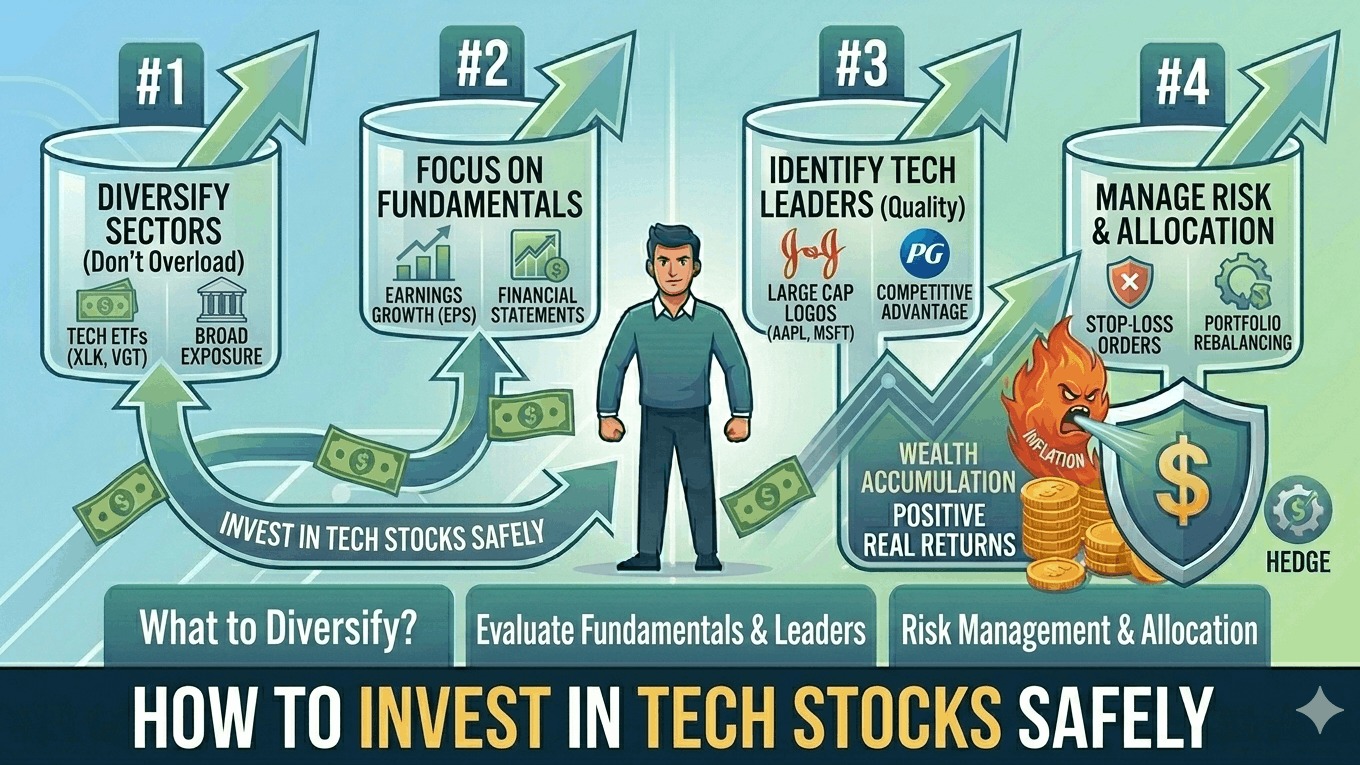
In 2026, the technology sector remains the primary engine of global wealth, but the "growth at any cost" era has been replaced by a focus on profitable innovation. With the AI-driven rally entering a more mature phase and interest rates stabilizing around 3.75%, "safe" tech investing now requires a balance of exposure to mega-cap stability and selective participation in the "AI productivity boom."
Investing in tech is inherently more volatile than utilities or consumer staples, but you can significantly lower your risk profile by following this structured 2026 framework.
1. Avoid the "Top-Heavy" Trap (Diversification)
A major risk in 2026 is the extreme concentration in a few "hyperscaler" names. Currently, just three stocks—Nvidia, Apple, and Microsoft—make up nearly 43% of some major tech ETFs. If one of these giants misses an earnings target, the whole fund can sink.
- The Safe Move: Look for Equal-Weight Tech ETFs or funds that include "AI infrastructure" beyond just chips.
- Real-World Example: Instead of only owning the "Magnificent 7," diversify into the "picks and shovels" of the next wave: cybersecurity firms (protecting AI data), fiber optic providers (speeding up data centers), and electrical equipment manufacturers (powering the massive AI grid).
2. Use the "Rule of 40" to Vet Companies
For software and cloud companies, the "Rule of 40" is a gold-standard metric for safety in 2026. It helps you identify which companies are growing sustainably versus those burning too much cash.
- The Calculation: Revenue Growth % + Profit Margin % = Should be 40 or higher.
- Why it works: A company growing at 30% with a 10% profit margin (40) is much safer than a company growing at 50% but losing 30% (20). In a high-interest-rate environment, the market rewards companies that can fund their own growth.
3. The "Anti-Bubble" Strategy: Valuation Ratios
Tech stocks are famous for "sky-high" valuations, but in 2026, savvy investors use the PEG Ratio (Price/Earnings to Growth) to find safety.
- The Metric: A PEG ratio of 1.0 is considered "fair value."
- The Comparison: If a tech giant has a P/E of 30 but is growing earnings at 30% per year, its PEG is 1.0. If a speculative AI startup has a P/E of 100 but is only growing at 20%, its PEG is 5.0—making it dangerously expensive.
- The Safe Move: Avoid any stock with a PEG ratio significantly above 2.0 unless there is a massive structural reason for the premium.
4. Focus on "Agentic AI" and Monetization
By 2026, the market has moved past being impressed by "chatbots." Investors now demand to see monetization.
- What to look for: Companies successfully deploying "Agentic AI"—AI that doesn't just talk but actually performs tasks like hyper-personalized marketing, automated customer support, or complex supply chain forecasting.
- Real-World Example: Look at companies like ServiceNow or Salesforce that are integrating AI into existing enterprise workflows. These are safer than "pure-play" AI startups because they have existing, paying customers and recurring revenue.
5. Implementation: The "Core and Satellite" Approach
To invest in tech safely, do not bet your entire portfolio on individual tickers. Use a tiered structure:
- The Core (70-80%): Low-cost, broad-market tech ETFs (e.g., VGT or QQQM). This gives you the average growth of the sector with lower individual risk.
- The Satellites (20-30%): Individual "high-conviction" stocks that you have researched using the Rule of 40 and PEG ratio.
- The Rebalance: In 2026, it is recommended to rebalance quarterly. If your tech "satellites" have a massive run and now make up 50% of your portfolio, sell some profit and move it back to the "Core" to lock in your gains.