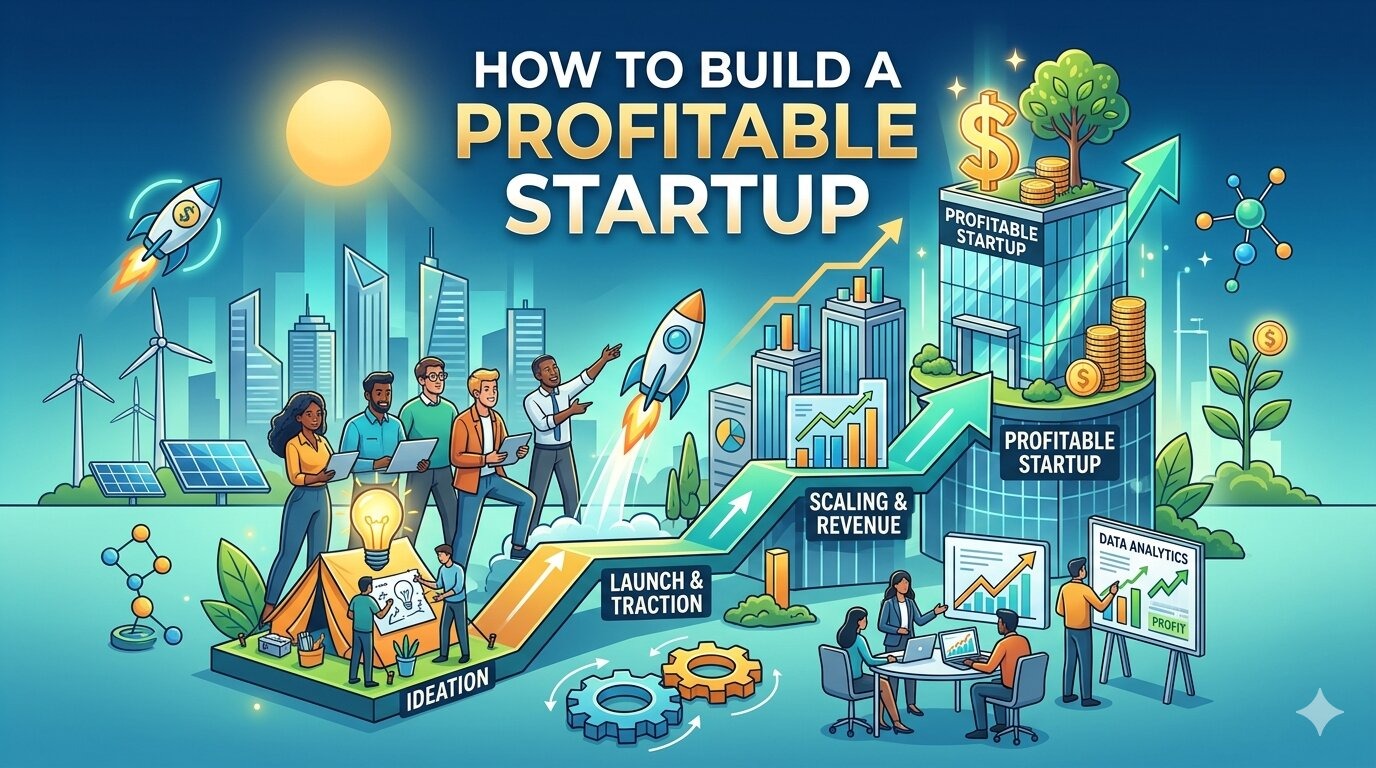
Starting a business is one thing—but building a profitable startup is a completely different challenge. Many startups focus on growth, branding, or funding, but forget the most important goal: making consistent profit.
A profitable startup doesn’t just survive—it sustains itself, grows steadily, and creates long-term value.
In this guide, we’ll break down how to build a profitable startup step by step, using simple strategies, real-world thinking, and practical execution.
What Makes a Startup Profitable?
A profitable startup is not just about high revenue. It means:
- You earn more than you spend
- Your business model is sustainable
- You can grow without constant external funding
Simple formula:
Profit = Revenue – Expenses
Your goal is to increase revenue while controlling costs.
Step 1: Start with a Problem That People Will Pay to Solve
A profitable startup begins with a real problem.
Ask yourself:
- What problem am I solving?
- Who is facing this problem?
- Are they willing to pay for a solution?
Example:
People struggling with time management → productivity tools or services.
If you’re still exploring ideas, read:
How to Find a Profitable Business Idea → https://statush.com/entrepreneur/how-to-find-a-profitable-business-idea
Step 2: Choose the Right Business Model
Your business model determines how you make money.
A strong model should:
- Be simple
- Be scalable
- Generate consistent income
Examples:
- Subscription-based
- Service-based
- Product-based
To choose the best model, read:
How to Choose the Right Business Model → https://statush.com/entrepreneur/how-to-choose-the-right-business-model
Step 3: Validate Before You Build
Many startups fail because they build first and validate later.
Instead:
- Test your idea
- Talk to potential customers
- Try to get early sales
Example:
Offer a basic version before investing heavily.
If you have an idea, follow:
How to Turn Your Idea into a Business → https://statush.com/entrepreneur/how-to-turn-your-idea-into-a-business
Step 4: Focus on Revenue Early
Don’t wait too long to start earning.
Even small revenue:
- Validates your idea
- Builds confidence
- Improves sustainability
If you’re starting from scratch, read:
How to Generate Your First $1,000 in Business → https://statush.com/entrepreneur/how-to-generate-your-first-1000-in-business
Step 5: Keep Costs Low in the Beginning
Profitability is easier when expenses are controlled.
Avoid:
- Unnecessary hiring
- Expensive tools
- High overhead costs
Tip:
Spend only on what directly helps you grow or serve customers.
If budget is a concern, read:
How to Start a Business with No Money → https://statush.com/entrepreneur/how-to-start-a-business-with-no-money
Step 6: Build a Strong Offer
Your offer is what makes people buy.
A strong offer should:
- Solve a clear problem
- Deliver real results
- Be easy to understand
Example:
| Weak Offer | Strong Offer |
|---|---|
| Marketing service | Get 20+ leads in 30 days using Instagram |
Clarity increases conversions.
Step 7: Focus on Customer Value
Profit comes from satisfied customers.
Focus on:
- Delivering quality
- Clear communication
- Consistent results
Happy customers:
- Return
- Refer others
- Increase your revenue
Step 8: Optimize Pricing for Profit
Pricing directly impacts profitability.
Avoid:
- Underpricing to attract customers
- Overpricing without value
Instead:
- Align price with value
- Test different pricing strategies
To learn more, read:
How to Price Your Products for Profit → https://statush.com/entrepreneur/how-to-price-your-products-for-profit
Step 9: Build Systems for Efficiency
Efficiency increases profit.
Create systems for:
- Sales
- Delivery
- Customer management
This reduces:
- Time
- Errors
- Costs
Step 10: Reinvest Profits for Growth
Once your startup becomes profitable:
- Reinvest into marketing
- Improve product/service
- Expand operations
This helps you grow faster without relying on external funding.
Startup Profit Framework
| Stage | Focus | Outcome |
|---|---|---|
| Idea | Problem + solution | Direction |
| Validation | Test demand | Proof |
| Revenue | First sales | Income |
| Optimization | Improve offer | Profit |
| Scaling | Expand systems | Growth |
Real-World Example
Let’s say someone starts:
- Freelancing → ₹20,000/month
Then:
- Improves offer → ₹50,000/month
- Adds premium services → ₹1,00,000/month
Same business—more profit through better strategy.
Common Mistakes to Avoid
- Focusing only on growth, not profit
- Spending too much early
- Ignoring customer feedback
- Delaying revenue generation
If you want to avoid mistakes, read:
Common Entrepreneur Mistakes to Avoid → https://statush.com/entrepreneur/common-entrepreneur-mistakes-to-avoid
Connect Profit with Scaling
Once your startup is profitable, you can scale it.
To grow further, read:
How to Scale a Small Business → https://statush.com/entrepreneur/how-to-scale-a-small-business
Final Thoughts
Building a profitable startup is not about complexity—it’s about clarity and execution.
Focus on:
- Solving real problems
- Generating revenue early
- Controlling costs
- Delivering value
You don’t need funding to succeed—you need a profitable system.
Over time, a simple, profitable startup can grow into a powerful business.