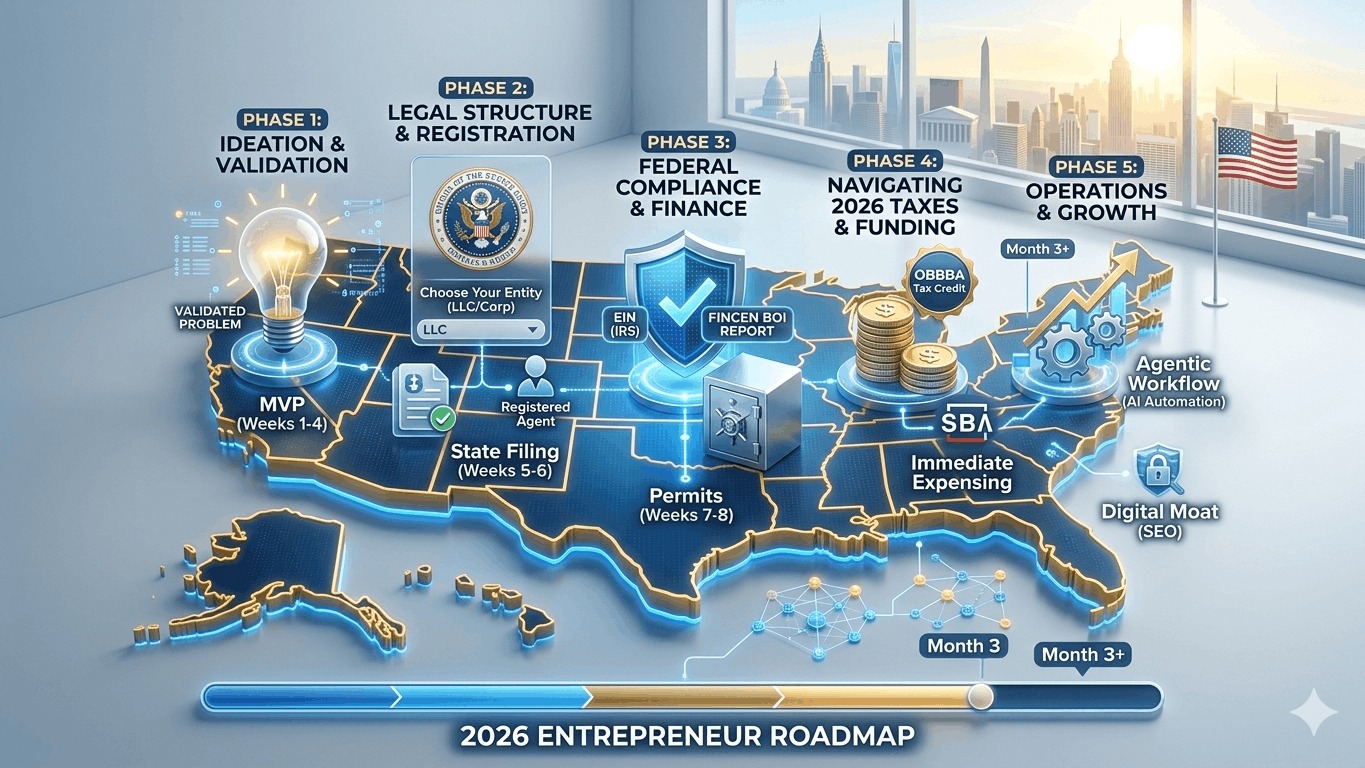
Becoming an entrepreneur in the USA in 2026 is a journey that blends high-tech tools with a simplified, yet highly regulated, legal framework. With the passage of the One Big Beautiful Bill Act (OBBBA), the tax and incentive landscape has become more predictable, while federal automation has made registration faster than ever.
Here is your comprehensive, step-by-step roadmap to launching a business in the United States this year.
Phase 1: Ideation & Validation (Weeks 1–4)
In 2026, a "good idea" is no longer enough; you need a validated problem.
- Identify Your "Why": Focus on a marketplace "why" rather than a personal one. Are you solving a friction point in AI implementation, green energy, or professional services?
- Validate via MVP: Build a Minimum Viable Product. Use 2026 no-code tools like Glide or Framer to test your concept with real users before investing significant capital.
- Conduct Market Intelligence: Use AI-driven tools like Perplexity or SEMrush to analyze competitors and find "content gaps" or "service voids" in your niche.
Phase 2: Legal Structure & Registration (Weeks 5–6)
Choosing the right "bucket" for your business affects your personal liability and how much you pay the IRS.
Step 1: Choose Your Entity
| Structure | Liability Protection | Best For |
|---|---|---|
| Sole Proprietorship | None | Freelancers & micro-businesses (simplest). |
| LLC | High | Most small businesses (flexible & protective). |
| S-Corporation | High | Owners wanting to save on self-employment taxes. |
| C-Corporation | High | Startups seeking Venture Capital or planning to go public. |
Step 2: Formalize with the State
- Check Name Availability: Search your state’s Secretary of State database.
- Appoint a Registered Agent: This is a person or service that receives legal documents for you. Most 2026 entrepreneurs use professional services ($100–$300/year) for privacy.
- File Formation Documents: Submit your Articles of Organization (LLC) or Articles of Incorporation (Corp). In 2026, most states process these online in 24–48 hours.
Phase 3: Federal Compliance & Finance (Weeks 7–8)
Once the state recognizes you, you must introduce yourself to the Federal Government.
- Obtain an EIN: Apply for your Employer Identification Number on the IRS website. It’s free and acts as a Social Security number for your business.
- FinCEN BOI Filing: As of 2024–2026 rules, most small businesses must file a Beneficial Ownership Information report with FinCEN. Failure to do this can result in heavy daily fines.
- Open a Business Bank Account: Never mix personal and business funds. Use 2026-era digital banks like Mercury or Relay which offer instant virtual cards and deep accounting integrations.
- Secure Permits & Licenses: Check with your city and county for general business licenses or industry-specific permits (e.g., health permits for food, professional licenses for consulting).
Phase 4: Navigating 2026 Taxes & Funding
The tax code in 2026 offers significant "Immediate Expensing" for new ventures.
- R&D Deductions: Under the OBBBA, you can now claim immediate expensing for domestic Research & Development costs.
- The QBI Deduction: Most pass-through owners (LLCs/S-Corps) can still deduct 20% of their qualified business income from their taxes.
- Secure Funding: * SBA Microloans: Great for loans up to $50,000.
- 2026 Grants: Check Grants.gov or private foundations like the Amber Grant (for women) or the Pride Fund (for LGBTQIA+).
- Equity Crowdfunding: Platforms like Wefunder allow you to raise capital from your community in exchange for small equity stakes.
Phase 5: Operations & Growth (Month 3+)
- The "Agentic" Workflow: Don't hire too fast. Use AI automation (n8n, Make.com) to handle your initial customer support and lead generation.
- Build Your Digital Moat: Secure your domain name and professional email. In 2026, a high-performing, SEO-optimized website is your primary "Storefront."
- Networking: Join niche communities on Slack or Discord rather than just general LinkedIn groups. Proximity to other founders is your greatest asset.
Key 2026 Checklist
- [ ] Registered Agent appointed.
- [ ] EIN obtained from IRS.gov.
- [ ] FinCEN BOI report filed.
- [ ] Sales Tax Nexus established (if selling products).
- [ ] Business Insurance (General Liability) secured.