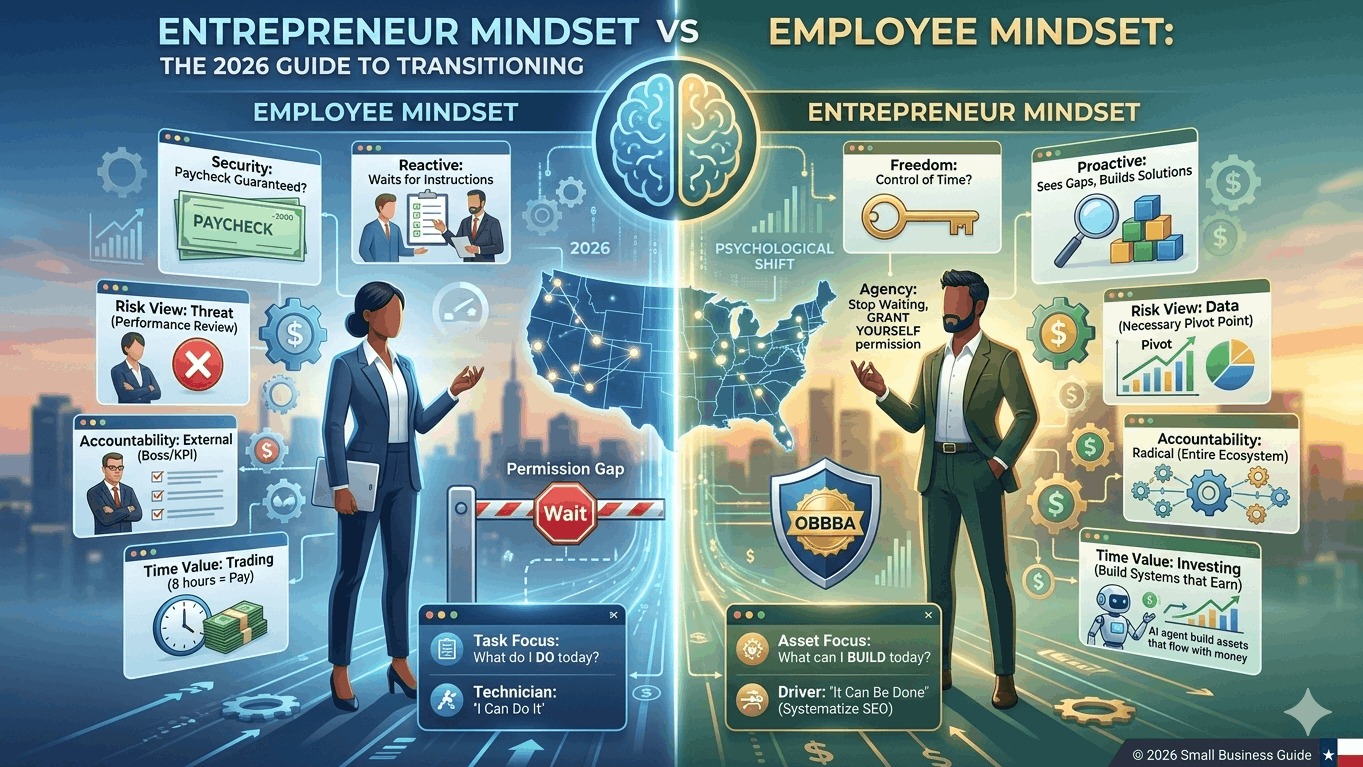
In 2026, the shift from employee to entrepreneur is no longer just a career change; it’s a psychological overhaul. With the One Big Beautiful Bill Act (OBBBA) lowering the cost of entry and AI automating the "tasks" of business, the only remaining competitive advantage is how you think.
To thrive, you must move from a mindset of Permission to a mindset of Agency.
1. The Core Contrast: Stability vs. Freedom
The fundamental tension between these two mindsets is what you value most when you wake up in the morning.
| Feature | Employee Mindset | Entrepreneur Mindset |
|---|---|---|
| Primary Driver | Security: "Is my paycheck guaranteed?" | Freedom: "Am I in control of my time?" |
| Problem Solving | Reactive: Waits for instructions or a manager. | Proactive: Sees a gap and builds a solution. |
| Risk View | Threat: Failure is a mark on a performance review. | Data: Failure is a necessary "Pivot Point." |
| Accountability | External: Responsible to a boss or KPI. | Radical: Responsible for the entire ecosystem. |
| Time Value | Trading: "I get paid for 8 hours of work." | Investing: "I build systems that earn while I sleep." |
2. The 2026 "Permission Gap"
The most difficult transition for a first-time founder in 2026 is overcoming the Permission Gap.
- Employees are trained to wait for the "Green Light"—from a supervisor, a policy manual, or a budget approval.
- Entrepreneurs realize that in 2026, no one is coming to give them the green light. You must grant yourself the authority to launch, even if the "market research" is incomplete.
2026 Insight: In the era of the OBBBA, the government has provided the tax breaks, and AI has provided the tools. The only thing missing is your decision to act.
3. Four Psychological Shifts for 2026
If you are moving from a 9-to-5 into your own venture, you must intentionally install these "Software Updates" into your brain:
Shift 1: From "Tasks" to "Assets"
An employee asks, "What do I need to do today?" An entrepreneur asks, "What can I build today that makes tomorrow easier?" In 2026, this means focusing on building Agentic Workflows (AI automations) rather than just clearing your inbox.
Shift 2: From "I Can Do It" to "It Can Be Done"
The "Employee Pride" of being the best at a specific task is a trap for a founder. To scale, you must move from a Technician (doing the work) to a Driver (ensuring the work gets done).
- Employee: "I'm the best at SEO."
- Entrepreneur: "I've built a system where SEO happens automatically."
Shift 3: Redefining Failure as "Losing the Deposit"
Employees often view failure as a permanent loss of status. Successful 2026 entrepreneurs view failure like a Non-Refundable Deposit on their education. You paid the price (time/money), you didn't get the result, but you kept the lesson.
Shift 4: Embracing "Healthy Friction"
Employees seek a frictionless day (no meetings, no "fires"). Entrepreneurs realize that Friction is where the profit lives. If a problem is easy to solve, someone has already automated it. The harder the problem, the more valuable your solution is.
Quotes & Taglines
- "Employees focus on the 'How'; Entrepreneurs focus on the 'Why'."
- "Security is an illusion; Agency is a choice."
- "Stop trading your hours for dollars; start trading your vision for assets."
- “In 2026, the most dangerous place to be is comfortable.”