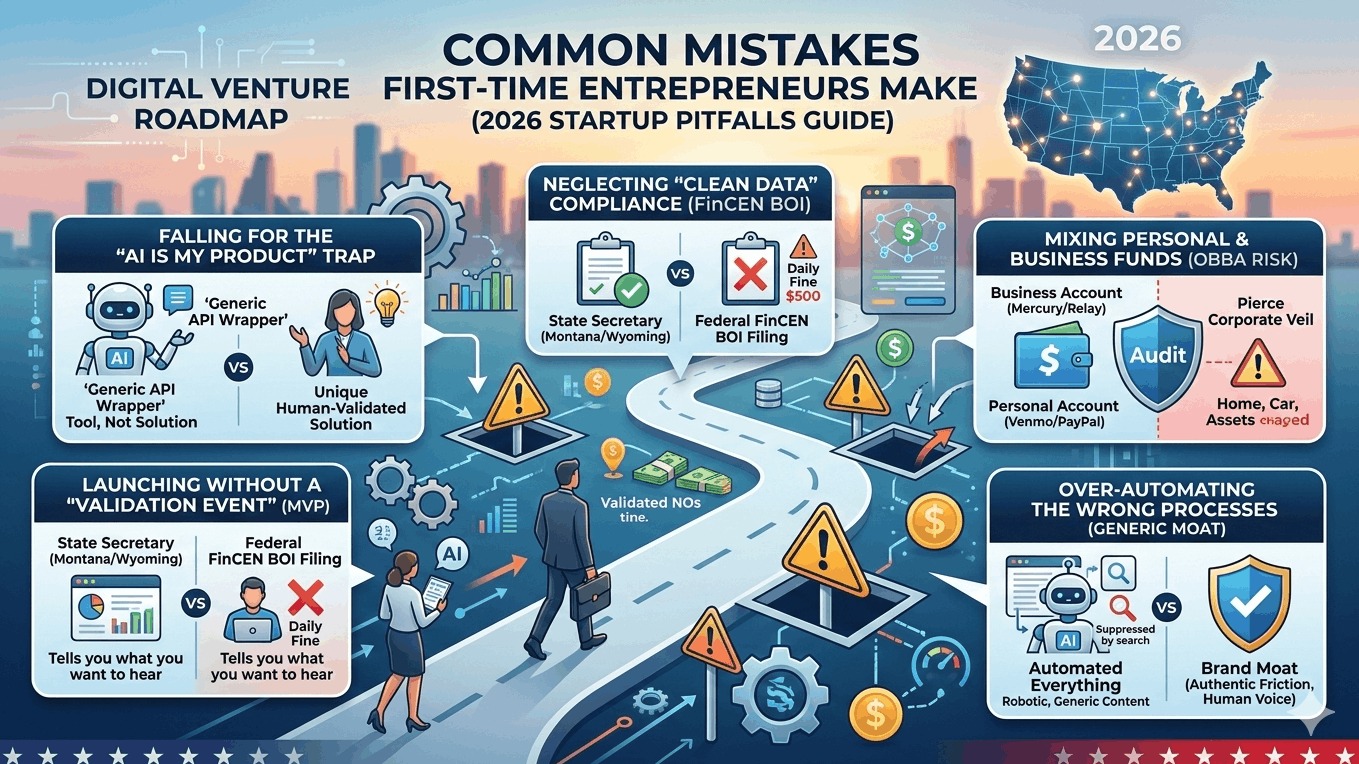
In 2026, the cost of entering the business world has dropped significantly, but the complexity of succeeding has risen. As the One Big Beautiful Bill Act (OBBBA) streamlines regulations and AI lowers operational barriers, a new breed of entrepreneur is emerging—but they are also making a new breed of mistakes.
If you are a first-time founder in 2026, you cannot afford to waste your "digital momentum." Here are the five most common pitfalls that sink startups this year and how you can avoid them.
1. Falling for the "AI is My Product" Trap
In 2026, AI is a utility, not a value proposition.
- The Mistake: Believing that simply wrap-ping an API (e.g., using GPT-o1 or Claude 3.7 to build a "custom coach") is a sustainable business model. Consumers in 2026 are already "AI-Saturated" and can spot a derivative tool instantly.
- How to Avoid: AI should power the solution to a deeply human problem. Your value must come from Proprietary Data, a Niche Framework, or human-in-the-loop validation—things the foundation models don't have.
2. Neglecting "Clean Data" Compliance (FinCEN BOI)
The legal "barrier to entry" is lower in 2026, but the "barrier to non-compliance" is higher.
- The Mistake: Forgetting that the 2024 Beneficial Ownership Information (BOI) report is mandatory. A common error is filing with the Secretary of State (e.g., in Montana or Wyoming) but missing the federal FinCEN filing.
- How to Avoid: File your BOI report within 30 days of formation. Set an automated "AI Agent" reminder to update your filing whenever an owner moves, changes their ID, or the structure is altered.
3. Launching without a "Validation Event" (MVP)
You can still have an MVP in 2026 without writing code.
- The Mistake: Relying on "AI-Generated Market Research" instead of real human conversation. In 2026, AI tools will tell you what you want to hear. You need to get out (digitally) and talk to 50 potential customers.
- How to Avoid: Conduct "Human-Centric Validation" (HCV). Spend zero dollars on ads or a website until you have: 1. A list of 50 validated 'No's', or 2. A waiting list of 100 people who will buy.
4. Mixing Personal and Business Funds (The 2026 OBBBA Risk)
The OBBBA has made certain tax deductions incredibly simple—but only if your records are pristine.
- The Mistake: Paying your personal AI subscriptions or family cell phone bill with the business debit card. In 2026, auditors use AI to scan for "Commingling of Funds." If they find one mix-up, they can "pierce the corporate veil," exposing your personal assets (home, car) to business liabilities.
- How to Avoid: Keep Absolute Separation. Open a dedicated business account (e.g., Mercury or Relay) the day you get your EIN. Categorize every transaction weekly with an automated accounting tool (e.g., QuickBooks Magic).
5. Over-Automating the Wrong Processes (The Generic Moat)
In 2026, a brand is built on "Authentic Friction."
- The Mistake: Automating all customer service, all content creation, and all sales calls with generic AI agents. Your brand will feel robotic, lacks soul, and eventually will be suppressed by search engines looking for "Human Original Intelligence."
- How to Avoid: Deploy "Selective Automation." Automate backend operations (billing, fulfillment, data entry). Keep human elements in the frontend (initial strategy, critical customer support, high-level negotiation). Your "Brand Moat" is your un-copyable human experience.
Quotes & Taglines
- "AI is your fuel; validation is your map."
- "Don't just build a product; build a compliant asset."
- "In 2026, your reputation is your true barrier to entry."
- "Automation speeds you up; friction builds your soul."
- "If the AI can build your business in 10 minutes, your competitor can copy it in 5."