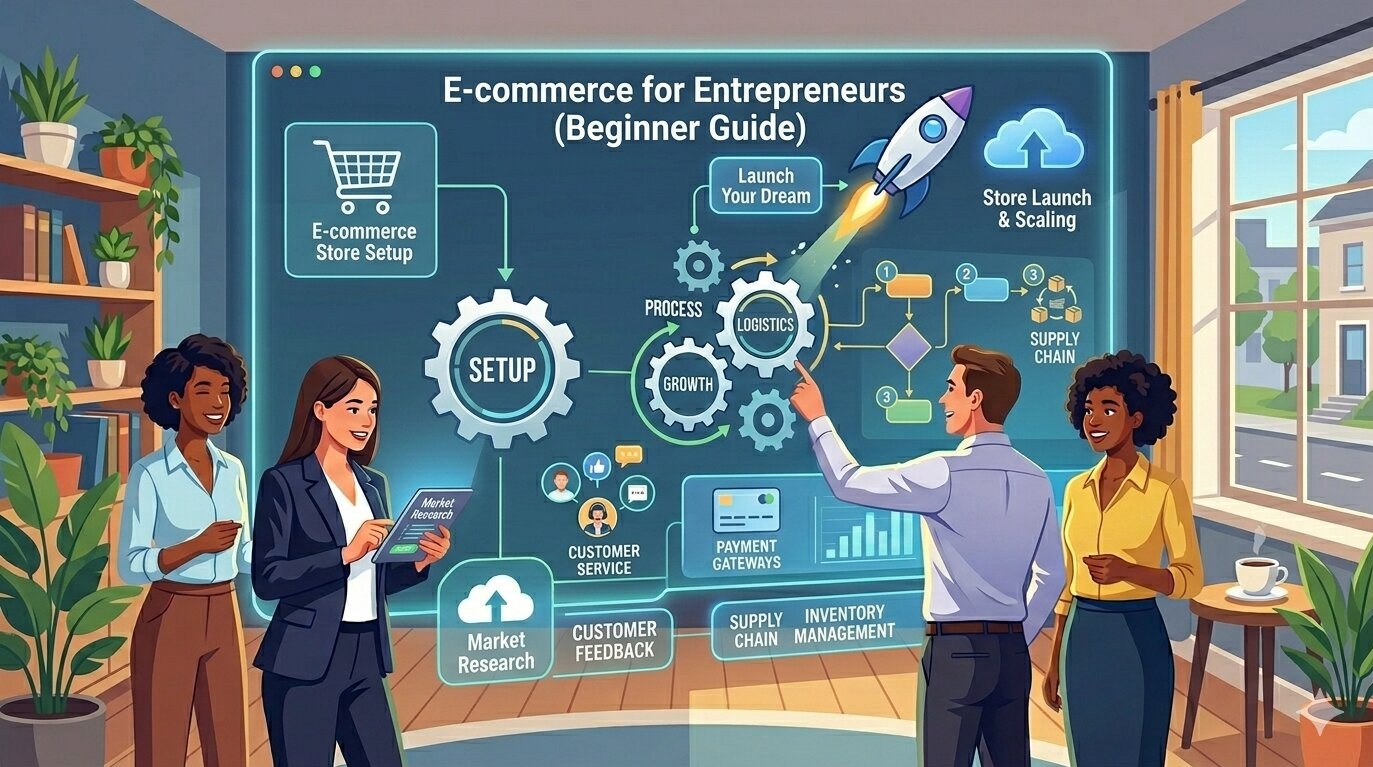
E-commerce has completely changed how businesses operate. Today, you don’t need a physical store to sell products—you can build a profitable business entirely online.
But while starting an e-commerce business looks simple, doing it the right way requires clarity, strategy, and consistency.
In this beginner-friendly guide, we’ll walk you through how e-commerce works, how to start, and how to grow step by step.
What Is E-commerce?
E-commerce means buying and selling products online.
You can sell through:
- Your own website
- Marketplaces
- Social media platforms
Examples:
- Selling clothes on Instagram
- Running a Shopify store
- Listing products on marketplaces
Why E-commerce Is a Great Opportunity
E-commerce offers:
- Low startup costs
- Global reach
- Flexible working
- High scalability
Simple truth:
You don’t need a shop—you need a system.
Step 1: Choose the Right Product
Your product is the foundation of your business.
Choose products that:
- Solve a problem
- Have demand
- Are easy to market
Examples:
- Fashion items
- Home products
- Fitness accessories
If you’re unsure, read:
Best Online Business Ideas for Entrepreneurs → https://statush.com/entrepreneur/best-online-business-ideas-for-entrepreneurs
Step 2: Validate Your Product Idea
Before investing:
- Check demand
- Analyze competitors
- Test small
Example:
- Sell a few units before buying inventory
If you want guidance, read:
How to Find a Profitable Business Idea → https://statush.com/entrepreneur/how-to-find-a-profitable-business-idea
Step 3: Choose Your E-commerce Model
There are different ways to run an e-commerce business:
| Model | Description |
|---|---|
| Inventory | You stock products |
| Dropshipping | No inventory needed |
| Print-on-demand | Custom products |
Each has its pros and cons.
To understand better, read:
How to Choose the Right Business Model → https://statush.com/entrepreneur/how-to-choose-the-right-business-model
Step 4: Set Up Your Store
You need a place to sell your products.
Options:
- Shopify store
- WordPress + WooCommerce
- Instagram shop
Keep it simple at the beginning.
Step 5: Create a Strong Product Offer
People don’t just buy products—they buy value.
Focus on:
- Clear product description
- Benefits (not just features)
- Attractive visuals
Example:
| Weak | Strong |
|---|---|
| T-shirt for sale | Comfortable premium T-shirt for daily wear |
Step 6: Price Your Products Smartly
Pricing should cover:
- Product cost
- Marketing
- Profit margin
If you want to learn pricing, read:
How to Price Your Products for Profit → https://statush.com/entrepreneur/how-to-price-your-products-for-profit
Step 7: Start Marketing Your Products
Without marketing, there are no sales.
Start with:
- Social media content
- Influencer collaborations
- Paid ads (later stage)
If you want to grow faster, read:
Digital Marketing Strategies for Entrepreneurs → https://statush.com/entrepreneur/digital-marketing-strategies-for-entrepreneurs
Step 8: Focus on Customer Experience
Customer experience drives repeat sales.
Focus on:
- Fast delivery
- Good packaging
- Clear communication
To improve retention, read:
How to Turn Customers into Repeat Buyers → https://statush.com/entrepreneur/how-to-turn-customers-into-repeat-buyers
Step 9: Manage Operations Efficiently
E-commerce involves:
- Order processing
- Inventory management
- Customer support
To simplify operations, read:
How to Automate Your Business Operations → https://statush.com/entrepreneur/how-to-automate-your-business-operations
Step 10: Scale Your E-commerce Business
Once you start getting sales:
- Improve your products
- Increase marketing
- Expand your product range
To scale effectively, read:
How to Scale a Small Business → https://statush.com/entrepreneur/how-to-scale-a-small-business
E-commerce Business Flow
| Stage | Action | Goal |
|---|---|---|
| Product | Choose item | Demand |
| Setup | Create store | Presence |
| Marketing | Promote | Sales |
| Delivery | Fulfill orders | Trust |
| Growth | Optimize | Scale |
Real-World Example
Let’s say someone starts:
- Product → Phone accessories
- Platform → Instagram
- First sales → ₹20,000/month
- Scaling → Ads + website → ₹1,00,000/month
Simple start → scalable business.
Avoid These Common Mistakes
- Choosing the wrong product
- Ignoring marketing
- Poor customer experience
- Over-investing too early
If you want to avoid mistakes, read:
Common Entrepreneur Mistakes to Avoid → https://statush.com/entrepreneur/common-entrepreneur-mistakes-to-avoid
Final Thoughts
E-commerce is one of the most powerful business models today—but success comes from doing the basics right.
Focus on:
- Choosing the right product
- Creating value
- Marketing consistently
- Improving over time
You don’t need a big start.
You need a smart start.
With the right approach, your e-commerce business can grow into a strong and scalable income source.