When beginners start learning about stocks, they often hear the word dividend and wonder what it actually means. Then another term appears right after it: dividend yield. At first, it may sound technical, but it is actually one of the simpler concepts in investing once you break it down clearly.
Dividend yield helps investors understand how much income a stock may generate relative to its current share price. For people interested in income investing, retirement planning, or building a portfolio that produces cash flow, dividend yield can be an important number to understand.
But dividend yield should never be looked at in isolation. A high yield may seem attractive, but it does not always mean a stock is a great investment. A low yield does not always mean a stock is weak. To use dividend yield properly, beginners need to understand what it measures, how it is calculated, and how it fits into a broader investing strategy.
This article explains dividend yield in simple terms, shows how it works with examples, and helps beginners understand why this metric matters in the U.S. stock market.
What Is Dividend Yield?
Dividend yield is a financial ratio that shows how much a company pays in dividends each year compared to its current stock price. It is usually expressed as a percentage.
In simple terms, dividend yield tells you how much annual dividend income you may receive for every dollar invested in a stock, based on the stock’s current price.
For example, if a company pays $2 per share annually in dividends and its stock price is $50, the dividend yield is 4%.
That means an investor buying the stock at that price would earn dividend income equal to about 4% of the share price each year, assuming the dividend stays the same.
Dividend Yield Formula
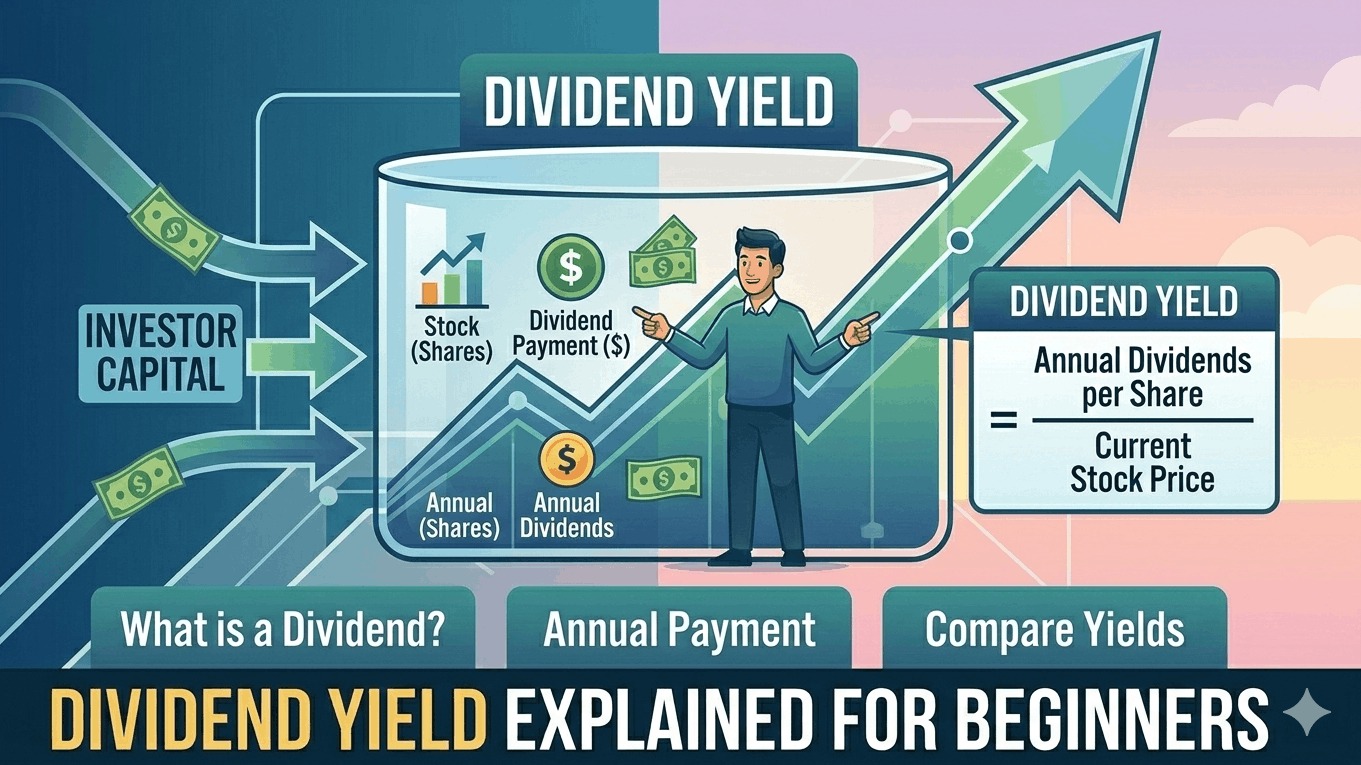
The basic formula for dividend yield is:
Dividend Yield = Annual Dividend Per Share ÷ Current Share Price
Then multiply by 100 to convert it into a percentage.
Here is a simple example:
- Annual dividend per share: $3
- Current stock price: $60
Dividend yield = 3 ÷ 60 = 0.05, or 5%
This means the stock is offering a 5% dividend yield at its current market price.
Why Dividend Yield Matters
Dividend yield matters because it helps investors measure the income potential of a stock. For investors who want regular income from their investments, this can be a useful starting point.
A stock’s price alone does not tell you how much income it produces. Two companies may both have stock prices around $100, but one may pay a much larger dividend than the other. Dividend yield helps compare them more fairly.
It is especially useful for:
- Income-focused investors
- Retirees looking for cash flow
- Beginners learning dividend investing
- Investors comparing dividend-paying stocks
- People building a long-term portfolio with both growth and income
Still, dividend yield is only one piece of the puzzle. It should be used alongside other factors like payout ratio, earnings stability, dividend history, and company fundamentals.
What Is a Dividend?
Before going deeper, it helps to understand the dividend itself.
A dividend is a payment that some companies make to shareholders, usually from profits. These payments are often made quarterly in the United States, although some companies may pay monthly, semiannually, or annually.
When you own shares of a dividend-paying stock, you may receive these payments as cash in your brokerage account or choose to reinvest them to buy more shares.
Not all companies pay dividends. Some businesses prefer to reinvest profits into growth rather than distribute them to shareholders.
Simple Example of Dividend Yield
Let’s say you are comparing three stocks:
| Company | Annual Dividend Per Share | Stock Price | Dividend Yield |
|---|---|---|---|
| Company A | $1.00 | $25 | 4.0% |
| Company B | $2.00 | $100 | 2.0% |
| Company C | $3.00 | $50 | 6.0% |
From this table, Company C has the highest dividend yield because it pays the most dividend relative to its share price.
This does not automatically make Company C the best stock. It simply means that based on its current price and annual dividend, it offers the highest yield of the three.
How Stock Price Affects Dividend Yield
One important thing beginners should understand is that dividend yield changes when the stock price changes.
If a company keeps paying the same dividend but its stock price falls, the dividend yield rises.
If the company keeps paying the same dividend but its stock price rises, the dividend yield falls.
For example:
- Annual dividend: $2
- Stock price at first: $50
- Dividend yield: 4%
Now imagine the stock price falls to $40 while the dividend stays the same:
- Dividend yield becomes 5%
Now imagine the stock price rises to $80 while the dividend stays the same:
- Dividend yield becomes 2.5%
This is why a high dividend yield can sometimes be misleading. It may be high because the stock price dropped sharply, not because the company suddenly became a better income investment.
Example Table: Comparing Yield Quality
| Stock Type | Dividend Yield | Possible Meaning |
|---|---|---|
| Stable blue-chip company | 2% to 4% | Often balanced income and stability |
| Very high-yield stock | 8%+ | May offer strong income, but could carry higher risk |
| Growth-oriented company | 0% to 1.5% | May focus more on reinvestment than income |
| Dividend growth company | 1% to 3% | May offer lower current yield but stronger future growth |
This table is only a general guide, but it shows why yield needs context.
How Dividends Help With Long-Term Investing
Dividends can play an important role in long-term wealth building.
When investors reinvest dividends, those payments buy additional shares. Those extra shares may then generate their own dividends. Over time, this can create a compounding effect.
Here is a simple example:
| Year | Shares Owned | Annual Dividend Per Share | Total Dividend Income |
|---|---|---|---|
| Year 1 | 100 | $1.50 | $150 |
| Year 2 | 103 | $1.50 | $154.50 |
| Year 3 | 106 | $1.55 | $164.30 |
This is a simplified example, but it shows how reinvesting dividends and dividend growth may increase income over time.
Where Beginners Can Find Dividend Yield
Most U.S. brokerage platforms, investing apps, and financial websites show dividend yield as part of a stock’s profile.
You may also see yield listed for:
- Dividend ETFs
- REITs
- Utility stocks
- Blue-chip stocks
- Income-focused mutual funds
Still, the displayed yield may change with the stock price, so it is useful to understand how the number is calculated instead of relying on it blindly.
What Is Considered a Good Dividend Yield?
There is no single dividend yield that is always “good.”
A good yield depends on:
- The company’s financial strength
- The industry
- Market conditions
- Interest rates
- Dividend history
- Your personal investing goal
Some investors may be comfortable with a 2% yield from a strong company with consistent dividend growth. Others may seek higher yields from utilities, telecom stocks, REITs, or income-oriented funds.
In general, it is wise to be cautious when a yield looks unusually high compared with similar companies. That can be a sign that the market expects trouble.
Common Mistakes Beginners Make With Dividend Yield
Chasing the highest yield
This is one of the biggest mistakes. A very high yield can signal risk, not safety.
Ignoring company fundamentals
A dividend is only as strong as the business paying it. Revenue, earnings, debt, and cash flow all matter.
Forgetting about stock price risk
A stock may pay a nice dividend but still lose significant value if the business struggles.
Confusing yield with total return
Dividend yield is only one part of return. Total return also includes changes in stock price.
For example, a stock with a 5% yield that falls 20% in price is not necessarily a better investment than a stock with a 1% yield that rises 15%.
Dividend Yield vs Total Return
This is a very important concept for beginners.
Dividend yield measures income.
Total return measures the full investment result, including both income and price appreciation.
Here is a simple comparison:
| Stock | Dividend Yield | 1-Year Price Change | Approximate Total Return |
|---|---|---|---|
| Stock A | 4% | -10% | -6% |
| Stock B | 1.5% | 12% | 13.5% |
This shows why dividend yield should not be the only factor in choosing investments.
Should Beginners Focus on Dividend Stocks?
Dividend stocks can be a good part of a portfolio, but they should fit the investor’s goal.
A beginner interested in income may naturally pay more attention to dividend yield. A beginner focused on long-term growth may care less about current dividends and more about diversification and total return.
Many investors choose a balanced approach by using:
- Broad index funds
- Dividend ETFs
- Blue-chip dividend stocks
- Growth investments alongside income investments
There is no rule saying every beginner must focus on dividends. But understanding dividend yield helps investors make smarter choices when comparing income-producing investments.
Final Thoughts
Dividend yield is one of the most useful basic metrics for understanding income from a stock. It tells you how much annual dividend income a company pays relative to its share price, expressed as a percentage. For beginners, it can be a helpful way to compare dividend-paying stocks and funds.
But dividend yield should always be viewed in context. A high yield can be attractive, but it can also be a warning sign. A lower yield may come from a stronger company with better long-term growth and dividend safety.
The most important thing is to understand that dividend yield is not a shortcut to finding the best investment. It is simply one tool among many.
For beginner investors in the United States, learning how dividend yield works is a smart step toward understanding income investing, evaluating dividend stocks, and building a more informed long-term portfolio.