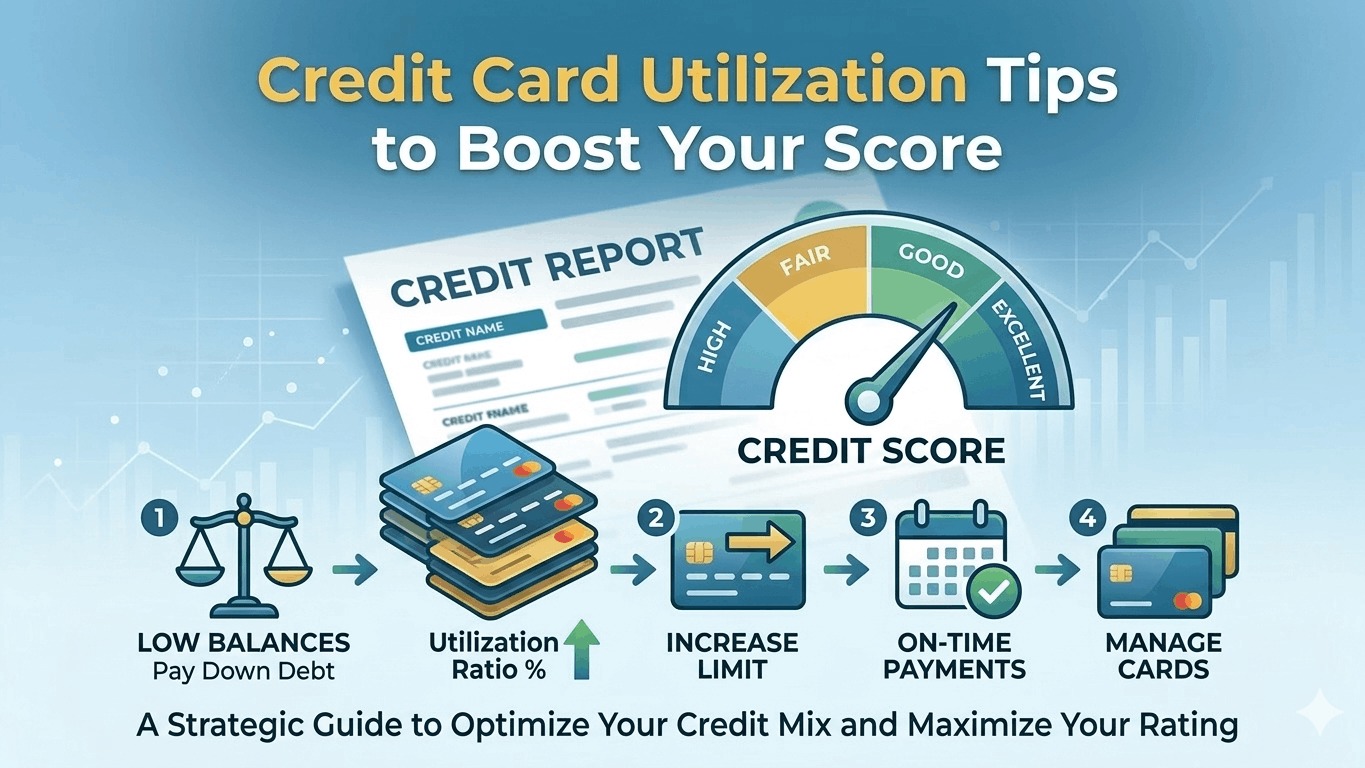
Credit Utilization remains the second most important factor in your credit score, accounting for 30% of your FICO score and roughly 20% of your VantageScore.
However, the "30% rule" is outdated. In the modern lending environment—driven by FICO 10T and VantageScore 4.0—lenders now use Trended Data to see if your balances are rising or falling over a 24-month period. To achieve a "Superprime" score (800+), you need to master the math behind your limits.
1. The 2026 "Magic Ratios"
While 30% is the "danger zone," high achievers aim much lower. Here is how 2026 scoring models typically categorize your utilization:
| Utilization Rate | Rating | Impact on Score |
|---|---|---|
| 0% – 3% | Exceptional | The "sweet spot" for 800+ scores. |
| 4% – 10% | Excellent | Highly favorable for premium card approvals. |
| 11% – 29% | Good | Safe, but won't maximize your score. |
| 30% – 50% | Fair | Risk of score plateau or slight drops. |
| 51%+ | High Risk | Significant score damage; signals financial stress. |
2. The "Statement Date" Hack
The biggest mistake borrowers make is paying their bill on the due date.
- The Problem: By the time your due date arrives, the bank has already reported your high balance to the bureaus.
- The 2026 Fix: Find your Statement Closing Date (usually 21–25 days before your due date). Pay your balance down to under 3% three days before the statement closes. When the bureau receives the data, it sees a tiny balance, even if you spent thousands that month.
3. Strategies to Lower Utilization Fast
The "AZEO" Method (All Zero Except One)
If you have multiple cards, 2026 models reward "cleanliness."
- Pay off every card to a $0 balance before the statement closes.
- On only one card, allow a small balance (e.g., $15) to report.
- This proves you are an active user of credit but have zero dependency on it.
Strategic Limit Increases
In 2026, most major US banks (Chase, Amex, Capital One) allow you to request a credit limit increase via their mobile app with a "Soft Pull" (no score damage).
- The Math: If you owe $1,000 on a $2,000 limit, you are at 50% (Bad). If you increase that limit to $5,000, you are instantly at 20% (Good) without spending a dime.
Micropayments
Instead of one large payment, make weekly payments. In the 2026 "Trended Data" environment, this shows a consistent downward trend in debt, which AI underwriting models favor over "lumpy" once-a-month payments.
4. Utilization Myths to Ignore
- "Carrying a balance helps your score": False. Carrying a balance only costs you interest. 2026 models care about the reported balance, not how much interest you pay.
- "Closing an unused card is good": False. Closing a card removes its limit from your total pool, which instantly spikes your utilization ratio. Unless it has a high annual fee, keep it open and put one small subscription (like Netflix) on it.