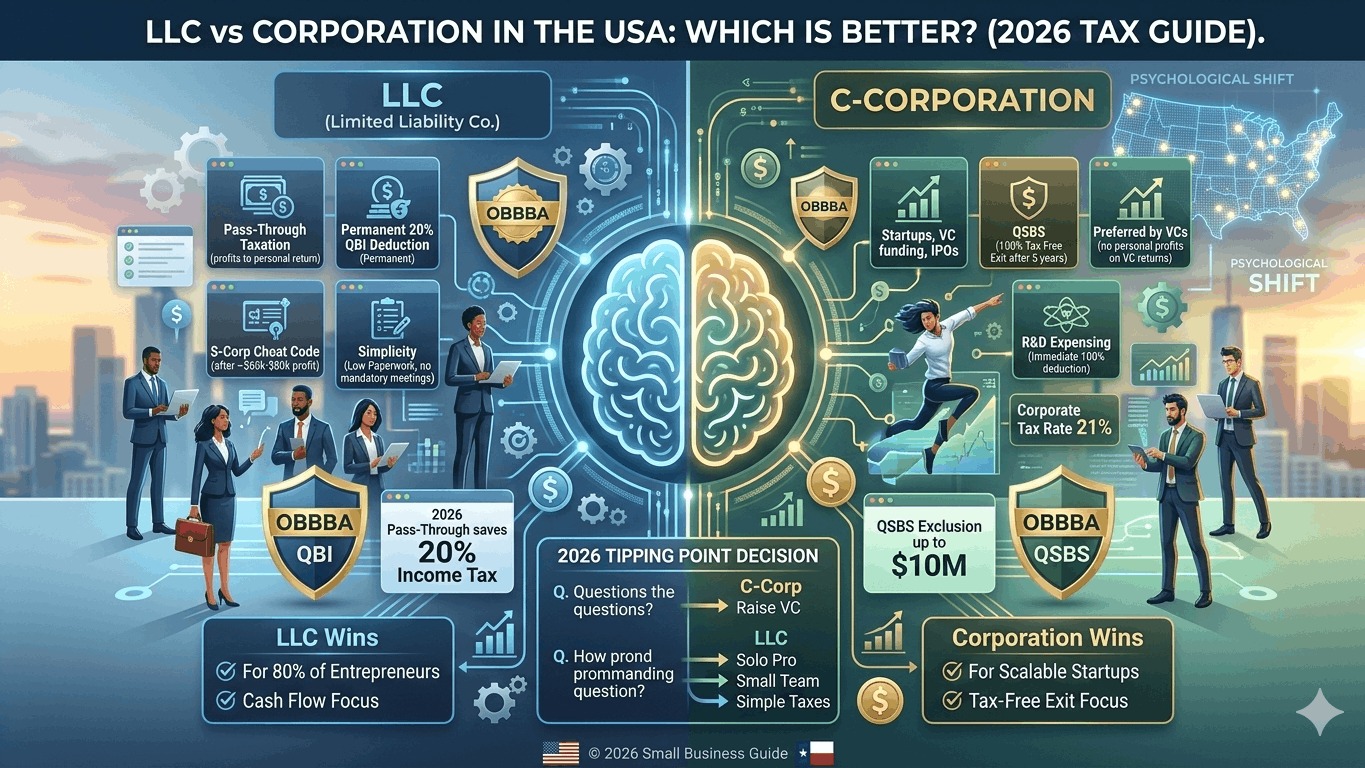
In 2026, the debate between an LLC and a Corporation has been fundamentally reshaped by the One Big Beautiful Bill Act (OBBBA). Choosing the wrong one isn't just a paperwork headache—it can cost you thousands in missed permanent tax deductions or disqualify you from the new 2026 investment incentives.
Here is the 2026 breakdown of which structure actually wins for your specific goals.
1. Quick Comparison: LLC vs. Corporation
| Feature | LLC (Limited Liability Co.) | C-Corporation |
|---|---|---|
| Best For | Small businesses, solo founders, and "lifestyle" ventures. | Startups seeking VC funding, IPOs, or heavy scaling. |
| 2026 Taxation | Pass-Through: Profits go straight to your personal return. | Double Taxation: Taxed at corporate level (21%) AND dividend level. |
| OBBBA Benefit | Permanent 20% QBI Deduction (save 20% on income tax). | Immediate R&D Expensing and QSBS gain exclusion. |
| Paperwork | Low. No mandatory annual meetings or board minutes. | High. Requires Board of Directors, minutes, and bylaws. |
| Ownership | Flexible. Any number of "members" (individuals or entities). | Rigid. Ownership is defined by shares of stock. |
2. Why the LLC Wins (The "Lifestyle" Founder)
For 80% of entrepreneurs in 2026, the LLC is the superior choice because of Pass-Through Flexibility.
- The OBBBA Advantage: The 20% Qualified Business Income (QBI) deduction is now permanent. If your LLC makes $100,000, you only pay income tax on $80,000. C-Corps cannot claim this.
- The "S-Corp" Cheat Code: As an LLC, you can elect S-Corp Tax Status once you hit ~$60k–$80k in profit. This allows you to split your income into "Salary" and "Distributions," saving you thousands in self-employment taxes.
- Simplicity: You don't need a board of directors to decide to buy a new laptop. You just buy it.
3. Why the Corporation Wins (The "Scalable" Founder)
If you plan to raise venture capital or offer employee stock options, an LLC is a "deal-breaker" for most 2026 investors.
- QSBS (The 100% Tax Free Exit): Under the OBBBA, if you hold Qualified Small Business Stock in a C-Corp for 5 years, you can potentially exclude 100% of your gains (up to $10M) from federal tax when you sell.
- Preferred by VCs: Institutional investors hate "pass-through" entities like LLCs because they don't want business profits showing up on their own personal tax returns.
- R&D Deductions: The OBBBA now allows C-Corps to immediately deduct 100% of domestic Research & Development costs, providing massive upfront cash flow for tech startups.
4. The 2026 "Tipping Point" Decision Matrix
Ask yourself these three questions to decide:
- Do I want to raise money from a VC? → C-Corp.
- Am I a solo pro or a small team? → LLC.
- Do I want the simplest taxes possible? → LLC.
Quotes & Taglines
- "The LLC is for cash flow; the Corporation is for the exit."
- "In 2026, your entity structure is your first tax strategy."
- "Don't build a C-Corp skyscraper if you only need an LLC cottage."
- "Structure for the business you have, not the ego you want."