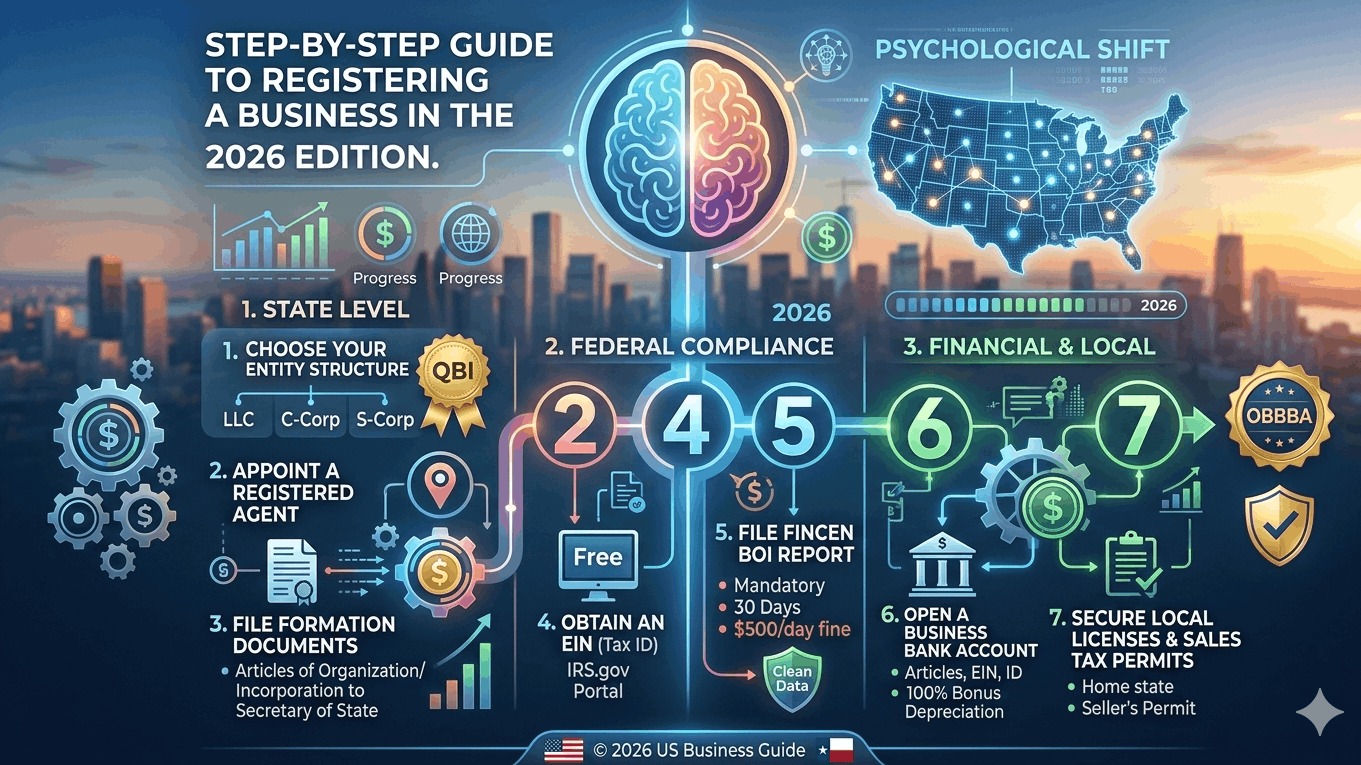
In 2026, registering a business in the United States has become a blend of traditional state filings and new federal transparency requirements. With the One Big Beautiful Bill Act (OBBBA) now in effect, entrepreneurs enjoy permanent tax benefits, but must navigate stricter "Clean Data" compliance rules.
This guide provides the definitive 2026 step-by-step framework for establishing a legal, tax-compliant entity.
1. The 2026 Registration Roadmap
Launching a business today requires satisfying three levels of government: State (Legal Entity), Federal (Tax & Transparency), and Local (Operating Permission).
Step 1: Choose Your Entity Structure
Your choice impacts your liability and how you benefit from the OBBBA’s permanent tax cuts.
- LLC (Limited Liability Company): Most popular for 2026 startups. Provides personal asset protection and qualifies for the permanent 20% QBI deduction.
- C-Corp: Best for those seeking venture capital. Under OBBBA, R&D costs are now immediately deductible.
- S-Corp: An LLC or C-Corp that elects to be taxed as a pass-through entity to save on self-employment taxes.
Step 2: Appoint a Registered Agent
In 2026, every entity must have a designated "Registered Agent" with a physical address in the state of formation to receive legal service of process and government notices.
Step 3: File Formation Documents
Submit your Articles of Organization (for LLCs) or Articles of Incorporation (for Corporations) to the Secretary of State.
- Cost: Varies by state (e.g., ~$50 in Kentucky, ~$300 in Texas).
- Timeline: 24–72 hours via most state online portals.
2. Federal Compliance: Tax & Transparency
Once your state entity is live, you must secure your "Digital DNA" with the federal government.
Step 4: Obtain an EIN (Employer Identification Number)
Your EIN is your business’s Social Security Number. It is free and required to open bank accounts or hire employees. Under 2026 rules, you must apply directly via the IRS.gov portal.
Step 5: File Your FinCEN BOI Report
CRITICAL: As of 2025/2026, the Corporate Transparency Act is strictly enforced.
- Requirement: You must report "Beneficial Ownership Information" (BOI) to the Financial Crimes Enforcement Network (FinCEN).
- Deadline: Within 30 days of your state formation.
- Penalty: Non-compliance carries a $500 per day fine.
Note: While some 2025 court cases briefly paused this for domestic companies, current 2026 guidance mandates filing for nearly all active small businesses.
3. Financial & Local Infrastructure
Step 6: Open a Business Bank Account
Under the OBBBA, maintaining a separate business account is vital to claiming the 100% bonus depreciation on equipment.
- Required Documents: Articles of Incorporation, EIN Confirmation, and Owner’s ID.
- 2026 Recommended Banks: Mercury, Relay, or Chase Business.
Step 7: Secure Local Licenses & Sales Tax Permits
Even an online business may need a "General Business License" from their city or county. If you sell physical or digital goods, you must register for a Sales Tax Permit (Seller's Permit) in your home state to collect and remit tax.
Quotes & Taglines
- "Registration is the birth certificate of your ambition."
- "In 2026, compliance is the ultimate competitive advantage."
- "A business without an EIN is just a hobby with higher risk."
- "Build your entity on a rock of compliance, not the sand of 'I'll fix it later'."