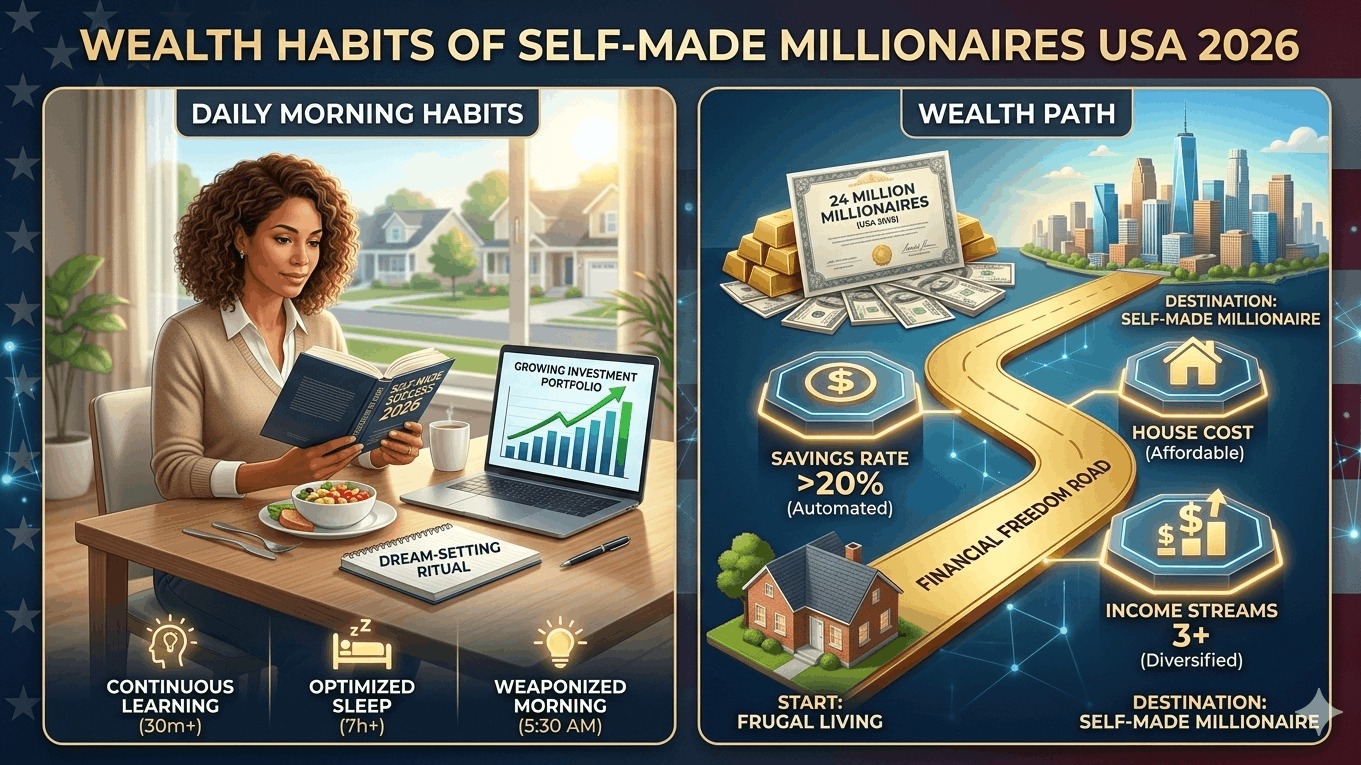
In 2026, the image of a millionaire has shifted away from the "Instagram jet-setter" toward the "Saver-Investor Next Door." As of early this year, the United States is home to over 24 million millionaires, and nearly 80% of them are self-made. These individuals didn't find a "lucky break"; they built their empires on a foundation of boring, repeatable habits that prioritize long-term freedom over short-term flash.
1. The Financial Blueprint of the 2026 Millionaire
Self-made success in the U.S. is rarely about one high-paying job. It is about a disciplined strategy for managing the "gap" between what you earn and what you spend.
| Habit | The "Millionaire" Standard | 2026 Practical Application |
|---|---|---|
| Savings Rate | Save 20% or more of net income. | Automate transfers to a brokerage on payday. |
| Housing Cost | Spend <25% of monthly income. | Avoid "house hacking" into a home you can't afford. |
| Income Streams | Maintain 3 or more sources of income. | Dividends, side hustles, and rental income. |
| Vehicle Choice | Buy and hold used cars for 10+ years. | Avoid the 8-12% APR trap of new auto loans. |
| Investment Style | Buy & Hold index funds and equity. | 95% own their home; 47% are heavy stock investors. |
2. The "Rich Habits" Daily Routine
Research into hundreds of U.S. millionaires (most notably by Tom Corley and recent 2026 surveys) reveals a striking pattern of daily behaviors that sharpen the mind and protect the wallet.
- Continuous Learning: 88% of self-made millionaires read for at least 30 minutes daily. They focus on self-education (finance, biographies, or industry trends) rather than entertainment.
- The 7-Hour Sleep Rule: Despite the "hustle culture" myth, 93% of millionaires sleep at least 7 hours a night. They treat rest as a "recharge station" for high-stakes decision-making.
- The "Dream-Setting" Ritual: Instead of vague resolutions, they practice "dream-setting"—writing a script for their life 10 years in the future and breaking it into actionable daily tasks.
- Active Restoration: Successful entrepreneurs in 2026 are aggressively protecting their "shutdown" time. Many close their laptops by 7 PM to ensure they have the mental clarity for a "weaponized morning."
2026 Insight: In the "Post-Information Age," millionaires are choosing depth over distraction. They curate their environments to minimize noise (less social media, fewer useless meetings) to focus on high-impact tasks.
3. The 3 Paths to Wealth in 2026
According to 2026 economic data, self-made millionaires typically follow one of three specific trajectories:
- The Saver-Investor: The most common path. Middle-class workers who live frugally, maximize employer 401(k) matches, and let compounding do the heavy lifting over 30 years.
- The Virtuoso: Highly skilled professionals (doctors, lawyers, tech leads) who maximize their "career milk"—using every benefit from HSAs to employee stock purchase plans.
- The Entrepreneur: The fastest path. These individuals live extremely frugally to reinvest every cent of profit back into their business until it hits a "valuation inflection point."
Quotes & Taglines
- "Wealth is a quiet accumulation of disciplined choices."
- "The millionaire next door doesn't look like a millionaire; that's how they stayed one."
- "In 2026, focus is the new currency and discipline is the new gold."
- "Don't work for a paycheck; build a machine that pays you."
- "Your future self is counting on the habits you build today."