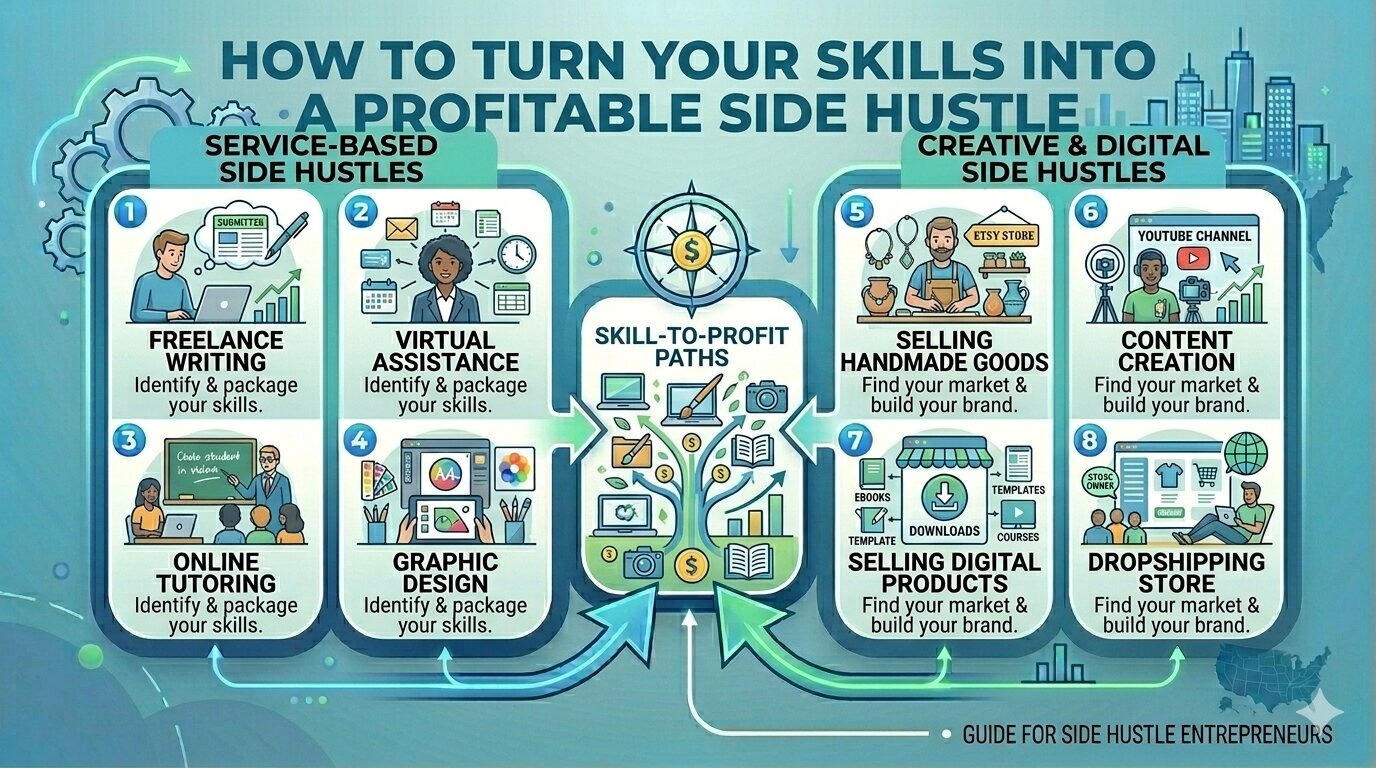
Most people think they need a “new idea” to start a side hustle. In reality, they already have something far more valuable—skills.
The problem isn’t lack of ability. It’s not knowing how to convert those skills into income.
Once you understand that process, making money becomes much more straightforward.
Why Skills Are Your Biggest Asset
Unlike traditional businesses that require capital, skill-based side hustles require something different: what you already know.
This gives you three major advantages:
- No upfront investment
- Faster start
- Higher profit margins
For example, someone who knows basic graphic design doesn’t need inventory, storage, or logistics. They just need a client.
If you're still figuring out how to start, read:
How to Start a Side Hustle While Working a 9-to-5 Job
https://statush.com/side-hustles/how-to-start-a-side-hustle-while-working-a-9-to-5-job
Step 1: Identify Your Marketable Skills
The first step is awareness. Many people overlook their own skills because they feel “too normal.”
Ask yourself:
- What do I do well at my job?
- What do people ask my help for?
- What tasks feel easy to me but difficult to others?
Types of Skills You Can Monetize
| Skill Type | Examples | Monetization Idea |
|---|---|---|
| Professional | Writing, coding, marketing | Freelancing |
| Creative | Design, video editing | Content services |
| Knowledge-based | Teaching, coaching | Tutoring |
| Administrative | Organization, communication | Virtual assistant |
Real Insight
If someone is willing to pay to save time or solve a problem—and your skill can help—you have a monetizable skill.
Step 2: Match Skills With Real Demand
Having a skill is one thing. Matching it with demand is what creates income.
Here’s how skills translate into real opportunities:
| Skill | Service You Can Offer |
|---|---|
| Writing | Blog writing, copywriting |
| Design | Logos, social media graphics |
| Teaching | Online tutoring |
| Tech | Website development |
| Organization | Email management |
Example
A person who is good at writing emails can offer email copywriting services to businesses. What seems simple to them can be valuable to someone else.
Step 3: Package Your Skill as a Service
This is where most beginners struggle.
A skill alone is not enough—you need to present it as a clear service.
Instead of saying:
“I know graphic design”
Say:
“I create professional logos for small businesses”
Why This Matters
Clients don’t buy skills—they buy solutions to problems.
Simple Service Formula
Skill + Problem + Outcome = Service
Example:
- Skill → Writing
- Problem → Businesses need content
- Outcome → SEO blog posts
Final service:
“I write SEO blog articles for businesses”
Step 4: Start Small and Validate Quickly
You don’t need a perfect website or branding to start.
Instead:
- Offer one service
- Target one audience
- Start immediately
Example
A beginner offers resume writing services:
- First client → $20
- Second client → $50
- Later → $100+
You improve as you go.
If you're unsure how to start offering services, read:
How to Start Freelancing as a Beginner
https://statush.com/side-hustles/how-to-start-freelancing-as-a-beginner
Step 5: Use Platforms to Find Clients Faster
Instead of searching for clients manually, use platforms where demand already exists.
Explore:
Best Freelance Websites to Find Work in the USA
https://statush.com/side-hustles/best-freelance-websites-to-find-work-in-the-usa
These platforms allow you to:
- Showcase your skills
- Get discovered by clients
- Build experience quickly
Step 6: Build a Simple Portfolio
A portfolio shows proof of your work. Even if you don’t have clients yet, you can create sample work.
Example
- Writers → Write sample blog posts
- Designers → Create sample logos
- Developers → Build demo websites
This builds trust—even before you have real clients.
Step 7: Improve and Scale
Once you start getting work, your focus should shift from starting → improving.
Growth Strategy
- Increase pricing gradually
- Specialize in one niche
- Build long-term clients
- Improve quality and efficiency
Real-World Example
A freelance writer:
- Starts at $20/article
- Moves to $50/article
- Specializes in finance writing → $150/article
Same skill—better positioning and pricing.
Common Mistakes to Avoid
Many beginners slow themselves down with these mistakes:
- Waiting too long to start
- Trying to learn too many skills
- Undervaluing their work
- Not focusing on one niche
- Ignoring consistency
The biggest mistake?
Not taking action early enough.
How to Choose the Right Skill to Monetize
If you have multiple skills, use this simple filter:
| Criteria | Question |
|---|---|
| Demand | Are people paying for this? |
| Ease | Can I start quickly? |
| Interest | Do I enjoy doing this? |
| Growth | Can I scale this over time? |
Choose the skill that checks most boxes.
Final Thoughts
Turning your skills into a profitable side hustle is not complicated—it’s a structured process.
- Identify what you’re good at
- Match it with demand
- Package it as a service
- Start small
- Improve consistently
You don’t need a new idea. You need to use what you already have.
And once you do, you’ll realize that your skills are not just abilities—they’re income opportunities.