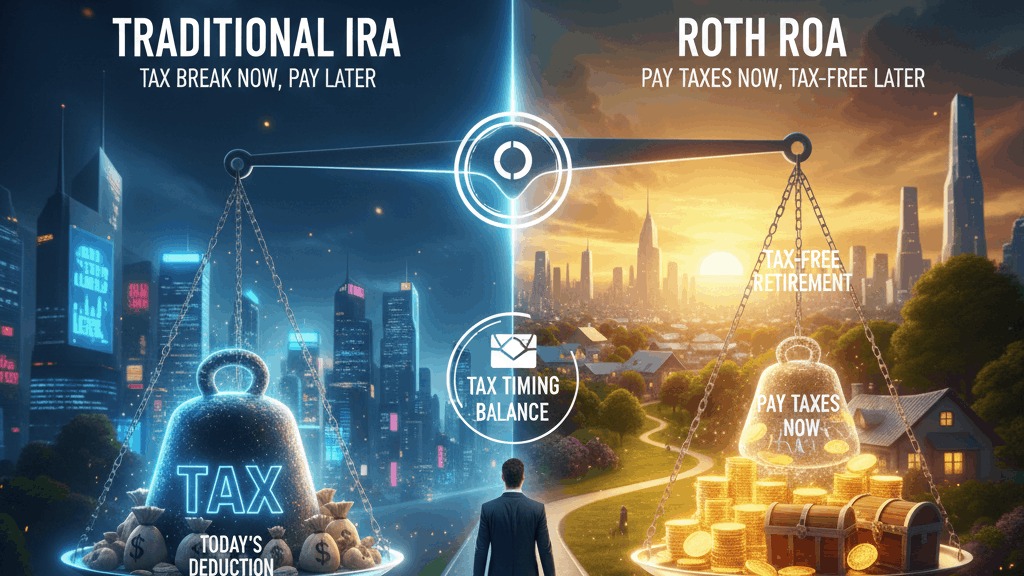
The fundamental difference between these two accounts is when you pay the tax man. * Traditional IRA: You get a tax break now (contributions are often deductible), but you pay taxes on everything you withdraw later.
- Roth IRA: You get no tax break now (contributions are after-tax), but everything you withdraw in retirement is 100% tax-free.
In 2026, the IRS has increased contribution limits, making it even more lucrative to pick the right strategy for your current income bracket.
2026 Contribution Limits
For the first time in several years, the limits have seen a significant jump. You can split your money between both accounts, but the total combined contribution cannot exceed these amounts:
| Category | 2026 Limit |
|---|---|
| Under Age 50 | $7,500 |
| Age 50 and Older | $8,600 (Includes $1,100 catch-up) |
The Deep Dive: How They Compare
1. Tax Treatment
- Traditional: Your contributions can lower your taxable income today. If you earn $60,000 and contribute $7,500, the IRS only taxes you as if you earned $52,500.
- Roth: You pay tax on your full $60,000 income. However, that $7,500 can grow for 30 years and turn into $100,000—and you won't owe a single penny in taxes when you spend it.
2. Income Eligibility (The "Fine Print")
The IRS restricts who can use these accounts based on their Modified Adjusted Gross Income (MAGI):
- Roth IRA: If you make too much money, you are barred from contributing directly. For 2026, the phase-out starts at $153,000 for singles and $242,000 for married couples.
- Traditional IRA: Anyone with earned income can contribute, but your ability to deduct those contributions on your taxes disappears if you (or your spouse) have a retirement plan at work and earn above certain levels.
3. Early Withdrawals
- Roth IRA: This is the more flexible account. You can withdraw your contributions (the money you put in) at any time, for any reason, with no taxes or penalties. You only get penalized if you touch the earnings before age 59½.
- Traditional IRA: Generally, any money you take out before 59½ is hit with a 10% penalty plus income tax, though there are exceptions for first-time home buys and education.
4. Required Minimum Distributions (RMDs)
- Traditional: The government eventually wants its tax money. You must start taking money out (and paying tax on it) once you reach age 73.
- Roth: There are no RMDs during your lifetime. You can let the money sit and grow tax-free until the day you pass away, making it a superior tool for inheritance.
Which Should You Choose?
The Rule of Thumb: > * If you think your tax rate will be higher in retirement (you're early in your career), go Roth.
- If you think your tax rate is higher now than it will be in retirement (you're in your peak earning years), go Traditional.
Why "Roth" is winning in 2026:
Many investors are leaning toward the Roth IRA because tax rates are historically low. By "locking in" today's tax rates, you protect yourself against the risk of the government raising taxes in the future.
10 Powerful Quotes on Roth IRA vs Traditional IRA
- “A Roth IRA pays taxes now for freedom later; a Traditional IRA delays taxes for relief today.”
- “With a Roth IRA, you trade today’s deduction for tomorrow’s tax-free growth.”
- “A Traditional IRA rewards you upfront; a Roth IRA rewards you at retirement.”
- “Choosing between Roth and Traditional isn’t about which is better — it’s about when you want to pay taxes.”
- “A Roth IRA bets on higher taxes later; a Traditional IRA bets on lower taxes in retirement.”
- “Pay taxes on the seed with a Roth, or pay taxes on the harvest with a Traditional.”
- “Your current income and future expectations should guide your IRA choice.”
- “A Traditional IRA lowers taxable income now; a Roth IRA eliminates taxes on qualified withdrawals.”
- “The smartest retirement strategy may include both — balancing today’s savings with tomorrow’s security.”
- “Roth or Traditional, the real power lies in starting early and contributing consistently.”
Conclusion
Choosing between a Roth and a Traditional IRA isn't just about math; it's about predicting the future. While the Traditional IRA offers instant gratification with a tax break today, the Roth IRA offers the ultimate peace of mind: a tax-free future. Most financial experts recommend having a mix of both to stay "tax-diversified."