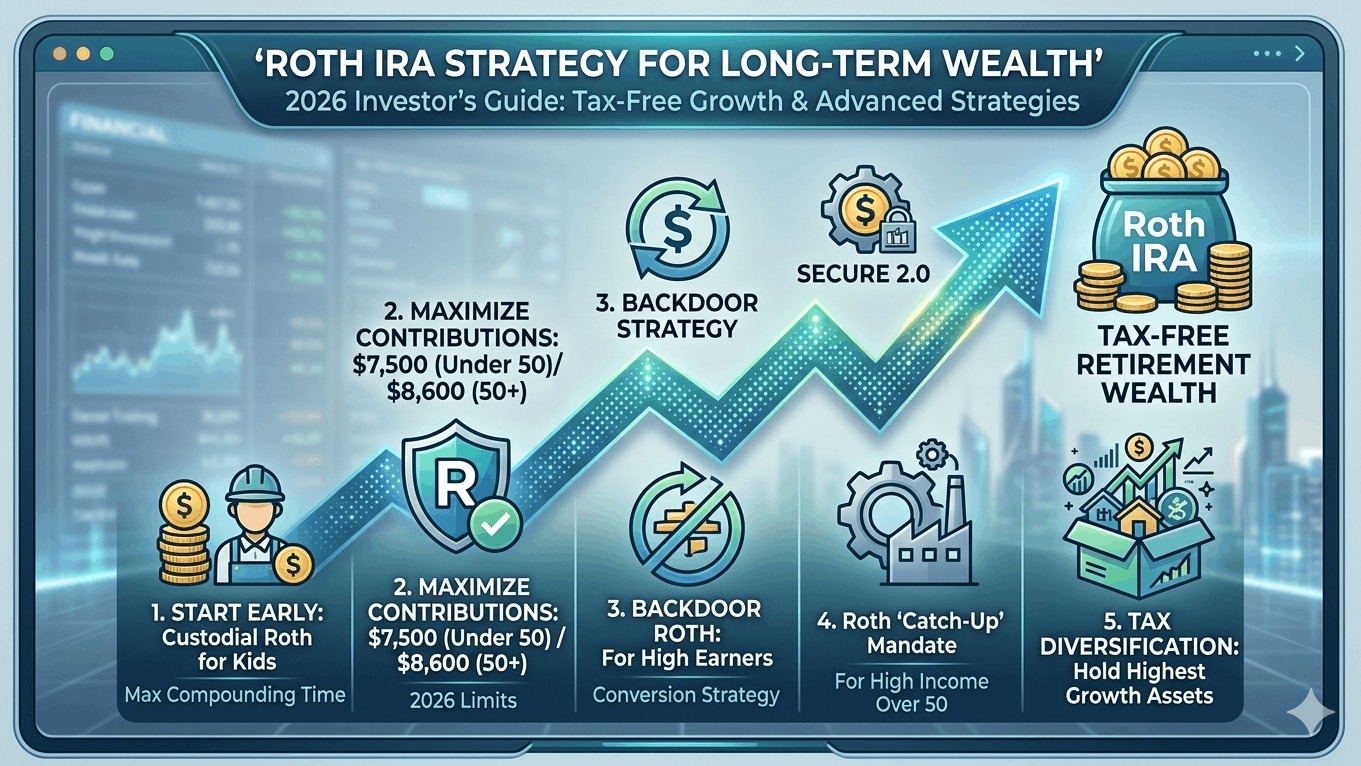
💰 The 2026 Roth IRA Rules
The IRS has adjusted the limits for 2026 to keep up with inflation, allowing you to shield more money from future taxes than ever before.
2026 Contribution Limits
- Under Age 50: $7,500
- Age 50 and Older: $8,600 (includes a $1,100 catch-up contribution)
2026 Income Phase-Out Ranges
To contribute directly to a Roth IRA, your Modified Adjusted Gross Income (MAGI) must be below these thresholds
- Single / Head of Household: Full contribution if MAGI is < $153,000.
- Married Filing Jointly: Full contribution if MAGI is < $242,000.
🚀 Advanced Wealth Strategies for 2026
1. The "Backdoor" Roth IRA (For High Earners)
If you earn too much to contribute directly, you can still use the Backdoor Roth strategy. You contribute to a non-deductible Traditional IRA and then immediately "convert" those funds to a Roth IRA.
- Pro Tip: In 2026, be wary of the Pro-Rata Rule. If you have existing pre-tax money in any Traditional IRA, the IRS will tax your conversion proportionally. Consider rolling old IRAs into your current 401(k) to "clear the path" for a tax-free backdoor conversion.
2. SECURE 2.0 "Rothification"
Starting in 2026, a key provision of the SECURE 2.0 Act kicks in: If you earn more than $145,000 (indexed for inflation, approximately $150k+ in 2026) in the previous year, any "catch-up" contributions you make to your employer's 401(k) must go into a Roth account. This mandate effectively forces high-earning older workers to build tax-free wealth.
3. The "Parent Match" for Kids
A Roth IRA isn't just for adults. If your child has earned income (from a summer job or part-time work), you can open a Custodial Roth IRA for them.
- Strategy: If your teen earns $3,000, you can "match" it by contributing $3,000 to their Roth IRA while they keep their paycheck. Starting a Roth at age 15 can result in millions of tax-free dollars by age 65 due to the extra decade of compounding.
📊 Roth IRA vs. Traditional IRA: The 2026 Verdict
| Feature | Roth IRA | Traditional IRA |
|---|---|---|
| Tax Break | None (Post-tax dollars) | Immediate (Pre-tax dollars) |
| Withdrawals | Tax-Free in retirement | Taxed as ordinary income |
| RMDs | No Required Distributions | Must start at age 73/75 |
| Accessibility | Can withdraw contributions anytime | 10% penalty before 59½ |
Here are 10 strong quotes for “Roth IRA Strategy for Long-Term Wealth”:
- "A Roth IRA turns today’s taxed dollars into tomorrow’s tax-free wealth."
- "The power of a Roth IRA lies in long-term, tax-free compounding."
- "Pay taxes now, enjoy freedom later — that’s the Roth IRA strategy."
- "Time is the greatest advantage inside a Roth IRA."
- "Consistent contributions to a Roth IRA can quietly build substantial retirement wealth."
- "A Roth IRA rewards patience with tax-free growth."
- "The earlier you start a Roth IRA, the greater the long-term impact."
- "Smart investors use a Roth IRA to protect future income from taxes."
- "Long-term wealth isn’t just about returns — it’s about keeping what you earn."
- "A disciplined Roth IRA strategy today can create financial independence tomorrow."