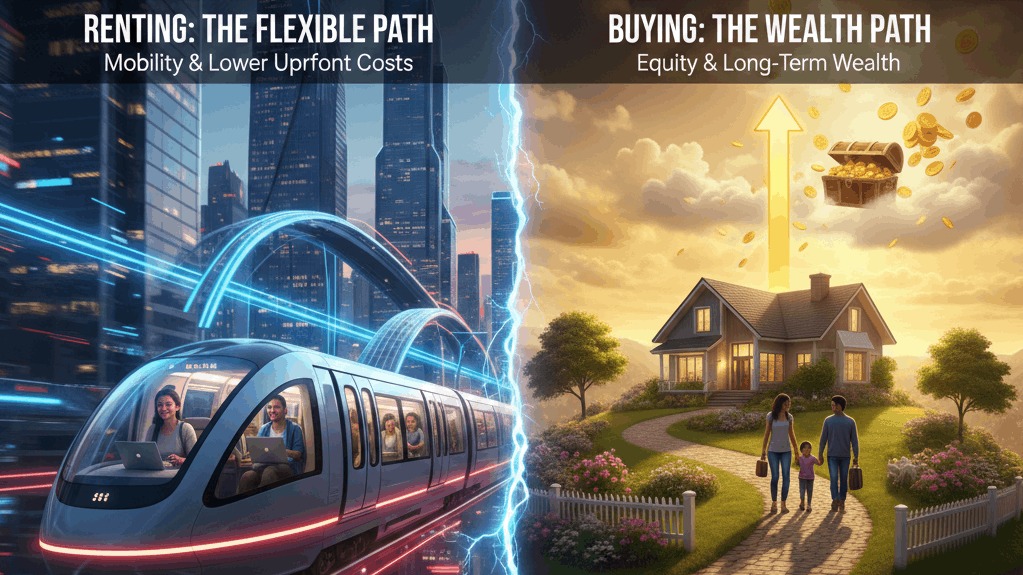
The decision to rent or buy a home is rarely just about a roof over your head; it’s a major pivot point for your net worth. In 2026, the housing market has shifted into a "New Normal" of steady but slower appreciation, making the choice more strategic than emotional.
1. The Cost Comparison: Upfront vs. Ongoing
Understanding the "entry price" and the "carrying cost" is the first step in the math.
| Feature | Renting in 2026 | Buying in 2026 |
|---|---|---|
| Upfront Cost | 1–2 months' rent (Security Deposit) | 10–20% Down Payment + Closing Costs |
| Monthly Payment | Rent + Utilities | Mortgage (P&I) + Taxes + Insurance + HOA |
| Maintenance | $0 (Landlord's responsibility) | 1–2% of home value annually (Estimated) |
| Tax Impact | Generally none (except HRA in some regions) | Deductions for mortgage interest & property tax |
| Asset Building | None (Money is "spent") | Equity (Money is "saved" in the asset) |
2. Why Renting Wins (The Case for Flexibility)
Renting isn't "throwing money away"—it’s buying freedom and time.
- Mobility: In the hybrid-work economy of 2026, the ability to move for a better job or lifestyle without selling a property is a massive financial advantage.
- Lower Risk: You aren't tied to a single asset. If the local neighborhood declines or a major employer leaves, you can leave when your lease is up.
- Opportunity Cost: By not locking up $100,000 in a down payment, you can invest that capital in high-growth areas like the stock market or a private business.
3. Why Buying Wins (The Case for Equity)
Buying is essentially a forced savings account with significant perks.
- Equity Growth: Every monthly mortgage payment reduces your loan balance. Over 10+ years, this "principal paydown" builds massive wealth that renters never see.
- Inflation Hedge: While rents typically rise by 5–8% annually, a fixed-rate mortgage stays the same for 30 years. As inflation rises, your housing cost effectively becomes "cheaper" in real dollars.
- Creative Control: You don't need a landlord's permission to renovate, paint, or landscape. Your home is an expression of your lifestyle.
4. The 2026 Market Reality: Mortgage Rates & Prices
In 2026, we are seeing mortgage rates hover between 5.8% and 6.5%. While this is higher than the "unicorn years" of 2020, it is historically average.
The "Breakeven" Rule: > In 2026, the average "breakeven point"—the time it takes for the costs of buying to become lower than renting—is approximately 5 to 7 years. If you plan to move sooner, renting is almost always the smarter financial move.
Which Should You Choose?
You Should RENT if:
- You are unsure where you want to live in 3 years.
- Your career is in a high-growth, high-mobility phase.
- You don't want the "hidden" work of home maintenance (mowing, repairs, etc.).
- You prefer to keep your capital liquid for other investments.
You Should BUY if:
- You plan to stay for at least 7 years.
- You have a stable income and a 20% down payment ready.
- You want to lock in your housing costs and avoid annual rent hikes.
- You value the emotional security of "owning your dirt."
10 Powerful Quotes on Renting vs. Buying
- “Renting offers flexibility; buying builds equity.”
- “When you rent, you pay for a place to live — when you buy, you invest in ownership.”
- “Renting keeps your options open; buying plants roots.”
- “A renter values mobility; a buyer values stability.”
- “Buying a home turns payments into potential wealth.”
- “Renting may cost less upfront, but buying may build more over time.”
- “The choice between renting and buying depends on your goals, not just your budget.”
- “Renting gives freedom from maintenance; buying gives freedom from landlords.”
- “Short-term plans often favor renting; long-term visions often favor buying.”
- “The best decision isn’t renting or buying — it’s choosing what fits your lifestyle and financial future.”
Conclusion
The Rent vs. Buy debate in 2026 isn't about which is "better," but which fits your current life stage. Renting provides the agility needed for a fast-paced career, while buying provides the foundation for long-term generational wealth. Run the numbers, check your timeline, and choose the path that lets you sleep best at night.