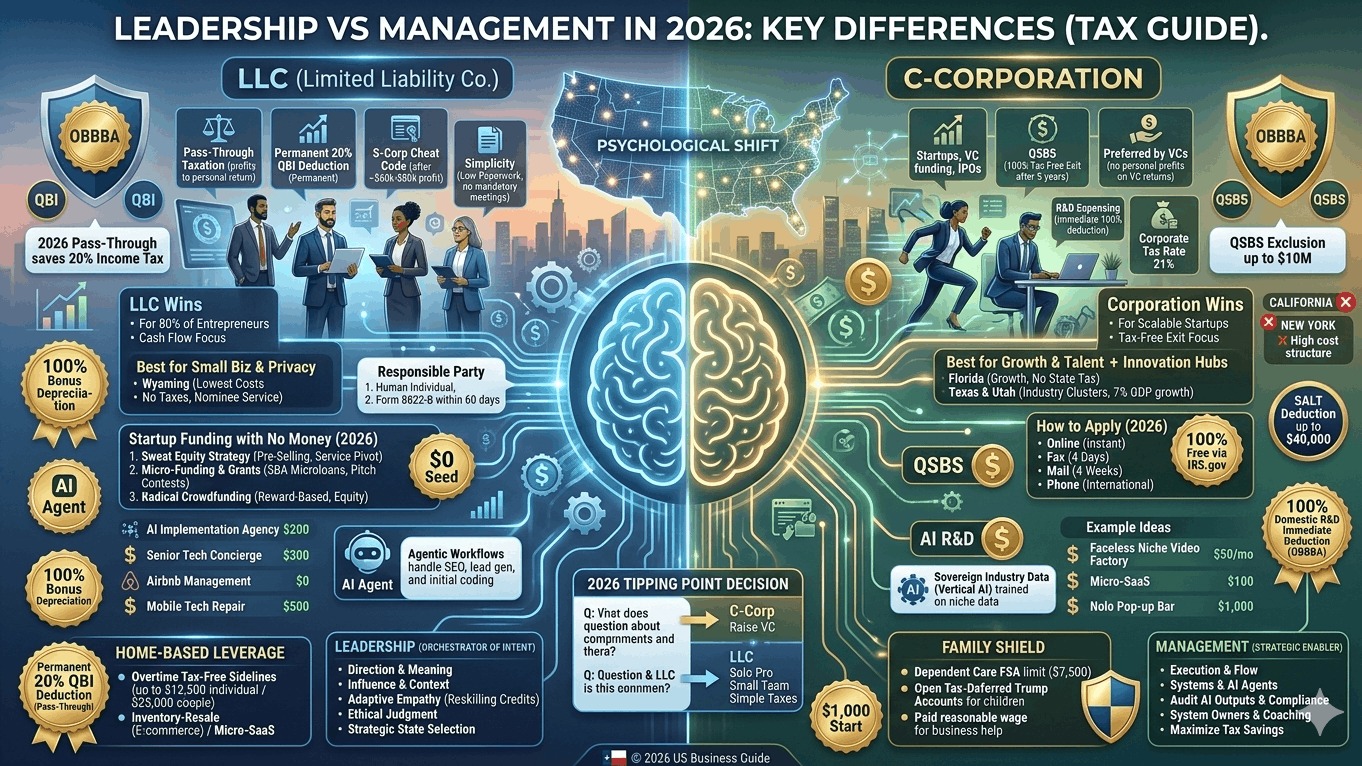
In 2026, the traditional line between leadership and management has been permanently redrawn. With the One Big Beautiful Bill Act (OBBBA) simplifying tax codes and Agentic AI automating the "drudgery" of administration, the 2026 manager is becoming a Strategic Enabler, while the 2026 leader is becoming an Orchestrator of Intent.
Understanding the difference is no longer an academic exercise; it is a requirement for survival in an AI-augmented economy.
1. The 2026 Comparison: Leadership vs. Management
| Feature | Leadership (The Visionary) | Management (The Enabler) |
|---|---|---|
| Focus | Direction & Meaning. Asks "Why?" and "What next?" | Execution & Flow. Asks "How?" and "When?" |
| Primary Tool | Influence & Context. Uses vision to align. | Systems & AI Agents. Uses workflows to deliver. |
| 2026 Shift | Orchestrating human-AI collaboration. | Auditing AI outputs and agentic reliability. |
| Risk Profile | Seeks opportunity and disrupts the status quo. | Minimizes risk and ensures 2026 compliance. |
| OBBBA Role | Strategizing long-term QSBS tax-free exits. | Managing 100% Bonus Depreciation assets. |
2. Management in 2026: From Controller to Enabler
Management in 2026 has been "automated from the middle." Because AI can now handle scheduling, basic reporting, and even initial performance metrics, the manager’s role has evolved:
- AI Orchestration: Managers no longer "assign tasks" to people alone; they assign tasks to Human-AI teams. Their job is to ensure the "Agentic Workflow" doesn't have bottlenecks.
- The Compliance Guardian: With the OBBBA’s strict new reporting rules for Tax-Free Overtime and Trump Accounts, managers are the ones ensuring that every minute of work is categorized correctly to maximize tax savings.
- Coaching as a Baseline: In 2026, coaching is no longer a "soft skill." It is the primary way managers retain talent in a world where AI has commoditized technical tasks.
3. Leadership in 2026: The "Human Layer"
As AI takes over the "how," leaders must double down on the "why."
- Adaptive Empathy: Leaders must navigate the psychological shift of AI integration. They use the OBBBA's reskilling credits to help employees move from "task-doers" to "system-owners."
- Ethical Judgment: AI can give you a data-driven answer, but only a leader can decide if that answer aligns with the company's 100-year legacy.
- Strategic Arbitrage: Leaders look at the 2026 tax landscape—the permanent 20% QBI deduction and the SALT cap increase to $40,000—and decide which states (like Wyoming or Florida) the company should "lead" from.
Quotes & Taglines
- "Management is doing things right; Leadership is doing the right things."
- "In 2026, your manager is your AI's pilot; your leader is your company's soul."
- "The OBBBA is the engine; Management is the steering; Leadership is the map."
- "Don't manage people; manage the environment so people can lead."