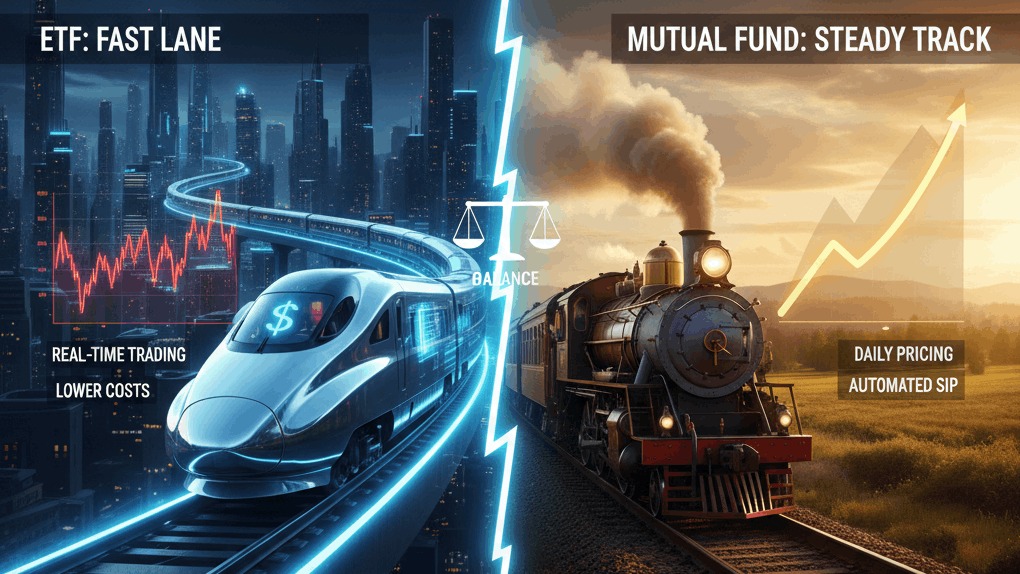
At first glance, Exchange-Traded Funds (ETFs) and Mutual Funds look identical. They both pool money from many investors to buy a diversified collection of stocks, bonds, or other assets. However, the way you buy them, the fees you pay, and how the tax man treats them are worlds apart.
The Core Differences
The simplest way to remember the difference is: ETFs trade like stocks, while Mutual Funds trade like a bank transaction.
| Feature | Exchange-Traded Funds (ETFs) | Mutual Funds |
|---|---|---|
| Trading Time | Any time during market hours | Once a day (after market close) |
| Pricing | Real-time market price | Fixed daily Net Asset Value (NAV) |
| Management | Mostly Passive (Index-tracking) | Mostly Active (Human-managed) |
| Minimums | Price of 1 share (as low as $5-$50) | Often $500 to $3,000+ |
| Tax Efficiency | High (due to unique structure) | Lower (tax "drag" from other investors) |
| Brokerage Required | Yes (Demat/Trading account) | No (Can buy directly from fund house) |
1. Trading and Liquidity
- ETFs: You can buy or sell an ETF at 10:30 AM, 1:00 PM, or 3:59 PM. If the market starts crashing, you can exit immediately. This flexibility is great for active investors but can lead to impulsive "panic" trading.
- Mutual Funds: No matter when you click "sell," your transaction only happens at the end of the day. You get the price (NAV) calculated after the market closes. This "slow" nature is actually a benefit for long-term investors as it prevents over-reacting to midday volatility.
2. The Battle of Costs (Expense Ratios)
In 2026, costs are lower than ever, but ETFs generally still hold the edge.
- ETFs: Because most are passive (they just follow an index like the S&P 500), they require fewer highly-paid managers. Average expense ratios often range from 0.03% to 0.25%.
- Mutual Funds: Actively managed funds involve research teams and high-frequency trading, which costs more. Average ratios can range from 0.5% to 1.5%.
Note: Always look for "Direct Plans" of mutual funds to avoid paying an extra 1% in "regular" commission fees to middlemen.
3. Tax Efficiency: The "In-Kind" Advantage
This is the "secret sauce" of ETFs.
- Mutual Funds: When other investors sell their shares, the fund manager often has to sell stocks to pay them. This creates capital gains taxes for everyone in the fund, even if you didn't sell anything.
- ETFs: They use an "in-kind" redemption process that allows them to move stocks out of the fund without "selling" them in the traditional sense. This significantly reduces the tax bill for long-term holders. In 2025, only 7% of ETFs paid out a capital gain compared to 52% of mutual funds.
Which Should You Choose?
Choose ETFs If:
- You want the lowest possible fees.
- You value the ability to trade instantly.
- You are investing in a taxable brokerage account and want to minimize tax drag.
- You already have a brokerage account and like managing all your assets in one place.
Choose Mutual Funds If:
- You want to set up an automated monthly SIP (Systematic Investment Plan). Mutual funds are still superior for "set it and forget it" automation.
- You prefer fractional investing. While some brokers allow fractional ETFs, every mutual fund allows you to invest exactly $100.00, down to the penny.
You want a professional manager to try and "beat the market" (Alpha), rather than just matching an index.
10 Powerful Quotes on ETF vs. Mutual Fund
- “ETFs trade like stocks — mutual funds invest like traditions.”
- “An ETF offers flexibility during the day; a mutual fund closes with patience at day’s end.”
- “ETFs are built for real-time moves — mutual funds are built for steady plans.”
- “Choosing between an ETF and a mutual fund isn’t about better or worse — it’s about what fits your strategy.”
- “ETFs often win on cost and flexibility; mutual funds often win on structure and simplicity.”
- “An ETF gives you control over price timing; a mutual fund gives you end-of-day certainty.”
- “Both ETFs and mutual funds diversify — they just take different roads to get there.”
- “ETFs trade on the exchange; mutual funds transact through the fund company.”
- “The right choice isn’t the trendiest option — it’s the one aligned with your goals.”
- “ETFs and mutual funds are tools — your strategy determines which one builds your future.”
Conclusion
In the ETF vs. Mutual Fund debate, there is no "loser." Both are excellent tools for diversification. For most modern investors, low-cost Index ETFs are the most efficient way to build wealth. However, if you struggle with the discipline of seeing your portfolio value change every second, a Mutual Fund SIP is the best way to ensure you stay invested for the long haul.