🏘️ How Real Estate Builds Wealth
Real estate is a multi-dimensional asset. Unlike stocks, which primarily offer appreciation and dividends, real estate builds wealth in four distinct ways simultaneously:
- Cash Flow: Monthly profit after all expenses and mortgage payments are made.
- Appreciation: The increase in property value over time.
- Equity Buildup: Every mortgage payment made by your tenant reduces your debt, increasing your ownership stake.
- Tax Advantages: Strategic deductions that can often make your rental income "tax-free" on paper.
🚀 Top Strategies for 2026
1. The BRRRR Method (Buy, Rehab, Rent, Refinance, Repeat)
This is the ultimate "velocity of money" strategy. You buy a distressed property, renovate it to add value, rent it out to stabilize income, and then do a "cash-out refinance" to pull your initial capital back out.
- 2026 Tip: Investors are moving away from luxury flips and focusing on "Workforce Housing"—reliable homes for middle-income families where demand is highest.
2. House Hacking
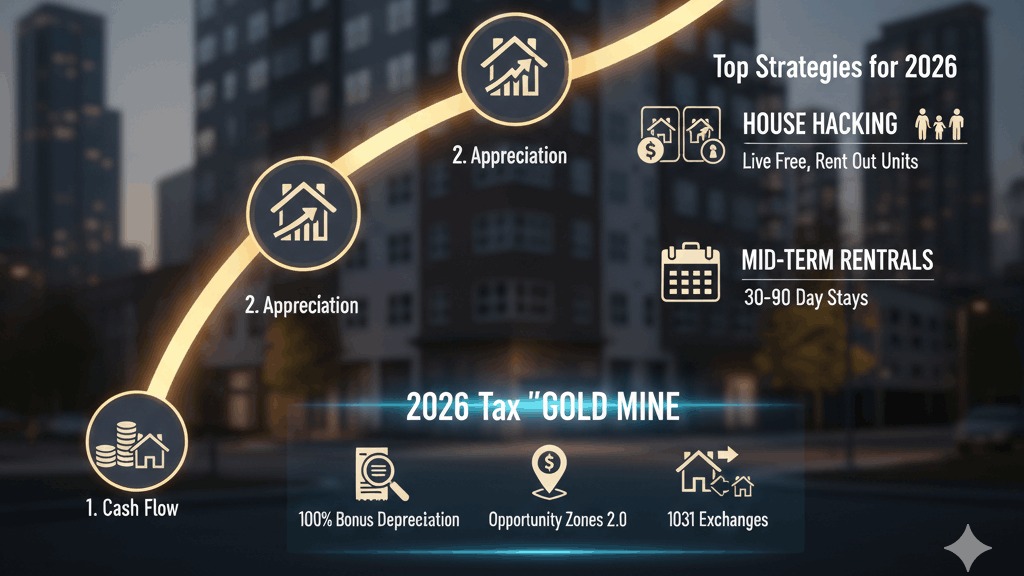
Perfect for beginners, house hacking involves buying a multi-unit property (like a duplex), living in one unit, and renting out the others.
- The Benefit: You can often use low-down-payment loans (like FHA 3.5% down) and let your tenants cover your entire mortgage, allowing you to live for free while building equity.
3. Mid-Term Rentals (The New Sweet Spot)
While Short-Term Rentals (Airbnb) face increasing regulations, Mid-Term Rentals (30–90 days) are booming. These cater to travel nurses, corporate relocations, and digital nomads.
- Advantage: Higher rents than long-term leases but fewer "cleaning fee" headaches and regulations than Airbnbs.
⚖️ The 2026 Tax "Gold Mine"
The One Big Beautiful Bill Act (OBBBA), passed in late 2025, has revolutionized real estate tax strategy:
- Permanent 100% Bonus Depreciation: You can now deduct 100% of the cost of qualifying personal property (appliances, flooring, specialized lighting, landscaping) in the very first year.
- Opportunity Zones 2.0: Extended deadlines now allow investors to defer capital gains tax until 2026 and potentially eliminate tax on all future appreciation if held for 10 years.
- 1031 Exchanges: These remain a powerful tool, allowing you to sell a property and reinvest the proceeds into a new one without paying immediate capital gains tax.
📍 Where to Invest in 2026?
The "Great Housing Reset" has shifted eyes away from overpriced Sun Belt cities toward stable, supply-constrained markets.
| Region | High-Growth Markets | Why? |
|---|---|---|
| Midwest | Indianapolis, Columbus | High yield, low entry price. |
| Northeast | Rochester, Hartford | Supply-constrained, strong rental demand. |
| Sun Belt | Charlotte, Dallas-FW | Sustained population migration. |
Conclusion: Your Path to Real Estate Prosperity
Wealth building through real estate in the USA remains one of the most reliable strategies for achieving financial independence, even as the market evolves in 2026. By leveraging the "four pillars"—cash flow, appreciation, equity buildup, and significant tax advantages—you aren't just saving money; you're building a scalable business.
Success in today's landscape requires a blend of traditional wisdom and modern strategy. Whether you choose to start small with house hacking, scale rapidly using the BRRRR method, or pivot into the high-demand world of mid-term rentals, the key is to take educated action. With the added power of the 2026 tax laws, such as 100% bonus depreciation, the barrier to building a multi-million dollar portfolio is more about strategy than just high initial capital.
The "Great Housing Reset" of 2026 has proven that while markets fluctuate, the need for quality housing is eternal. Start by analyzing your local market, consulting with a tax professional, and picking the strategy that aligns with your long-term goals. Your future self will thank you for the equity you start building today.